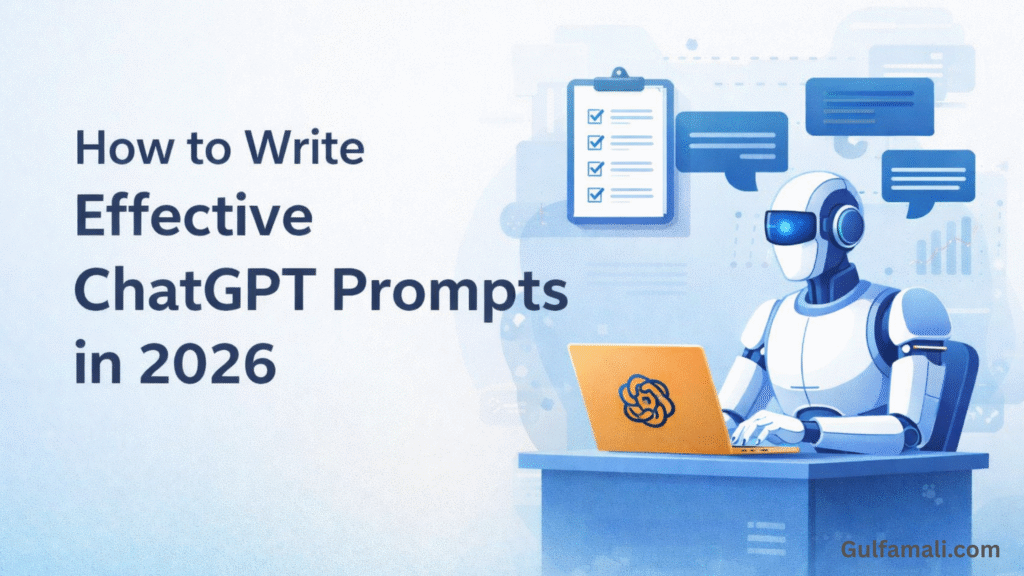
How to Write Effective ChatGPT Prompts in 2026
In 2026, the results you get from AI are no longer limited by the model. They are limited by how well you communicate with it.
Many people still assume weak output means weak AI. In real projects, that is rarely true. The gap between useful and useless output usually comes down to prompt quality. As AI systems have matured, they have become better at following instructions. At the same time, they have become less forgiving of vague input.
Short, casual prompts may work for experimentation. They do not work for professional SEO, content creation, or structured workflows.
This guide explains how to write ChatGPT prompts in 2026 the right way. The focus is practical. These are the same principles used in real content systems, not theoretical prompt tricks.
What Is a ChatGPT Prompt (Modern Definition)
A ChatGPT prompt is not just an instruction. In modern usage, it is a complete specification.
A strong prompt defines:
- The role the AI should assume
- The task it needs to perform
- The context in which the task exists
- The format of the output
- The limits it must respect
Think of a prompt as a written brief. If you were assigning work to a skilled assistant, you would not give a single sentence and expect perfect results. AI works the same way.
When intent, context, and constraints are clear, output quality improves automatically.
Why Most Prompts Fail (And Always Will)
Most prompts fail for predictable reasons. These problems have not changed, even as AI has improved.
Vague instructions
Prompts like “Write an SEO article about AI” leave too many decisions undefined. The AI fills gaps with generic assumptions, which leads to shallow content.
No role definition
Without a defined role, the AI defaults to general explanations. This is why many responses feel like basic summaries instead of expert insights.
Missing context
AI does not know your audience, platform, or goal unless you tell it. Without context, relevance suffers.
No output expectations
When format, depth, or structure are not specified, the output becomes inconsistent and harder to use.
Prompt failure is rarely technical. It is usually instructional.
The Core Elements of a High-Quality Prompt
Role Definition
The role sets the knowledge level and perspective.
Example:
“Act as an experienced SEO educator writing for professional marketers.”
Without a role, responses stay generic. With a role, responses gain focus.
Task Clarity
Define exactly what needs to be produced.
Instead of:
“Explain AI prompts”
Use:
“Explain how to write structured AI prompts for long-form SEO articles.”
Clear tasks reduce unnecessary content.
Context and Background
Context explains why the task exists.
Include:
- Target audience
- Industry or niche
- Platform where content will appear
Context helps the AI prioritize what matters.
Output Format
Format controls usability.
You can specify:
- Headings and subheadings
- Paragraph length
- Examples or explanations
This reduces editing time later.
Constraints and Limits
Constraints prevent unwanted behavior.
Examples:
- Avoid promotional tone
- Do not exaggerate claims
- Do not include external links
Clear limits improve consistency.
Tone and Audience Specification
Tone shapes credibility.
Professional content benefits from:
- Direct language
- Practical explanations
- Neutral confidence
This avoids filler and overstatement.
How Prompt Writing Has Changed in 2026
Earlier AI models responded well to short prompts. That approach is unreliable now.
Modern systems handle long, structured instructions better than fragmented requests. They follow rules more accurately when expectations are clear.
Short prompts often result in:
- Missing sections
- Overgeneralization
- Weak depth
In 2026, structured prompts outperform clever wording. Clear instruction matters more than creativity.
Prompt writing has shifted from conversation to specification.
Step-by-Step Framework to Write Better ChatGPT Prompts
This framework works across SEO, content, and marketing tasks.
Step 1: Define the role
Start with who the AI should be.
Example:
“You are an experienced SEO content strategist.”
Step 2: Define the task
State the exact output required.
Example:
“Write a detailed guide explaining how to structure AI prompts for SEO articles.”
Step 3: Add context
Explain where and how the content will be used.
Example:
“This content will be published on a professional SEO blog for working marketers.”
Step 4: Set output rules
Control structure and style.
Example:
“Use clear headings, short paragraphs, and practical examples.”
Step 5: Add constraints
Remove what you do not want.
Example:
“Avoid hype, promotional language, and basic definitions.”
This system alone improves output reliability significantly.
Examples: Weak Prompt vs Improved Prompt
Example 1: SEO Article Writing
Weak prompt:
“Write an SEO article about AI prompts.”
Improved prompt:
“Act as an experienced SEO writer. Write a 1500-word educational article explaining how to write effective AI prompts for SEO content. The audience is professional bloggers. Use clear headings, practical examples, and a neutral tone.”
Why it works:
The improved prompt defines role, length, audience, and expectations. The output becomes structured and relevant instead of generic.
Example 2: Blog Outline
Weak prompt:
“Create a blog outline for content writing.”
Improved prompt:
“Create a detailed blog outline for a long-form article on writing effective AI prompts for content writing. The audience is freelance writers with basic SEO knowledge. Focus on logical flow and practical sections.”
Why it works:
The outline aligns with reader skill level and real use cases.
Example 3: Marketing Content
Weak prompt:
“Write marketing copy for a service.”
Improved prompt:
“Write informational website copy explaining SEO content services. The tone should be professional and educational. Focus on process and methodology. Avoid sales language.”
Why it works:
Clear limits prevent exaggerated claims and improve trust.
Using ChatGPT Prompts for SEO Content (Correct Way)
AI prompts are most effective when used for structure and support.
Use prompts to:
- Create outlines
- Clarify explanations
- Expand sections logically
- Maintain consistency
Do not use prompts to:
- Replace research
- Invent authority
- Skip editorial review
AI assists execution. Humans handle judgment.
How Prompts Support Search Intent (Not Rankings)
Prompts help align content with intent by forcing clarity. They do not improve rankings on their own.
Search performance depends on usefulness, accuracy, and relevance. Prompts support these factors indirectly by improving structure and focus.
When You Should NOT Rely on AI Prompts
AI prompts should not lead strategic decisions.
Avoid relying on AI for:
- Brand positioning
- Niche selection
- Editorial priorities
- Final validation of facts
AI performs best as an assistant. Responsibility remains human. This balance protects credibility and long-term value.
Best Practices for Writing Prompts Professionally
- Write prompts as instructions, not conversations
- Always define role and audience
- Add context before asking for output
- Specify structure and format
- Use constraints to control tone
- Test and refine prompts over time
- Save effective prompts for reuse
- Review and edit before publishing
Professional prompt writing improves through iteration.
Conclusion+
Knowing how to write ChatGPT prompts in 2026 is a communication skill, not a trick.
Clear prompts produce clear outputs. Structured instructions create usable content. Constraints protect quality.
AI is a tool. Prompts are the interface. The quality of AI output will always reflect the quality of human input.
Used correctly, AI supports expertise instead of replacing it. That is where long-term value comes from.
If you want structured examples, you can get a PDF version of the ChatGPT prompts discussed in this guide for reference and practice.
About the Author
Gulfam Ali is an SEO and content writing expert with real-world experience optimizing content for search intent, topical authority, and AI-friendly structure. Founder of Gulfamali.com & Rankstraight.com.