
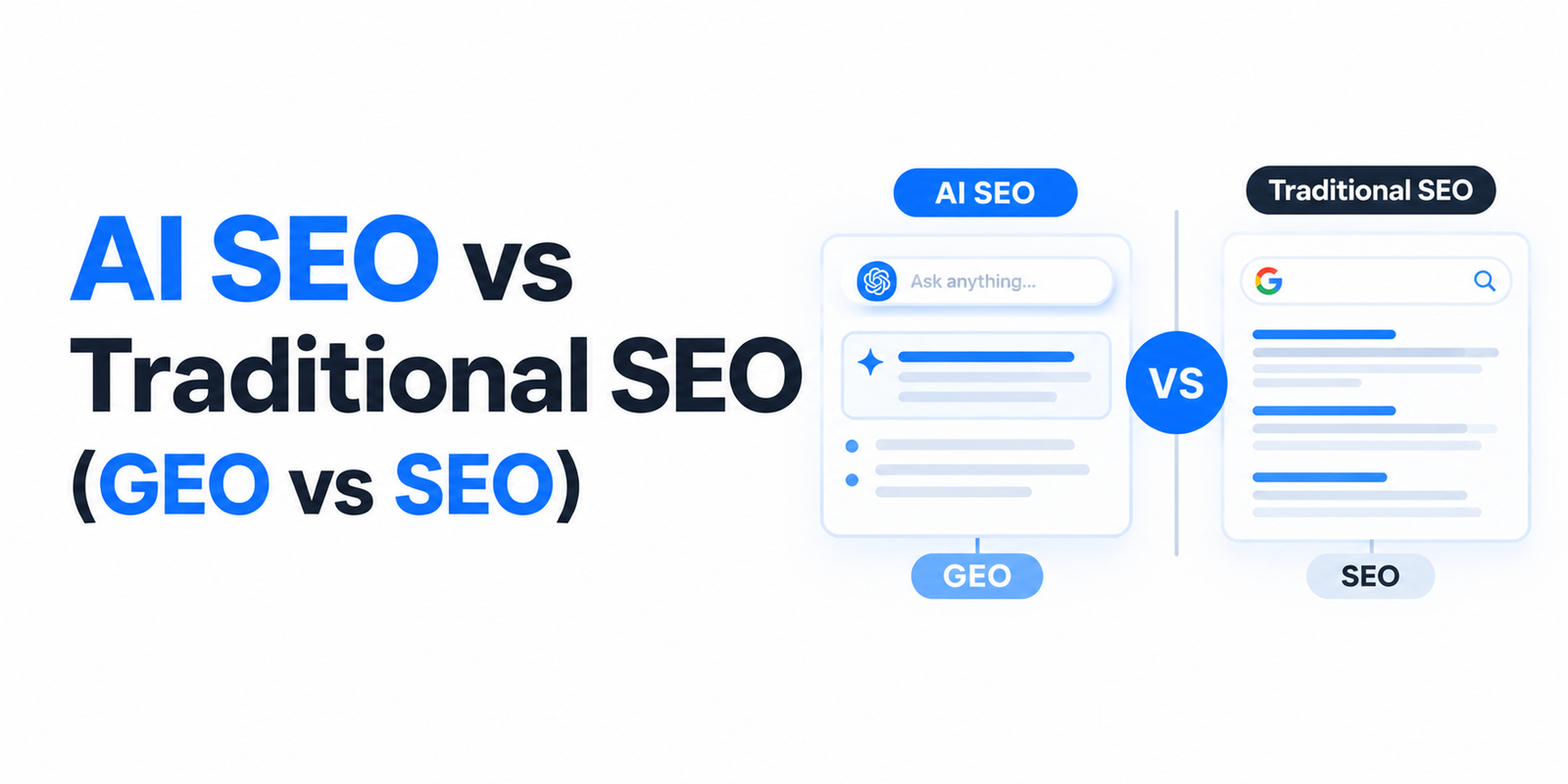
Quick answer: Traditional SEO gets your pages ranked in a list of search results. AI SEO, also called GEO, gets your content cited inside the answers that Google AI Overviews, ChatGPT, and Perplexity write. Traditional SEO earns clicks. AI SEO earns citations. You need both, because AI SEO is built on top of a healthy SEO foundation.
One of the most common questions I get from clients right now: “Should we stop doing SEO and switch to AI SEO?”
The answer is no. But the question is reasonable, because the rules really have changed. Ranking well no longer guarantees you show up where your customers are looking. In this guide I break down exactly what is different, what stays the same, and how to decide where to put your effort.
What Is Traditional SEO?
Traditional SEO is the work of getting your pages to rank on search results pages in Google and Bing. It rests on three pillars:
- On-page SEO: matching search intent, keywords, titles, headings, meta descriptions, and internal links.
- Off-page SEO: backlinks, brand mentions, and other trust signals from outside your site.
- Technical SEO: crawlability, indexing, site speed, Core Web Vitals, mobile experience, and site architecture.
The output is a list of blue links. The user chooses one and clicks.
What Is AI SEO (GEO)?
AI SEO is the work of making your content easy for AI systems to find, understand, trust, and cite. It targets Google AI Overviews, ChatGPT search, Perplexity, Gemini, Copilot, and Claude.
These systems do not hand the user a list. They read many sources, write one answer, and pick a few sources to back it up. Your goal is to be one of those sources. You will see this called GEO (Generative Engine Optimization) or AEO (Answer Engine Optimization). In practice, the work is the same. If you are new to the topic, start with my plain-English guide to what AI SEO is.
AI SEO vs Traditional SEO: The Key Differences
| Factor | Traditional SEO | AI SEO (GEO) |
|---|---|---|
| Goal | Rank on the results page | Get cited inside the AI answer |
| Platforms | Google, Bing | AI Overviews, ChatGPT, Perplexity, Gemini, Copilot, Claude |
| Unit of competition | The whole page | A single passage that can be lifted and quoted |
| Queries | Short typed keywords, like “best SEO tools” | Full questions, like “what are the best SEO tools for a small SaaS team?” |
| Main trust signals | Backlinks and relevance | Entity clarity, consistent brand details, mentions and reviews on other sites |
| Content format | Pages built around keywords and intent | Question-based headings with direct, self-contained answers |
| Success metric | Rankings, clicks, CTR | Citations, brand mentions, and qualified leads |
| Zero-click searches | Hurt by them | Built for them |
Why the Gap Between Ranking and Being Cited Is Growing
For a while, the advice was simple: rank in the top 10 and AI will cite you. The data no longer supports that.
- In July 2025, an Ahrefs study of 1.9 million AI Overview citations found that 76% of cited pages ranked in Google’s top 10 (Ahrefs).
- By March 2026, a follow-up Ahrefs analysis of 4 million AI Overview URLs found that figure had dropped to about 38%, meaning most citations now came from pages outside the top 10 (reported by Radiant Elephant).
- Meanwhile, 68% of US Google searches ended without a click in early 2026, up from about 60% in 2024 (SparkToro and Similarweb, via Search Engine Land).
Put together, this means two things. Ranking still helps, but it is no longer enough on its own. And a page that does not rank highly can still be cited if it gives the clearest answer. That is the opportunity AI SEO opens up.
Does Traditional SEO Still Work?
Yes. Here is why it is still the foundation:
- AI systems need to find you first. If your pages are not crawlable and indexed, no AI system can retrieve them. Google uses its own index, and ChatGPT search draws on third-party providers including Bing.
- Authority carries over. The trust you build through quality links and mentions helps you in both rankings and citations.
- Many searches still end in a click. Transactional and local searches, like “buy,” “near me,” and “pricing,” still send real traffic to websites.
What is dead is the shortcut version of SEO: keyword stuffing, thin pages, mass-produced content, and low-quality link schemes. Those hurt you in both systems.
What AI SEO Adds on Top
AI SEO does not replace your SEO work. It adds four layers:
- Crawler access for AI bots. GPTBot, OAI-SearchBot, ClaudeBot, and PerplexityBot need to reach your site. Many sites block them by accident through CDN or security settings.
- Entity clarity. The same name, description, founder, and details across your site, LinkedIn, directories, and schema markup, so AI systems can identify you with confidence.
- Extractable answers. Question-based headings, a direct answer in the first one or two sentences, and paragraphs that make sense on their own. I explain the method in how to write AI-friendly content.
- Citation-worthy substance. Original data, real results, and specific numbers with sources. Generic content gets summarized without credit. Specific content gets named.
Which Should You Prioritize? It Depends on Your Business
Almost every business needs both. But the balance shifts depending on how your customers search.
| Business type | Lean toward | Why |
|---|---|---|
| SaaS and tech | AI SEO, on a strong SEO base | Buyers research and compare tools in ChatGPT and Perplexity before visiting any site |
| B2B services and agencies | AI SEO, on a strong SEO base | Decision-makers ask AI for shortlists and recommendations |
| E-commerce | Balanced | Product pages still need clicks, while AI answers shape which brands get considered |
| Local businesses | Traditional SEO | Map results, Google Business Profile, and reviews still drive most calls and visits |
| Publishers and bloggers | Balanced | Informational queries are where AI answers take the most clicks, so citations protect brand visibility |
How to Win at Both: A 6-Step Strategy
- Fix the technical foundation. Indexing, speed, mobile experience, and clean architecture. Check Google Search Console for pages that are crawled but not indexed.
- Open the door to AI crawlers and verify your site in Bing Webmaster Tools.
- Build topical depth, not volume. Cover a few topics completely, and merge overlapping posts into single, stronger pages. See my guide to topic clusters for AI SEO.
- Turn keywords into questions. Do normal keyword research, then expand each keyword into the full questions people ask AI tools. Use those questions as your headings.
- Lead every section with the answer. One or two clear sentences first, then the detail, examples, and data.
- Build your reputation off-site. Reviews, directory profiles, industry mentions, and relevant links. AI systems trust what others say about you more than what you say about yourself.
This is the same process I used to take a US SaaS brand from 18% to 63% AI visibility in 68 days, while its organic traffic tripled at the same time. The SEO and AI SEO work reinforced each other.
How to Measure Each
| Traditional SEO metrics | AI SEO metrics |
|---|---|
| Rankings for target keywords | How often you are cited for your target questions |
| Organic clicks and CTR in Search Console | Brand mentions in ChatGPT, Perplexity, and AI Overviews |
| Indexed pages | AI crawler activity in your server or CDN logs |
| Backlinks and referring domains | Mentions and reviews on third-party sites |
| Leads from organic search | Leads who say they found you through an AI tool |
The simplest AI SEO check costs nothing: ask ChatGPT, Perplexity, and Google your customers’ real questions once a month and note who gets cited. Also add a “How did you find us?” question to your contact form, with ChatGPT and Perplexity as options, so you can see AI-driven leads directly.
Frequently Asked Questions
What is the difference between AI SEO and traditional SEO?
Traditional SEO aims to rank your pages in search results so users click through. AI SEO aims to get your content cited inside AI-generated answers from tools like Google AI Overviews, ChatGPT, and Perplexity. Traditional SEO earns clicks, while AI SEO earns citations and brand visibility.
What is the difference between GEO and SEO?
GEO, or Generative Engine Optimization, is another name for optimizing to be cited by generative AI systems. SEO focuses on ranking in traditional search results. GEO builds on SEO by adding entity clarity, extractable answers, and citation-worthy content.
Does AI SEO replace traditional SEO?
No. AI systems still need to crawl and retrieve your pages, so technical SEO and indexing remain essential. AI SEO adds the signals that decide whether AI systems choose your content once they can see it.
If I rank on page one, will AI cite me?
Not necessarily. Ahrefs data shows the share of AI Overview citations coming from top-10 pages fell from about 76% in 2025 to about 38% in early 2026. Ranking helps, but clear answers and trust signals increasingly decide who gets cited.
Is SEO dead in 2026?
No. Low-effort SEO is dead: keyword stuffing, thin content, and link schemes. Real SEO, meaning technical health, helpful content, and genuine authority, is the foundation that AI search depends on.
Which should a small business focus on first?
Start with traditional SEO fundamentals, because AI SEO cannot work without them. Then add the AI layer: allow AI crawlers, make your business details consistent everywhere, and restructure your key pages so they answer questions directly.
The Bottom Line
The question is not AI SEO or traditional SEO. It is how fast you add the AI layer to a solid SEO foundation. Traditional SEO gets you found. AI SEO gets you chosen.
If you want to see how your site performs in both, get a free consultation and I will show you where you rank, where you get cited, and what to fix first.
About the Author
I am Gulfam Ali, a Technical SEO and GEO Specialist and founder of GulfamAli.com, a results-driven SEO and GEO agency focused on scaling organic traffic for AI, SaaS, and content-driven websites.
Since 2017, I have worked with SaaS companies, AI businesses, e-commerce brands, and content-driven websites across the United States, United Kingdom, and international markets. My work sits at the intersection of Technical SEO, topical authority architecture, and GEO optimization, the three things that determine whether a brand shows up in Google, Google AI Overviews, ChatGPT, and Perplexity.
You can see the results of this work in my SEO and GEO case studies.