

Topic clusters are a structured way to organize content for better rankings.
This guide explains how to build topic clusters using AI to improve topical authority, content clarity, and long-term SEO performance.
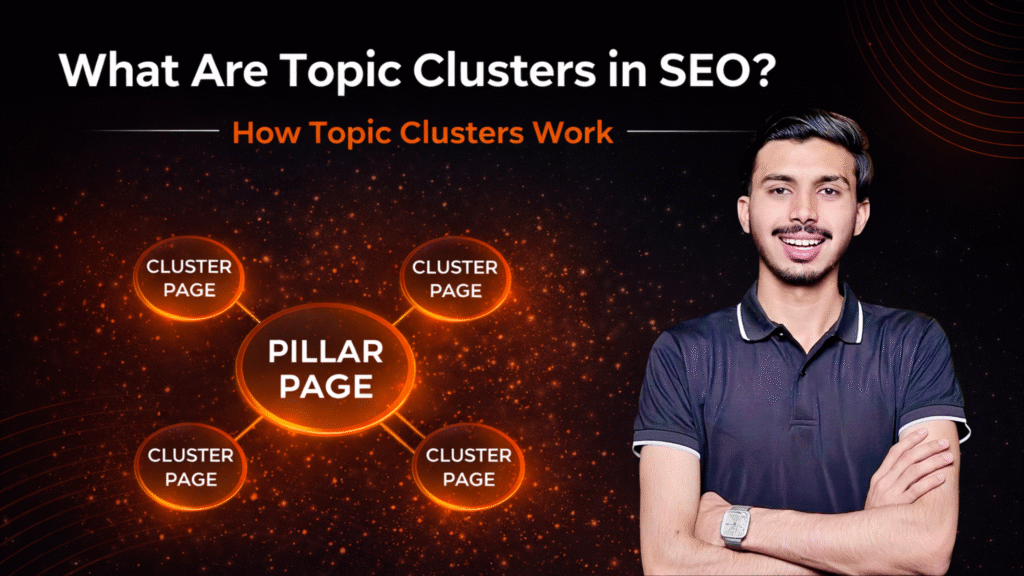
Topic clusters are an SEO content structure where a central pillar page is supported by multiple related articles (cluster content).
In AI-driven search, this structure improves search intent alignment, semantic relevance, and internal linking. It also makes content easier for AI systems to understand, retrieve, and use in answers.
What Are Topic Clusters in SEO?
Simple Definition
A topic cluster is built around one main page (pillar) connected to several related subtopics.
It creates a clear content hierarchy that helps both users and search engines understand your website.
How Topic Clusters Work
You start with one broad topic and support it with focused articles covering related angles.
All pages are internally linked, creating a connected content system instead of isolated posts.
Think of it like this:
One main page → multiple supporting pages → all connected together.
This structure improves content relevance signals and makes your site easier to interpret.
What Is Topical Authority and Why It Matters?

Topical Authority Explained
Topical authority means covering a subject deeply within a niche.
Instead of writing random articles, you build a complete knowledge base around a topic.
In real projects, this approach often leads to more stable rankings because search engines see consistent coverage, not isolated content.
How Search Engines Understand Authority
Search engines do not rely only on keywords anymore. They use complex systems to understand content, as explained in how Google Search works.
They analyze relationships between topics, entities, and how well your content connects ideas.
Content depth, topic relevance, and clear structure all contribute to authority.
Why AI SEO Needs Topic Clusters
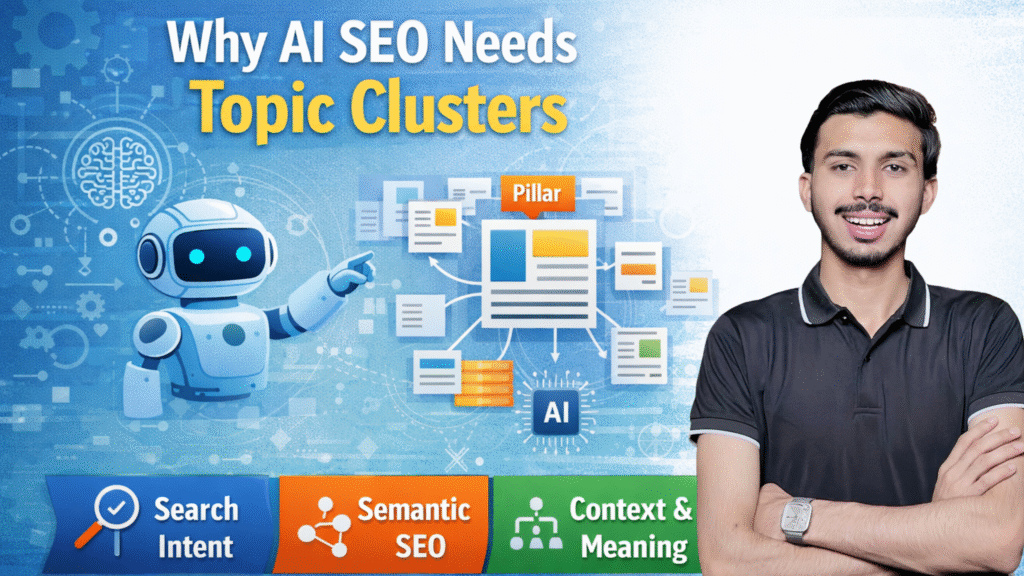
AI and Search Intent Understanding
AI systems focus heavily on user intent.
They try to understand what the user actually wants, not just what they type.
If your content matches intent clearly, it becomes easier for AI to extract and present it.
Role of Semantic SEO in AI Content
AI processes meaning and context.
Grouping related topics helps build stronger semantic connections across your content.
This improves how your content is interpreted and increases its chances of being used in AI-generated answers.
Content Structure and AI Understanding
AI prefers structured, well-organized content.
Clear hierarchy and logical flow make it easier for systems to process information. If you want to go deeper, you can learn more about best content structure for AI search (headings, FAQs, and formatting).
This is where strong SEO content structure and organized information architecture become critical.
How to Build Topic Clusters for AI SEO (Step-by-Step)
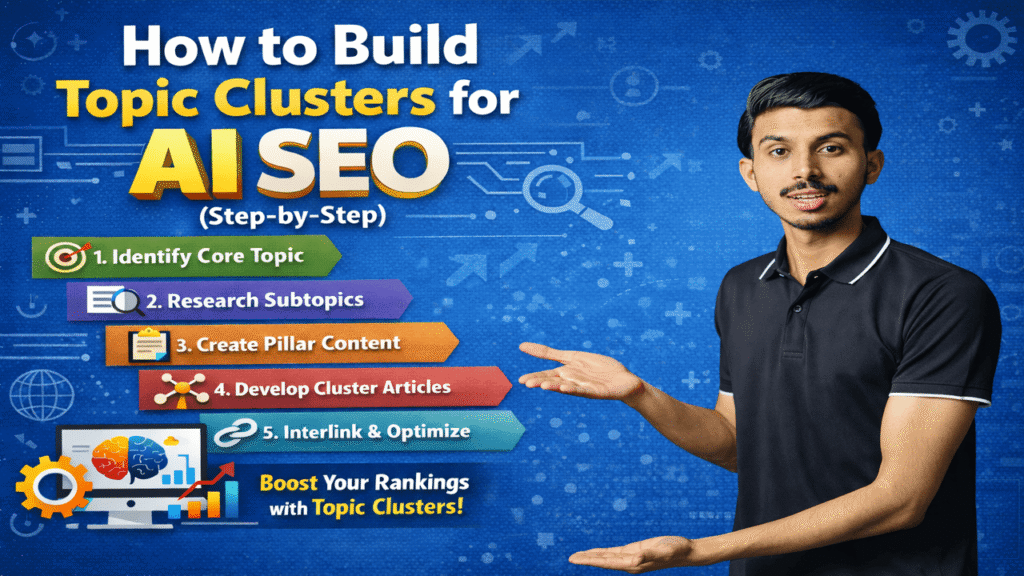
Step 1: Define the Core Topic (Pillar Page)
Choose a broad topic that allows deep coverage.
It should be important to your niche and support multiple subtopics.
Focus on building long-term niche authority, not short-term traffic.
Step 2: Perform Keyword Clustering
Group related keywords based on intent, not just similarity.
Here’s where most people go wrong:
They group keywords only by words, not meaning.
Instead, map relationships between topics and concepts.
This helps search engines understand your content at a deeper level.
Step 3: Map Content Structure
Create a clear content map before writing.
Define:
- Main topic (pillar page)
- Supporting topics (cluster pages)
- How everything connects
This step builds a strong content hierarchy and avoids confusion later.
Step 4: Create Cluster Content
Write detailed articles for each subtopic.
Each article should:
- Answer a specific question
- Add unique value
- Strengthen overall topic coverage
Avoid repeating the same ideas across pages.
Step 5: Build Internal Linking Strategy
Link every cluster page to the pillar page and back.
Use natural anchor text variations.
Avoid repeating the same keywords in links.
Good internal linking is not about quantity.
It is about context and clarity.
Step 6: Optimize for Search Intent
Each page should solve a specific problem and be written in a way that AI systems can easily extract answers. To understand this better, learn how to write AI-friendly content that gets quoted in search results.
Ask:
- What problem is this page solving?
- Is the answer clear and direct?
Strong intent matching improves both rankings and usability.
Real Example of Topic Cluster Structure
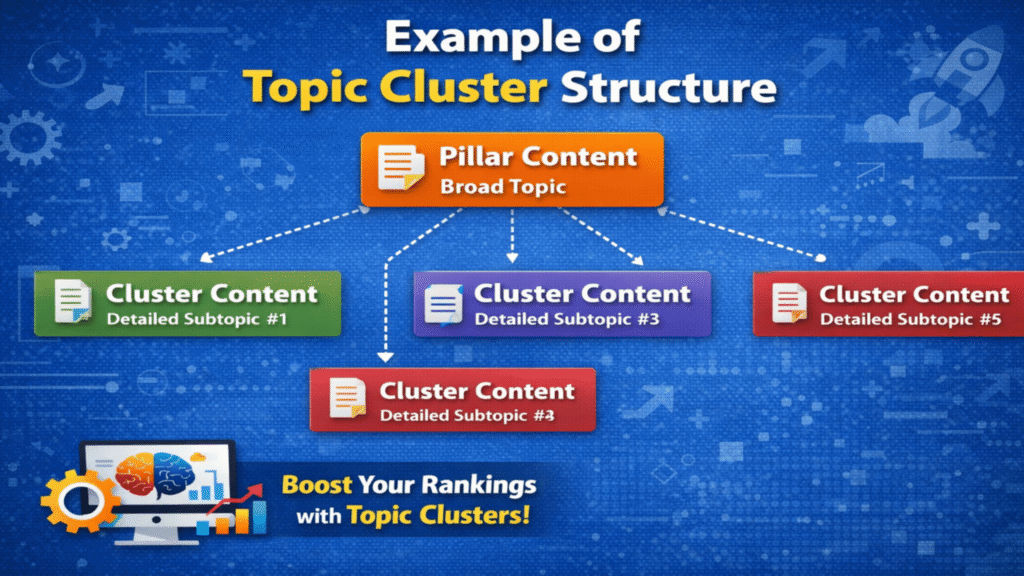
Example (SEO Niche)
Pillar: Complete guide on topic clusters
Cluster pages:
- Keyword clustering explained
- Internal linking strategy
- SEO content structure
How It Builds Authority
This creates a connected content system instead of isolated articles.
In practice, this structure helps search engines understand topic relationships more clearly, which improves ranking consistency over time.
Topic Clusters vs Traditional SEO
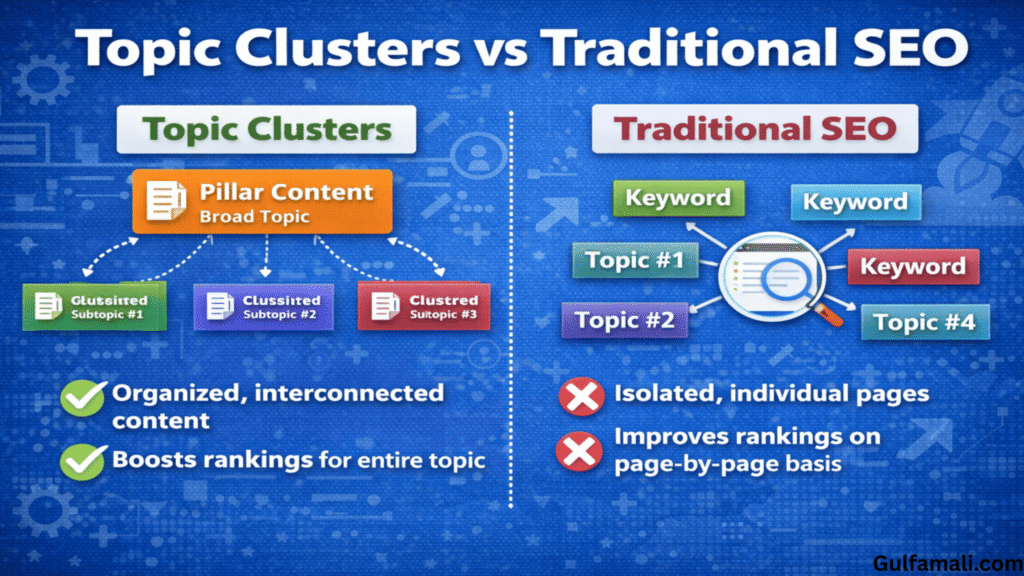
Traditional Keyword-Based SEO
Focuses on individual keywords.
Content is often scattered and lacks depth.
Topic Cluster Approach
Focuses on complete topic coverage.
Builds a strong content hierarchy and improves topical relevance.
This is the part most beginners miss:
SEO is no longer about single keywords. It is about covering a topic fully.
Common Mistakes When Building Topic Clusters
- Focusing only on keywords instead of full topic coverage
- Weak or missing internal linking
- Creating duplicate or overlapping content
- Ignoring search intent
- Poor content structure
- Building only a pillar page without clusters
- Not providing enough depth
- Many websites unknowingly create low-quality or spam-like content while doing this. If you want a clear breakdown, see the difference between SEO spam content and what AI actually prefers.
Practical Checklist for Building Topic Clusters
- Core topic clearly defined
- Keyword clustering completed
- Content map prepared
- Pillar page created
- 5–10 cluster articles planned
- Internal linking implemented
- On-page SEO optimized
FAQ
What are topic clusters in SEO?
Topic clusters organize content around a main topic.
A pillar page is supported by related articles, all connected through internal links.
How do you build topical authority?
You build topical authority by covering a subject in depth.
This requires multiple connected articles, consistent structure, and strong internal linking.
How many cluster articles are needed?
There is no fixed number.
In most cases, 5 to 10 high-quality cluster pages are enough to start building authority.
Can topic clusters work in every niche?
Yes.
Any niche with multiple related topics can benefit from structured content and better organization.
What is keyword clustering in SEO?
Keyword clustering is grouping similar keywords based on intent.
It helps you target multiple queries within a single content structure.
How important is internal linking?
Internal linking is critical.
It connects pages, improves navigation, and helps search engines understand relationships.
Can AI content build topical authority?
Yes, but only if it is structured properly.
Content must be clear, relevant, and aligned with search intent.
What is the difference between topic clusters and content silos?
Topic clusters allow flexible linking between pages.
Content silos follow a stricter hierarchical structure.
Conclusion
Topic clusters provide a strong foundation for modern SEO, especially in AI-driven search.
With clear structure, strong internal linking, and full topic coverage, you can build long-term authority and stable rankings.
The goal is not to publish more content, but to build a complete topic ecosystem.
About the Author
Gulfam Ali is an SEO specialist with over 7 years of experience in search engine optimization, with a strong focus on Technical SEO and organic growth. He has worked with businesses across multiple industries, managing SEO projects for clients in different countries and helping them improve Google rankings, increase organic traffic, and achieve sustainable growth.
His work includes contributions to international platforms, reflecting a strong understanding of high-quality content and SEO best practices. As the founder of GulfamAli.com, he helps businesses worldwide grow through structured SEO strategies, ethical practices, and performance-driven results.