
Over 50% of all Google searches now end without a single click and that number should alarm every marketer, blogger, and business owner operating in 2026.
We are living through the most significant transformation in the history of search. The GEO vs SEO debate is no longer theoretical. It is the most urgent strategic question in digital marketing today.
Search Engine Optimization (SEO) has driven organic growth for more than two decades. But a new discipline Generative Engine Optimization (GEO) is rapidly becoming just as important. As AI powered tools like ChatGPT Search, Google AI Overviews, Perplexity AI, and Gemini handle billions of queries every month, the rules of digital visibility are being rewritten in real time.
Understanding how AI search affects website traffic is no longer optional. It is the difference between growing your brand and watching your traffic quietly disappear.
In this comprehensive guide, you will learn:
- What GEO and SEO are and how they differ
- Which strategy drives more traffic in 2026
- The pros and cons of each approach
- How to combine both into a hybrid strategy that wins
- Step by step GEO optimization tactics you can apply immediately
What Is SEO and How Does It Work

Search Engine Optimization (SEO) is the process of optimizing your website and content to rank higher on traditional search engine results pages (SERPs) such as Google and Bing.SEO is built on three core pillars:
1. On Page SEO
On-page SEO covers everything within your content and website pages. This includes targeting the right keywords, writing compelling meta titles and descriptions, using a clear heading hierarchy (H1, H2, H3), optimizing image alt text, adding internal links, and ensuring your content fully satisfies the user’s search intent.
2. Off Page SEO
Off page SEO focuses on building your domain authority outside of your own website. Key tactics include earning high quality backlinks from authoritative sources, securing brand mentions, publishing guest posts, and generating social signals that tell search engines your content is trustworthy.
3. Technical SEO
Technical SEO ensures search engines can crawl and index your website efficiently. This covers page speed, Core Web Vitals, mobile responsiveness, structured data (schema markup), XML sitemaps, canonical tags, and overall site architecture.
For most of the past 20 years, a top-three ranking on Google for a high volume keyword could generate thousands of monthly visitors. Businesses have invested billions into SEO and it has delivered real, measurable ROI.
What Is GEO (Generative Engine Optimization)

Generative Engine Optimization (GEO) is the process of optimizing your content to be cited, referenced, or featured inside AI generated answers produced by large language models (LLMs) and AI powered search platforms.
Instead of competing for a top 10 blue link ranking, GEO focuses on making your content the trusted source that AI engines draw from when generating their responses.
Which AI Search Platforms Does GEO Target?
GEO optimization is relevant across all major AI search tools, including:
- Google AI Overviews (formerly Search Generative Experience / SGE)
- ChatGPT and ChatGPT Search
- Perplexity AI
- Microsoft Copilot (powered by Bing)
- Google Gemini
- Claude by Anthropic
When a user asks any of these platforms a question, the AI generates a comprehensive, conversational answer and sometimes cites its sources. GEO is about creating content that is credible, authoritative, and well-structured enough that AI engines choose to reference it in those answers.
What is GEO in digital marketing? It is the strategy that positions your brand inside the answer, not just below it. This is what modern AI search optimization looks like in practice.
SEO vs GEO: The Core Strategic Difference

The most fundamental distinction between these two strategies is this:
SEO earns clicks. GEO earns citations.
SEO wants you to rank on a results page so users click to your site. GEO wants your content to become the answer that users receive directly. In terms of SEO vs GEO digital marketing strategy, both are now essential pillars of comprehensive search visibility.
The rise of zero click searches is accelerating this shift. Research shows that when Google AI Overviews appear in results, click-through rates on traditional organic listings drop significantly. LLM search optimization is no longer a niche concept reserved for early adopters it is becoming a mainstream marketing priority.
GEO vs SEO Comparison: Key Differences at a Glance

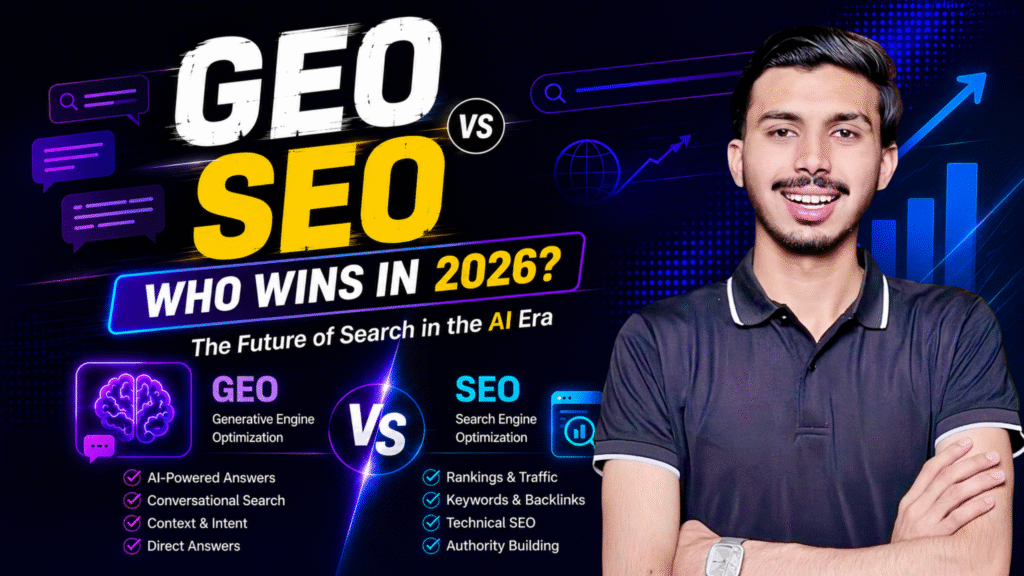
Understanding the difference between GEO and SEO is foundational to building a modern digital marketing strategy. Both aim to increase your online visibility, but they operate in entirely different environments and require different approaches
.
| Factor | SEO | GEO |
| Target Platform | Google, Bing, Yahoo | ChatGPT, Perplexity, Gemini, AI Overviews |
| Primary Goal | Rank on search engine results pages | Get cited in AI generated answers |
| Content Approach | Keyword density and search intent matching | Contextual authority and factual accuracy |
| Traffic Type | Click-based organic traffic | Brand impressions and high intent citation traffic |
| Optimization Focus | Backlinks, meta tags, and page speed | Credibility, structured data, topical depth |
| Result Type | Blue links on SERP | AI-generated summaries and answers |
| Key Metric | Rankings, clicks, CTR | Citations, brand mentions, AI visibility |
| Timeline | 3 6 months to see results | Can gain AI visibility faster with strong authority |
| Zero Click Impact | Heavily affected | Designed for the zero click environment |
| Content Format | Long form keyword optimized posts | Concise, fact based, clearly structured answers |
The organic search vs AI search distinction is now the starting point for any well rounded digital marketing strategy.
GEO vs SEO: Which Strategy Drives More Traffic in 2026
This is the heart of the debate and the honest answer depends on your business type, audience, and goals.
The Current State of SEO Traffic
SEO still drives enormous volumes of traffic. Google processes over 8.5 billion searches per day, and organic search remains the number one traffic driver across most industries. A page ranking in the top three positions for a competitive keyword can still generate thousands of visitors every month.
However, the landscape is shifting faster than at any point in SEO’s history. Google AI Overviews now appear for a significant and growing percentage of queries. Studies consistently show that when AI answer panels are present, click through rates on organic blue-link results fall sharply. This is the zero click problem, and it is one that AI search engine ranking strategies alone cannot solve.
The Rise of AI Powered Search Traffic
GEO driven visibility works differently from traditional SEO. When your content is cited in an AI generated answer, users encounter your brand name, data, and expertise directly even without clicking a link. When they click to verify your source, conversion intent tends to be significantly higher than with average organic traffic.
Consider the scale: Perplexity AI handles hundreds of millions of queries per month. ChatGPT Search is growing rapidly across every demographic. Google AI Overviews now appear for billions of queries globally. The audience using these AI tools skews younger, more educated, and higher purchasing power, making GEO visibility and AI overview optimization strategy extremely valuable for brands targeting these users.
Which Strategy Wins by Business Type
For local brick and mortar businesses, GEO (Generative Engine Optimization) is quickly becoming the edge they need, as AI powered search surfaces hyper local answers faster than traditional SEO ever could. E commerce and content driven brands, however, still rely heavily on classic SEO keyword rankings,
| Business Type | Recommended Strategy | Reason |
| E commerce | SEO + GEO Hybrid | Product discovery remains click dependent; GEO builds brand trust |
| Bloggers and Content Creators | GEO Priority | AI citations build authority faster and reduce click dependency |
| B2B Businesses | GEO Priority | AI tools are the primary research tool for B2B decision makers |
| Local Businesses | SEO Priority | Local intent still drives map pack clicks and foot traffic |
| SaaS and Tech Companies | GEO Priority | Tech savvy audiences use AI search tools extensively |
| News and Media | SEO Priority | Timeliness still favors Google News and traditional search indexing |
Pros and Cons of SEO vs GEO

Understanding both sides of the GEO vs SEO debate helps you make a smarter decision about where to invest your time and budget.
SEO: Advantages
- Proven track record with over two decades of measurable, scalable results
- Drives high volume, click based traffic directly to your website
- Strong long term ROI when rankings are maintained consistently
- Mature tooling ecosystem: Google Search Console, Ahrefs, Semrush, Surfer SEO, Screaming Frog
- Works well for local businesses, e commerce, and informational content at scale
SEO: Limitations
- Requires 3 6 months minimum before meaningful ranking gains appear
- Heavily dependent on Google algorithm updates that can erase rankings overnight
- Increasingly affected by zero click searches that reduce actual site traffic
- Demands significant ongoing investment in content, link building, and technical maintenance
GEO: Advantages
- Position your brand inside AI generated answers reaching millions of users daily
- Builds long term topical authority and brand credibility across platforms
- Less reliant on a single search engine’s algorithm changes
- Aligns with the clear direction of search behavior in 2026 and beyond
- High intent audiences who click from AI citations tend to convert at higher rates
GEO: Limitations
- Still an emerging field with limited direct traffic measurement and attribution tools
- Harder to quantify ROI compared to traditional SEO metrics
- Requires sustained investment in E-E-A-T signals and content credibility
- AI engines can change citation behavior with little warning or transparency
Should You Use GEO and SEO Together
Yes and the smartest marketers and brands in 2026 are already doing exactly this.
The GEO vs SEO debate should never be framed as an either or choice. These are complementary layers of a modern search visibility strategy. Some are calling this approach Search Everywhere Optimization and it is exactly the right framework for 2026.
Here is why combining both strategies in a GEO vs SEO hybrid approach delivers a significant competitive advantage:
SEO builds the foundation. Strong technical SEO, authoritative backlinks, and well structured content make your website trustworthy in the eyes of both traditional search engines and AI platforms. This is the bedrock of any effective GEO strategy 2026 and beyond.
GEO amplifies your reach. When AI tools cite your content, you gain visibility with audiences who may never conduct a traditional Google search. This is how AI powered search traffic becomes a genuine, scalable growth channel.
Together, they cover every stage of the search journey. Some users search on Google. Others ask ChatGPT. Still others use Perplexity or Gemini. A hybrid strategy that integrates ChatGPT driven SEO principles with traditional search best practices ensures you appear wherever your audience searches.
They share common ground. High quality, authoritative, well structured content optimized for E-E-A-T (Experience, Expertise, Authoritativeness, Trustworthiness) improves both SEO rankings and GEO citation likelihood simultaneously.
Recommended Hybrid Strategy Tools (2026)
- Google Search Console Monitor SEO performance, impressions, and click through rates
- Ahrefs or Semrush Track keyword rankings, backlink profiles, and competitor visibility
- Surfer SEO or Clearscope Optimize content for keyword relevance and topical depth
- Perplexity AI and ChatGPT Manually monitor how your brand appears in AI generated answers
- BrandMentions or Mention Track brand citations across the web and AI platforms
How to Optimize Your Content for GEO in 2026

Now that you understand the strategic landscape, here are the specific, actionable steps to optimize for AI search engines and improve your GEO performance.
1. Write Authoritative, Fact-Based Content
AI engines prioritize content that is accurate, well-sourced, and backed by verifiable data. Include original statistics, cite credible studies, and reference expert opinions. Vague, filler heavy content will not get cited. Specificity and accuracy are the price of admission for how to rank in AI search results.
2. Implement Structured Data and Schema Markup
Adding schema markup FAQ schema, HowTo schema, Article schema, and Organization schema helps AI engines understand your content structure and extract accurate answers more efficiently. This directly increases your citation likelihood and is a core component of any AI overview optimization strategy.
3. Build Topical Authority in Your Niche
AI engines favor websites that cover topics comprehensively and consistently. Build content clusters with a pillar page supported by multiple in depth supporting articles. This demonstrates topical expertise and is how you establish the authority needed to rank in AI search results over the long term.
4. Answer Questions Directly and Concisely
AI search tools are built to answer questions. Write content that provides direct, clear answers to the specific questions your audience is asking. Use question based H2 and H3 headings “What is,” “How does,” “Why is” and deliver a concise answer in the first one to two sentences. This is the single most important principle for how to optimize for AI search engines.
5. Earn Citations From High Authority Websites
When reputable websites link to or mention your content, AI engines are more likely to trust and reference you. Pursue digital PR, journalist outreach, guest posting on authoritative publications, and media coverage to expand your authority footprint. Understanding how AI search affects website traffic makes it clear why authority signals matter more than ever in 2026.
6. Optimize for Conversational and Long Tail Queries
AI search is conversational by nature. Users ask complete questions as they would ask another person. Optimize your content for natural language queries rather than only short, transactional keywords. This is fundamental to effective AI search optimization in 2026.
7. Strengthen Your E-E-A-T Signals
Google and AI engines both value Experience, Expertise, Authoritativeness, and Trustworthiness. Publish detailed author bios with credentials, display professional qualifications, cite primary sources, link to external data, and keep your content regularly updated. Is SEO still relevant in the AI era Absolutely especially when E-E-A-T is built into every piece of content you create.
8. Use Clear Headings and Structured Formatting
Well organized content with descriptive H2 and H3 headings, short focused paragraphs, bullet points where appropriate, and a logical information flow is significantly easier for AI to parse and extract accurate answers from. This practice supports both AI visibility and traditional search engine performance simultaneously.
Is SEO Dead The Future of Search in the AI Era

The short answer: No, SEO is not dead but it is evolving faster than at any point in its history.
Traditional SEO built on keyword stuffing, low quality link schemes, and thin content is absolutely finished. But high quality, user first SEO that prioritizes genuine expertise, authoritative content, and exceptional user experience is very much alive and essential in 2026.
What is changing is the ecosystem. The Search Generative Experience introduced by Google now branded as AI Overviews is fundamentally altering how users interact with search results. As more queries are answered directly by AI, the future of SEO with AI integration will reward content that earns both rankings and citations simultaneously.
Looking ahead, the search landscape in 2026 and beyond will be defined by:
- AI-first search interfaces becoming the dominant mode of information discovery
- Traditional SERPs coexisting with AI generated answer panels across all major platforms
- Brand authority and topical credibility becoming more important than keyword density alone
- Voice and conversational search growing as AI assistants become ubiquitous in daily life
- Personalized AI search experiences tailored to individual user history and preferences
Content creators and marketers who thrive in this environment will be those who commit to producing genuinely helpful, deeply authoritative, clearly structured content that serves both human readers and AI systems. Quality is no longer just rewarded it is required.
Frequently Asked Questions About GEO vs SEO
SEO still drives the majority of organic web traffic today. Google processes over 8.5 billion searches per day and ranking on page one still matters enormously. GEO is growing at a rapid pace. Millions of people are now getting their answers directly from AI tools like ChatGPT, Gemini, and Perplexity without ever clicking a website.
What is the difference between GEO and SEO?
SEO (Search Engine Optimization) focuses on ranking your website on traditional search engine results pages like Google through keyword optimization, backlinks, and technical improvements. GEO (Generative Engine Optimization) focuses on getting your content cited and referenced in AI generated answers produced by platforms like ChatGPT, Perplexity AI, Google AI Overviews, and Gemini. In summary: SEO drives click based traffic, while GEO drives brand visibility and citations within AI powered search environments.
Is GEO better than SEO for driving traffic
Neither strategy is universally superior. In the GEO vs SEO comparison, SEO still drives higher raw volumes of click-based website traffic for most industries. GEO drives brand impressions, citations, and high intent visits from AI search users. For most businesses in 2026, a hybrid strategy combining both SEO and GEO delivers the strongest, most sustainable results.
Does GEO replace SEO
No. GEO extends SEO it does not replace it. Both strategies are complementary. Strong SEO fundamentals like authoritative content, technical optimization, and quality backlinks also support GEO by building the credibility that AI engines rely on when selecting sources to cite. Investing in both simultaneously maximizes your competitive advantage.
How do I optimize my content for GEO
To optimize for GEO, focus on: writing authoritative, fact based content backed by data; implementing structured data and schema markup; building topical authority through content clusters; answering questions directly and concisely; earning citations from high authority websites; optimizing for conversational and long tail queries; and consistently demonstrating E-E-A-T signals.
What are AI search engines
AI search engines are platforms that use large language models (LLMs) and generative AI to understand user queries and produce direct, conversational answers in addition to or instead of traditional link-based results. The major AI search platforms in 2026 include Google AI Overviews, ChatGPT Search, Perplexity AI, Microsoft Copilot, and Google Gemini.
Is SEO still relevant in the age of AI
Yes, SEO remains highly relevant but it must evolve. High quality, E-E-A-T optimized content that genuinely helps users will continue to rank in both traditional search and support GEO performance. What is declining is low effort, keyword stuffed content that adds no real value.
Conclusion
The age of AI search is not approaching it is already here. And it is reshaping every aspect of how people find information, evaluate options, and discover brands. For any marketer still asking the GEO vs SEO question, the answer is clear: you need both.
GEO vs SEO is not a battle where one must win. It is a new chapter in the ongoing evolution of search that rewards marketers who adapt quickly and invest intelligently.
SEO remains essential for driving organic click-based traffic, particularly for local businesses, e-commerce, and informational content. It is proven, measurable, and still one of the highest ROI digital marketing channels available in 2026.
GEO is the emerging frontier that forward thinking marketers must begin building today. As AI search tools become the first stop for hundreds of millions of users globally, earning citations in AI generated answers is rapidly becoming one of the most valuable forms of digital visibility available.
The answer to which strategy drives more traffic in 2026 is this: neither GEO nor SEO alone is enough.
The brands that will dominate search visibility over the coming years are the ones that master both.
Start today audit your existing content for E-E-A-T quality, implement schema markup, build topical authority within your niche, and maintain strong technical SEO fundamentals. That is the formula for winning in the age of AI search.
About the Author
Gulfam Ali is an SEO specialist with over 7 years of experience in search engine optimization, with a strong focus on Technical SEO and organic growth. He has worked with businesses across multiple industries, managing SEO projects for clients in different countries and helping them improve Google rankings, increase organic traffic, and achieve sustainable growth.