
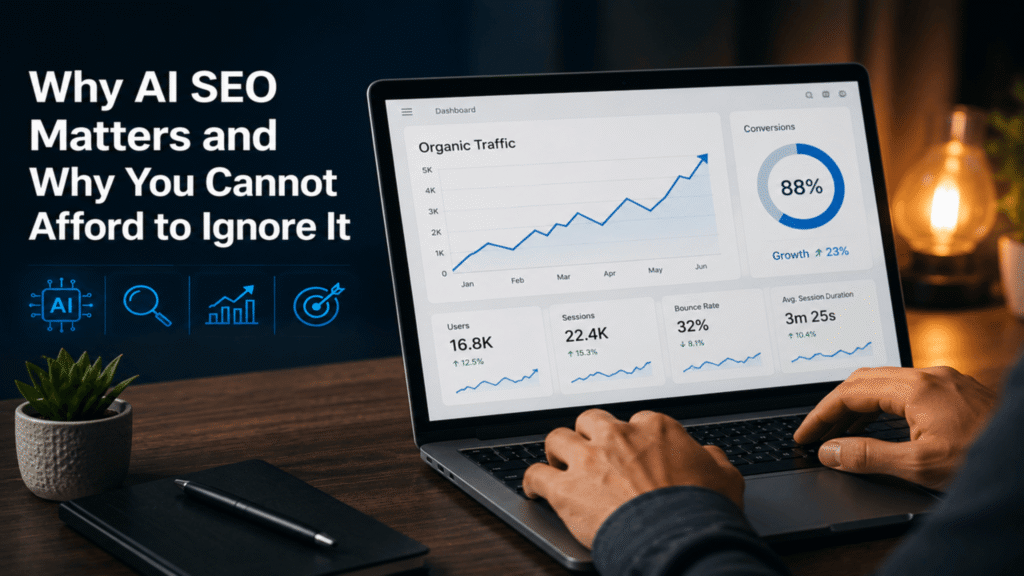
Why AI SEO matters is not just a question for digital marketers anymore. It is a question every business owner, blogger, content creator, and brand must answer in 2026.
Search engines are no longer simple keyword matching machines. They have evolved into intelligent systems powered by artificial intelligence, natural language processing, and machine learning. Google’s BERT, MUM, and AI Overviews have completely reshaped how content gets discovered, ranked, and consumed online.
If you are still running your SEO strategy the old way, relying on keyword stuffing, exact match phrases, and outdated backlink tricks, you are already falling behind. The truth is, why AI SEO matters becomes crystal clear the moment your organic traffic starts to drop and you do not know why.
This article will walk you through everything you need to understand about AI powered SEO, why ignoring it is a business risk you cannot afford, and exactly what steps you should take to stay competitive in an AI driven search world.
What Is AI SEO and Why Does It Exist?
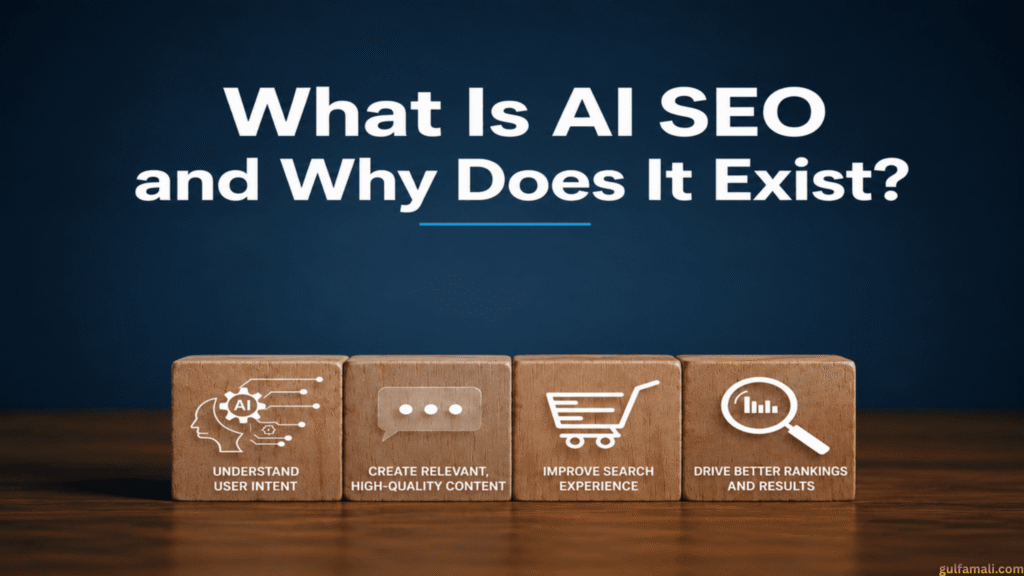
AI SEO refers to the use of artificial intelligence tools, algorithms, and machine learning models to improve a website’s visibility in search engine results pages (SERPs).
Traditional SEO was built around keywords, backlinks, and metadata. AI SEO goes much deeper. It focuses on understanding user intent, content context, semantic meaning, and the full topical coverage of your website.
Why AI SEO matters at its core is simple
AI now powers search engines themselves. Google uses AI to understand what users mean, not just what they type. If your content cannot communicate clearly with these AI systems, it will not rank.
AI SEO includes
Optimizing content for semantic search and natural language queries. Building topical authority across a subject area. Structuring content so AI systems can extract and summarize it. Using schema markup to help machines understand your data. Creating content that satisfies E E A T (Experience, Expertise, Authority, Trust).This is not the future. This is happening right now.
Why AI SEO Matters More Than Ever in 2026
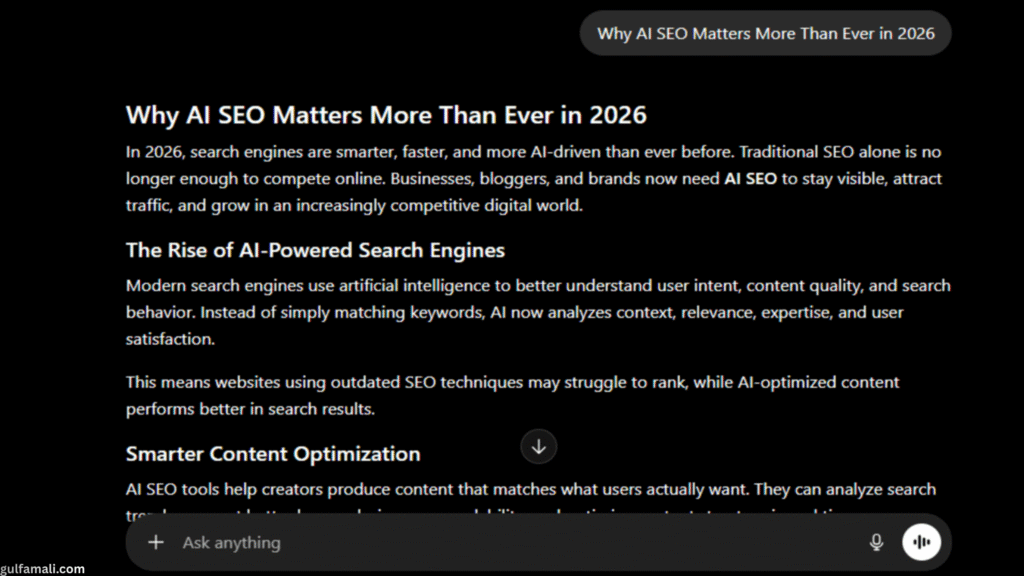
The pace of change in search is accelerating. In 2026, AI assistants like ChatGPT, Google AI Overviews, and Perplexity are handling a growing share of search queries. These tools do not send users to a list of links. They synthesize answers directly from trusted, well structured content.
Why AI SEO matters becomes obvious when you realize that if your content is not optimized for AI generated answers, you are invisible to a massive and growing audience.
According to recent data, AI tools are expected to handle over 25% of all global search queries by 2026. That is a quarter of your potential audience being served answers that might not include your website at all.
Businesses that understand why AI SEO matters are actively optimizing their content for AI Overviews, answer engine optimization (AEO), and generative engine optimization (GEO). Those that do not are watching their traffic quietly disappear.
The Real Consequences of Ignoring AI SEO
Let us be direct. Ignoring AI SEO does not mean staying in the same place. It means actively losing ground.He is what happens when businesses ignore why AI SEO matters:
Organic Traffic Drops Significantly
When Google’s AI Overviews answer a user’s question directly on the search page, they never click through to your website. If your content is not the source being cited in those AI answers, you receive zero traffic from those queries.
Websites not optimized for AI search are seeing sharp declines in click through rates, especially for informational queries. Zero click searches are rising, and only AI optimized content survives in this new environment.
Competitors Take Your Rankings
Your competitors who have understood why AI SEO matters are producing semantically rich, well structured, intent focused content. They are earning positions in AI generated summaries, featured snippets, and People Also Ask boxes.
While they capture your audience, your outdated content sinks lower in the SERPs. This is not temporary. It becomes harder and harder to recover the longer you wait
Your Content Becomes Invisible to AI Platforms
AI search tools like ChatGPT Search, Perplexity, and Google’s AI Mode do not just look for keyword matches. They look for authoritative, trustworthy, well structured content that clearly answers user questions.
If your content lacks semantic depth, clear structure, schema markup, and topical authority, these AI platforms simply ignore it. Why AI SEO matters is never more clear than when your brand disappears from AI generated results entirely.
Brand Authority Erodes
When your website stops appearing in search results and AI generated answers, users stop associating your brand with expertise. Brand authority is built through consistent visibility. Without AI SEO, that visibility fades.
Revenue and Leads Decline
Every missed search impression is a missed opportunity for a lead, a sale, or a new customer. The cumulative effect of ignoring AI SEO is felt directly in your bottom line. Traffic drops, lead generation slows, and revenue shrinks.
How AI Has Transformed Google’s Search Algorithm
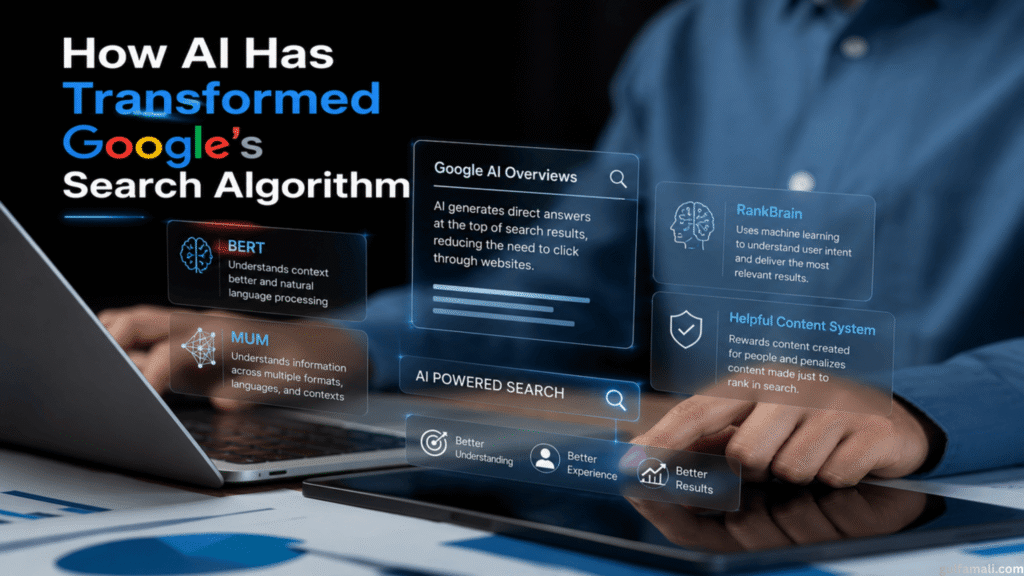
To truly grasp why AI SEO matters, you need to understand what has changed inside Google’s algorithm.
BERT (Bidirectional Encoder Representations from Transformers
Google’s BERT update changed how the algorithm understands the relationship between words in a sentence. Instead of reading left to right, BERT reads context from both directions, allowing it to understand meaning far more accurately.
Content that reads naturally for humans performs better in a BERT powered world. Keyword stuffing actively hurts rankings because BERT can detect it.
MUM (Multitask Unified Model)
MUM is 1,000 times more powerful than BERT. It can understand and generate language across multiple formats and languages simultaneously. It processes text, images, and video together to answer complex queries.
Why AI SEO matters in the context of MUM is that your content must be comprehensive, covering multiple angles of a topic, not just one thin layer of information.
Google AI Overviews
AI Overviews pull directly from websites that Google’s AI system identifies as authoritative, well structured, and relevant. If you want your content featured in AI Overviews, you must optimize specifically for it.
This means writing clear answers early in your content, using structured headings, implementing FAQ schema, and building genuine topical authority.
Key Elements of a Strong AI SEO Strategy
Understanding why AI SEO matters is step one. Building your strategy is step two. Here are the core pillars of an effective AI SEO approach.
Semantic SEO and Topical Authority
Semantic SEO means creating content that covers a topic deeply and completely, not just targeting one keyword. Search engines reward websites that demonstrate mastery over a subject area.
Build topic clusters. Create a pillar page for your main topic and support it with multiple in depth articles covering every subtopic. This signals to AI systems that your website is a genuine authority on the subject.
Search Intent Optimization
Every piece of content must match the intent behind the query it targets. Informational queries need educational answers. Commercial queries need comparison content. Transactional queries need clear calls to action.
Why AI SEO matters in the context of intent is that AI systems are specifically designed to match content to intent. Mismatched content will not rank, no matter how well written it is.
E E A T
Google’s quality guidelines emphasize E E A T as a core ranking signal. AI powered algorithms can assess these signals through multiple data points including backlinks from authoritative sources, author credentials, accurate and up to date information, clear sourcing and citations, and positive user signals.
If your content cannot demonstrate genuine expertise and trustworthiness, AI search systems will not recommend it.
Structured Data and Schema Markup

Schema markup tells search engines exactly what your content is about in a language machines understand perfectly. Implementing FAQ schema, Article schema, HowTo schema, and Organization schema dramatically increases your chances of appearing in AI generated summaries and rich results.
Why AI SEO matters is especially evident here because without structured data, even excellent content can be misunderstood by AI systems.
Conversational and Voice Search Optimization
AI has made conversational search the norm. Users increasingly phrase their queries as full questions, the way they would ask a human assistant. Your content must anticipate and directly answer these conversational queries.
Use natural language in your writing. Include FAQ sections. Answer the exact questions your audience is asking. This is how you get cited in voice search results and AI assistant responses.
AI SEO Tools That Give You a Competitive Edge
Why AI SEO matters is also reflected in the explosion of tools designed to help businesses implement it. Here are the most important categories:
AI Powered Keyword Research Tools
Tools like Semrush, Ahrefs, and Google’s Keyword Planner now incorporate AI to surface not just keywords but intent clusters, topic gaps, and semantic variations. Use them to build a comprehensive keyword architecture, not just a list of individual terms.
Content Optimization Platforms
Tools like Surfer SEO, Clearscope, and Content Harmony analyze top ranking content and provide semantic keyword recommendations. They help ensure your content covers all the contextual terms that AI systems expect to see for a given topic.
AI Writing Assistants
AI writing tools can help you produce content at scale while maintaining quality. However, the key is to use AI as a starting point and add genuine human expertise, original insights, and real world examples. AI generated content without human value will not satisfy E E A T requirements.
Technical SEO Auditing Tools
Screaming Frog, Sitebulb, and Google Search Console help identify technical issues that prevent AI systems from crawling and understanding your website. Page speed, mobile optimization, Core Web Vitals, and clean site structure are all critical for AI SEO success.
Content Quality: The Non Negotiable Foundation
Why AI SEO matters ultimately comes back to one thing: content quality. AI search systems are specifically designed to identify and promote genuinely helpful, accurate, and well structured content.
The era of thin content, spun articles, and keyword heavy filler is completely over. AI systems can detect low quality content with remarkable precision.
What high quality AI optimized content looks like:
It answers the user’s question clearly and completely in the first few paragraphs. It covers the topic from multiple angles with depth and nuance. It includes original insights, data, examples, and expert perspective. It uses clear headings, short paragraphs, and logical structure. It is regularly updated to reflect the latest information. It links to authoritative external sources and relevant internal pages.Every piece of content you publish should be the single best resource available on its topic. That is the standard AI SEO demands.
The Connection Between AI SEO and User Experience
Why AI SEO matters is deeply connected to user experience (UX). Google’s Core Web Vitals measure real world UX signals including page loading speed, visual stability, and interactivity.
AI systems reward websites that deliver fast, smooth, and enjoyable experiences. A technically perfect article buried inside a slow, cluttered, mobile unfriendly website will not rank well in 2026.
Prioritize
Fast page loading (under 2.5 seconds). Clean, distraction free design. Mobile first layouts. Easy to read typography and formatting. Clear calls to action and logical navigation.User experience is not separate from SEO. In the AI era, they are the same thing.
Local SEO and AI: A Critical Combination
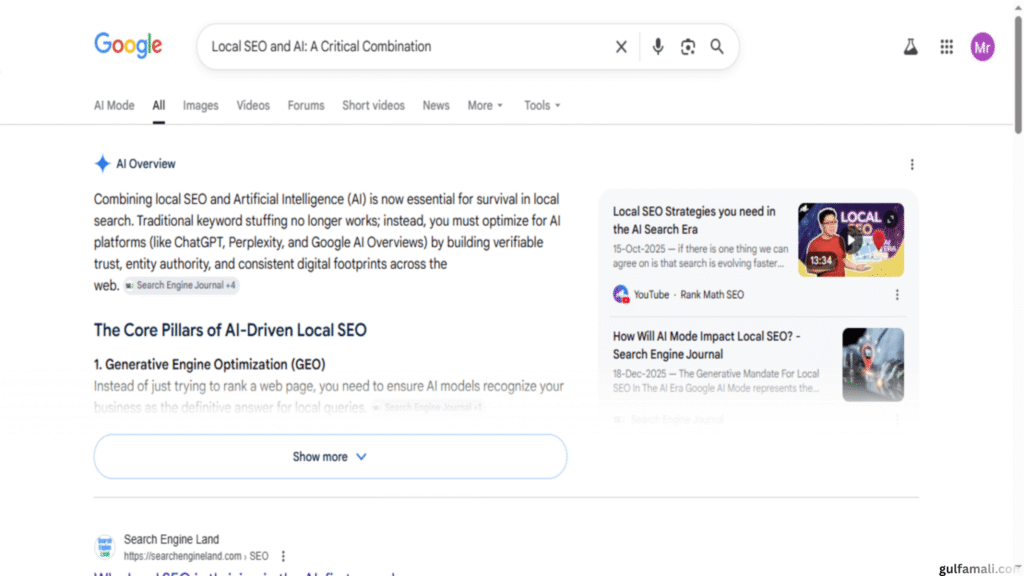
For businesses targeting local customers, why AI SEO matters extends into local search optimization. AI tools increasingly cross reference local business data from multiple sources before recommending businesses to users.
Ensure your Google Business Profile is complete and regularly updated. Earn positive customer reviews consistently. Build local citations across trusted directories. Create location specific content that addresses local search intent.
AI powered local search rewards businesses with strong, consistent, and trustworthy local signals. Ignoring this is especially costly for brick and mortar and service based businesses.
Video and Multimodal SEO in the AI Era
Google’s MUM algorithm processes multiple content formats simultaneously. Why AI SEO matters now includes optimizing video, images, and audio alongside written content.
YouTube SEO has become inseparable from web SEO. Videos that answer popular queries are increasingly surfaced in AI generated results. Optimize your video titles, descriptions, and transcripts with target keywords and semantic terms.
Images need descriptive alt text, appropriate file names, and context from surrounding text. AI systems read images in relation to the text around them. Every visual element on your page should reinforce your content’s topical relevance.
Measuring AI SEO Success: The New Metrics
Traditional SEO was measured primarily by keyword rankings and organic traffic. Why AI SEO matters introduces new metrics that reflect the changing landscape.
Track these in addition to traditional metrics
AI Overview appearances (how often your content is cited in Google’s AI summaries). Click through rates from AI driven search features. Topical authority scores across your content cluster. Brand mention frequency in AI generated answers. Engagement metrics like time on page and scroll depth. Core Web Vitals performance scores.These metrics tell the fuller story of how your AI SEO strategy is performing in 2026 and beyond.
A Practical Action Plan for AI SEO Success
Understanding why AI SEO matters is important. Taking action is what separates thriving websites from fading ones. Here is a practical roadmap:
Month 1: Audit and Foundation
Conduct a full technical SEO audit. Fix Core Web Vitals issues. Implement schema markup across key pages. Review and update your highest traffic existing content.
Month 2: Keyword and Topic Strategy
Build a topic cluster architecture around your primary keywords. Identify semantic and LSI keyword opportunities. Research the conversational queries your audience uses. Map every piece of content to a clear search intent.
Month 3: Content Creation and Optimization
Publish deeply comprehensive pillar content. Create supporting cluster articles targeting semantic keywords. Optimize all content for E E A T signals. Add FAQ sections to target voice search and AI Overviews.
Month 4 and Beyond: Authority Building and Monitoring
Earn high quality backlinks from authoritative sources. Monitor AI Overview citations regularly. Update content based on performance data. Expand your topic cluster with new supporting articles.
This is not a one time project. AI SEO requires ongoing attention, adaptation, and commitment.
Why AI SEO Matters for Every Type of Business
Some business owners mistakenly believe that AI SEO only matters for large enterprises or technology companies. This is completely false.
Why AI SEO matters applies equally to
Small local businesses competing for neighborhood customers. E commerce stores trying to appear in product related AI answers. Service providers building authority in their professional niche. Content creators and bloggers growing an audience through organic search. B2B companies generating leads through educational content marketing.Every business that relies on search engine visibility needs an AI SEO strategy. The size of the business does not change this reality.
The Future of AI SEO: What Is Coming Next
Why AI SEO matters today will be even more pronounced in the years ahead. Several emerging trends will shape the future of AI powered search.
Agentic AI search tools that complete tasks on behalf of users will become more common. These agents visit websites, evaluate content quality, and extract information automatically.
Multimodal search combining text, image, audio, and video will continue expanding. Personalized AI search results tailored to individual user histories and preferences will grow. Real time indexing and faster content freshness requirements will increase.
Staying ahead means building a flexible, quality first AI SEO strategy now, before these trends become even more dominant.
Conclusion: Your Next Move Decides Everything
Why AI SEO matters is no longer a debate. It is a business reality.
Every day you wait, competitors gain ground, rankings slip, and traffic quietly disappears.
AI powered search is not coming. It is already here, reshaping how content is found, ranked, and rewarded.
Businesses that act now will build authority that compounds over time.
Those who ignore why AI SEO matters will struggle to recover the ground they lost.
The strategy is clear. Optimize for intent. Build topical authority. Earn AI visibility.
Start today, because in the world of AI search, timing is everything.