
AI SEO is already happening whether you are ready or not. Every single day, millions of search queries are being processed, ranked, and answered by artificial intelligence systems that operate nothing like the traditional search engines most marketers learned to optimize for. If you are still writing content based on keyword density, building backlinks through outdated methods, or relying on SEO tactics from five years ago, you are not just behind. You are invisible.
The reality is uncomfortable but important. AI driven SEO strategies you are missing are not coming in the future. They are active right now. Google’s Search Generative Experience, AI Overviews, and machine learning ranking systems have fundamentally rewritten the rules of organic search. The brands, creators, and businesses that understand this shift are capturing traffic that everyone else is losing without knowing why.
The truth that most marketers are slowly realizing is that AI SEO is already happening at every level of the search ecosystem. It is happening in how Google ranks your pages. It is happening in how users phrase their queries. It is happening in how answers are generated and presented before a single click ever takes place.
This article is your complete guide to understanding what AI SEO is, why it is already reshaping search results, what strategies are working right now, and most importantly, what you need to do before the window to compete closes even further.
What Is AI SEO and Why Does It Matter Right Now
AI SEO is the combination of artificial intelligence and search engine optimization working together in the modern search landscape. Google no longer simply matches keywords to pages but evaluates content depth, authority, and genuine helpfulness using advanced AI systems. Marketers are also using AI powered tools to research, write, and optimize content faster and smarter than ever before. If your strategy has not adapted to this reality yet, you are already losing ground to competitors who have.
The Two Sides of AI SEO
AI SEO refers to the intersection of artificial intelligence and search engine optimization. It covers two distinct but deeply connected realities. The first is how search engines themselves now use AI to rank, interpret, and present content. The second is how content creators and marketers are using AI powered tools to research, write, optimize, and scale their SEO efforts.
Both dimensions are transforming the landscape at a pace that most businesses have not caught up with. Understanding both sides of this equation is essential to competing in modern organic search.
Practical Example: A local dental clinic and a national dental chain are both targeting the query “how to relieve tooth pain at home.” The national chain has a single article stuffed with that phrase repeated 20 times. The local clinic has published a comprehensive resource covering pain causes, remedies by pain type, when to see a dentist, questions to ask, and aftercare guidance. Google’s AI recognizes the local clinic’s content as the more genuinely helpful resource and surfaces it in AI Overviews, even though the national chain has far more backlinks. The depth and intent alignment matter more than the authority gap.
How Search Engines Evolved Into AI Systems
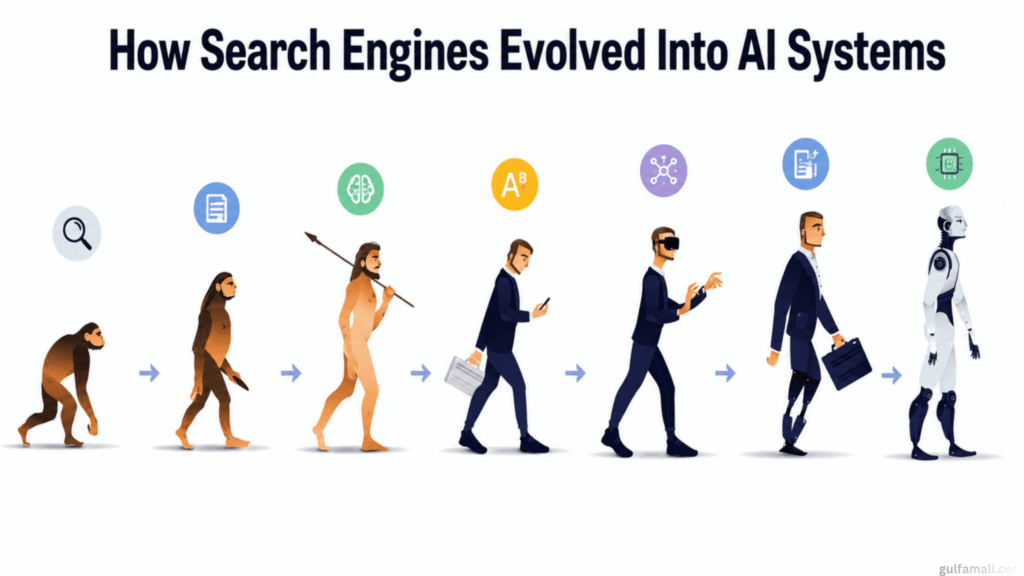
On the search engine side, Google has been incorporating AI into its ranking systems for nearly a decade. RankBrain, introduced in 2015, was the first major signal that Google was moving toward machine learning interpretation of search queries. BERT followed in 2019, enabling Google to understand natural language queries with extraordinary nuance. MUM, the Multitask Unified Model, went further still. And now AI Overviews represent the most visible and consequential shift yet.
What these changes mean for SEO is profound. Google no longer simply matches keywords to pages. It understands user intent at a deep contextual level. It evaluates the quality, depth, and authority of content. It synthesizes information across multiple sources to generate answers. And it makes all of this happen in milliseconds, for billions of queries every day.
Practical Example: Before BERT, a search for “can you get a visa for someone else” might have returned generic visa application pages. After BERT, Google understood the nuance of the query, that the user wants to know if a third party can apply on their behalf, and returned pages specifically addressing proxy applications. Businesses that had structured their content around specific user questions rather than broad keywords suddenly saw significant ranking gains without changing anything else.
The Marketer’s Side of the AI SEO Revolution
On the content creation and optimization side, AI powered keyword research tools, automated SEO analysis platforms, content generation assistants, and predictive analytics systems have given marketers capabilities that simply did not exist before. These tools allow faster research, more comprehensive topic coverage, better content structure, and more accurate performance forecasting.
AI SEO is already happening in every major marketing agency, every competitive niche, and every industry vertical. It is not one thing. It is a complete transformation of the entire search ecosystem, and the businesses that grasp this first are the ones pulling ahead.
Practical Example: A mid sized SaaS company used Surfer SEO and a large language model to audit their 80 existing blog posts. The AI identified 34 posts as having significant topical gaps, flagged 12 as cannibalizing each other’s rankings, and generated detailed content briefs for each gap. Within three months of implementing the recommendations, organic traffic to their blog increased by 47 percent. Their team of two writers accomplished in one quarter what a team of six had failed to do in two years using manual methods.
How AI Has Changed the Way Google Understands Content
Google no longer reads content by simply matching keywords to pages. It now uses advanced AI systems to evaluate topical authority, entity relationships, and semantic depth across your entire website. Content that genuinely answers the full range of user questions and demonstrates real expertise ranks far higher than content built around keyword repetition. The shift is permanent and every piece of content you publish today is being judged by these AI standards.
The Death of Old School Keyword Matching
To optimize for AI driven search, you first need to understand what Google is actually evaluating when it processes your content today. This is where most outdated SEO advice breaks down entirely.
Traditional SEO was largely about signals. You placed keywords in title tags, meta descriptions, headers, and body copy. You earned backlinks from authoritative sites. You ensured your site loaded quickly and was mobile friendly. These things still matter, but they are now the baseline, not the competitive edge.
AI SEO is already happening in Google’s core evaluation systems, and it goes far deeper than any signal based model ever did.
Practical Example: An e commerce store selling running shoes had a product category page that mentioned “women’s trail running shoes” in the title, headers, and first paragraph exactly as recommended by 2018 era SEO advice. A competitor published a buying guide that covered terrain types, shoe drop explained, pronation guidance, midsole technologies, and fit advice for different foot widths. The guide ranked above the category page for nearly every relevant query, including the narrow keyword that the category page was explicitly built around. The AI rewarded comprehensiveness over keyword placement.
Topical Authority: The New Ranking Currency
Google’s AI systems now evaluate content on dimensions that were never part of the old SEO conversation. Topical authority is one of the most significant. Google increasingly wants to understand whether your website is a genuine authority on a subject or whether you are publishing isolated pieces of content without real depth or coherence. Sites that cover a topic comprehensively, with interconnected content that answers questions at every level of depth, outperform sites that publish occasional articles on scattered subjects.
Practical Example: A financial advice blog published one article per month on random personal finance topics, ranging from retirement savings to credit card rewards to tax deductions. Their domain authority was decent but their rankings were inconsistent. After restructuring their content strategy around a single pillar topic, namely first time homebuying, they published a central guide plus 22 supporting articles covering everything from mortgage types to neighborhood research to closing costs. Within five months, nearly every article in the cluster appeared on page one, and the pillar guide ranked first for competitive queries they had never ranked for before.
Entity Optimization and Semantic Search Depth
Entity optimization has become critical. Google’s Knowledge Graph and AI systems think in terms of entities, meaning real world objects, concepts, people, places, and relationships, rather than just keywords. Optimizing your content to clearly establish entities and their relationships helps AI systems understand and trust your content far more deeply than keyword repetition ever could.
Semantic search depth is another area where AI SEO is already happening in ways that most content creators have not accounted for. When someone searches for a topic, Google’s AI evaluates whether your content genuinely addresses the full spectrum of related questions, subtopics, and user needs associated with that topic. Thin content that answers one narrow question while ignoring the broader context performs poorly compared to comprehensive resources that demonstrate real expertise.
Practical Example: A nutritionist’s website discussed magnesium supplements but never named specific forms like magnesium glycinate, malate, or citrate, never connected magnesium to related entities like sleep quality, muscle recovery, or specific deficiency conditions, and never mentioned relevant medical context like interactions with certain medications. A competitor’s page explicitly connected magnesium to its known entities and relationships within the knowledge graph. Google’s AI surfaced the competitor for every variation of the query, including ones that never used the word “supplement,” because the semantic depth of the content signaled genuine expertise.
User Experience Signals in the AI Era
User experience signals, including page engagement, time on site, click through rates, and return visit rates, feed into AI ranking systems in ways that are increasingly sophisticated. Google can identify when users are satisfied with content and when they are not, and it adjusts rankings accordingly. Content quality, genuine helpfulness, and excellent presentation are now ranking factors more directly and measurably than ever before.
Practical Example: A recipe website had strong keyword optimization but poor engagement metrics. Users were arriving, scanning for the recipe, and immediately scrolling past long personal stories and ads to find the ingredients. Bounce rates were high and dwell time was low. After restructuring the page to front load a recipe jump link, a concise ingredients summary, and a clear visual, average session time doubled, and Google’s rankings for those pages improved meaningfully within six weeks without any changes to the content itself. The AI had been reading the engagement data as a quality signal all along.
AI Overviews and the Zero Click Revolution
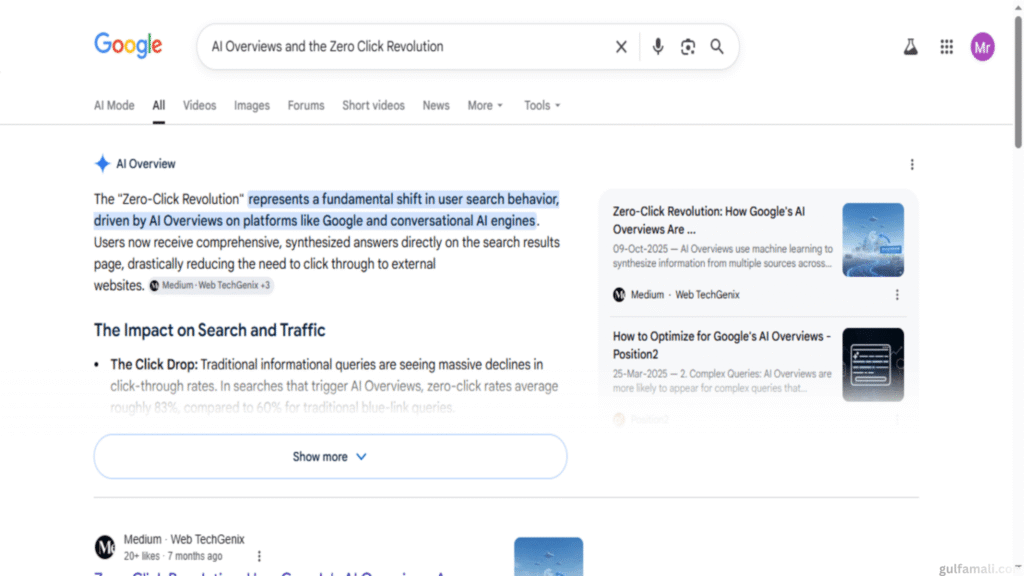
AI Overviews now appear at the very top of Google search results, generating direct answers from multiple sources before a single organic click ever takes place. This means your content can rank on page one and still lose traffic because users are getting their answers without visiting your website. The only way to win in this environment is to structure your content so clearly and authoritatively that Google’s AI chooses to cite you as a source inside those overviews.
What Are AI Overviews and Why Do They Matter
One of the most disruptive developments in modern SEO is the rise of AI Overviews, formerly known as the Search Generative Experience. These are the AI generated summaries that appear at the very top of Google search results, synthesizing information from multiple sources to answer user queries directly on the results page.
For many searches, especially informational queries, AI Overviews are changing the entire traffic dynamic. Users can now get answers without ever clicking through to a website. This is the zero click reality that every content creator and business needs to understand, because AI SEO is already happening at the very top of the results page before any organic listing even appears.
Practical Example: A digital marketing agency tracked a keyword they had ranked first for organically, “how long does it take to see SEO results,” for eighteen consecutive months. After AI Overviews launched widely, their organic clicks for that keyword dropped by 61 percent despite their ranking remaining at position one. The AI Overview was answering the question completely enough that most users never scrolled to the organic results. The agency’s response was to restructure their content to be cited within the overview rather than just ranked below it, which partially recovered their brand visibility even with fewer direct clicks.
The Click Through Rate Crisis Nobody Is Talking About
The implications for traditional SEO are significant. If you are ranking on page one for informational keywords and your entire strategy depends on those rankings to drive traffic, you may already be seeing declining click through rates even while your rankings remain stable. The traffic is being absorbed by AI generated answers before it ever reaches you.
This is one of the clearest signs that AI SEO is already happening without you if you are not paying attention to how your click through rates are trending alongside your rankings.
Practical Example: An HR software company noticed that their SEO dashboard showed stable rankings for 40 top keywords but Google Search Console revealed a 38 percent year over year decline in impressions converted to clicks. A manual audit showed that 29 of those 40 keywords were now triggering AI Overviews. The company pivoted their content investment toward deeper, more decision oriented queries like “HR software for manufacturing companies with 200 employees” where AI Overviews were less dominant and user intent clearly required visiting a website to evaluate a product.
How to Win AI Overview Citations
There is a critically important nuance that most marketers miss. Being cited as a source within an AI Overview represents an entirely new category of search visibility. When Google’s AI synthesizes an answer and cites your content, your brand appears at the moment of highest relevance and trust.
Optimizing for AI Overview citations requires a different approach than traditional ranking. Your content needs to be structured clearly, with direct and authoritative answers to specific questions. You need to demonstrate expertise and trustworthiness that Google’s AI can recognize and validate. You need structured data markup that helps AI systems understand and extract your content. The brands winning AI Overview citations today understand that AI SEO is already happening and they have built their content architecture around that reality.
Practical Example: A cybersecurity firm wanted to appear in AI Overviews for queries around “what is a phishing attack.” Their original article was 2,400 words of flowing prose. They restructured it by adding a clear one sentence definition in the opening paragraph, a bulleted breakdown of phishing types each with a one sentence description, an FAQ section with direct question and answer formatting, and FAQ schema markup in the page code. Within three weeks, the restructured page was cited in Google’s AI Overview for the target query and 14 related queries. The content did not get longer. It got more extractable.
The Rise of Generative AI and Organic Traffic Impact

Generative AI platforms like ChatGPT, Perplexity, and Microsoft Copilot are now handling millions of search queries that used to go directly to Google. These platforms do not send traffic to websites the way traditional search engines do, but they heavily influence brand discovery and buying decisions. If your content is not being referenced and cited by these AI systems, you are losing visibility in a rapidly growing search channel that most of your competitors have not yet taken seriously.
A New Category of Search Behavior
Beyond Google’s own AI systems, the emergence of generative AI tools has created an entirely new category of search behavior that is reshaping organic traffic patterns. ChatGPT, Perplexity AI, Claude, Microsoft Copilot, and a growing ecosystem of AI assistants are now handling a significant and rapidly growing share of queries that used to go directly to Google.
Users are increasingly turning to AI assistants for research, product recommendations, content suggestions, and complex questions. These platforms do not send traffic to websites in the same way that traditional search engines do. However, they influence brand perception, discovery, and decision making in ways that are just beginning to be understood and measured.
Practical Example: A B2B accounting software company discovered through a customer survey that 34 percent of their new customers in the past quarter had first heard of their product through an AI assistant conversation rather than a Google search. When they tested asking ChatGPT and Perplexity questions their target customers would ask, like “what accounting software works best for ecommerce businesses,” their brand was not being mentioned at all despite their strong Google rankings. Their competitor, whose website had detailed case studies with specific results and clearly structured product comparison content, was being named consistently. The difference was citation ready content, not domain authority.
Generative Engine Optimization: The Next Frontier
Some SEO experts are beginning to refer to this emerging discipline as Generative Engine Optimization, or GEO. The principles overlap significantly with traditional SEO, but with additional emphasis on being cited and referenced by AI language models rather than just ranked by search engines. If AI SEO is already happening on Google, it is happening even faster across the generative AI ecosystem.
Creating content that is factually accurate, clearly attributed, well structured, and genuinely authoritative increases your likelihood of being referenced by these systems. This is not a distant future concern. Generative AI tools are already handling enormous query volumes, and the strategies you build today will determine your presence in this landscape for years to come.
Practical Example: A health and wellness brand published an original study on sleep habits among remote workers, complete with methodology, sample size, and clearly cited statistics. Within months, the study was being referenced by AI assistants answering sleep related questions, attributed the brand by name in responses. The brand had not optimized the study for Google in any traditional sense. They had simply created factual, original, properly sourced content that AI systems found reliable enough to reference. One original data asset generated more AI visibility than their entire backlink building campaign had in two years.
Why Your Brand Needs to Be Referenced by AI Systems
If your brand, product, or content is being recommended or cited by AI assistants, you gain exposure and authority that compounds over time. If AI assistants are answering questions in your niche without mentioning your brand at all, you are losing ground in a competitive landscape that most of your competitors have not yet recognized. Recognizing that AI SEO is already happening across all AI platforms, not just Google, is the mindset shift that separates forward thinking marketers from the rest.
AI Powered Keyword Research: The New Competitive Edge
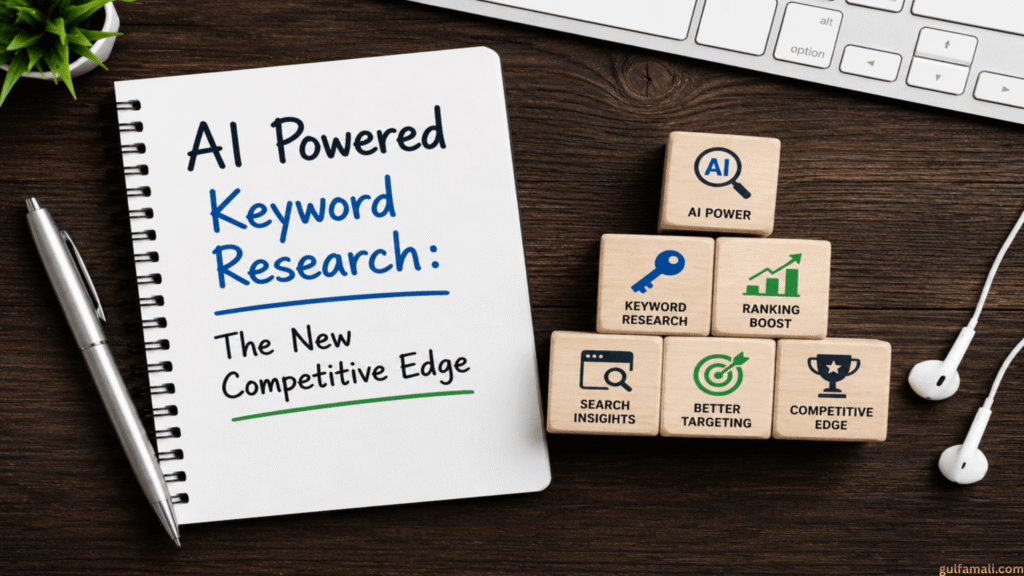
AI powered keyword research tools have completely changed what is possible for content strategists and marketers today. Instead of chasing individual high volume keywords, these tools identify full semantic topic clusters, content gaps, and user intent patterns that manual research would never uncover. Marketers who use AI for keyword research are building topical authority faster and more accurately than those still relying on traditional methods. The competitive edge is not just speed but the ability to see the entire landscape of a topic before your competitors do.
Why Traditional Keyword Research Is No Longer Enough
Traditional keyword research was largely about finding high volume, low competition search terms and building content around them. This approach still has value, but it is now far less effective as a standalone strategy than it once was. The reason is simple: AI SEO is already happening at the keyword research stage, and your competitors with AI tools are operating on a completely different level of insight.
Practical Example: A travel blog built their editorial calendar around keywords their writer found manually by browsing Google’s autocomplete and related searches. Each article took two to three hours of research to scope. A competing travel blog used an AI tool to generate a complete semantic topic map of “solo travel in Japan” in under 20 minutes, identifying 140 distinct subtopics across four stages of traveler intent, from inspiration to planning to in country navigation to post trip reflection. The competing blog published four times as many articles in the same quarter and captured search visibility across the entire topic cluster rather than isolated phrases.
What AI Powered Research Tools Can Do
AI powered keyword research tools have fundamentally changed what is possible. These tools can identify semantic clusters of related topics, predict which content angles are underserved, analyze SERP features to understand what Google is rewarding for any given query, and generate comprehensive content briefs that map out the full landscape of what needs to be covered for topical authority.
Tools like Semrush, Ahrefs, Surfer SEO, and Clearscope have incorporated machine learning into their core functionality in ways that make manual keyword research look primitive by comparison. They can analyze thousands of top ranking pages to extract the common themes, entities, and semantic patterns that correlate with high rankings. They can identify the specific questions users are asking at every stage of their journey.
Practical Example: A law firm used Clearscope to analyze the top 20 ranking pages for “wrongful termination California.” The tool identified 47 semantic terms and entities consistently present in top ranking content that the law firm’s existing page was missing entirely, including specific California labor code references, timelines for filing claims, and comparisons to federal protections. Adding these missing elements to their existing page, without significantly changing its length or structure, moved it from page three to position four on page one within two months.
Using AI Directly for Content Strategy
Beyond dedicated tools, marketers are increasingly using large language models directly for keyword research and content strategy. Prompting AI systems to analyze topics, generate comprehensive subtopic lists, identify user intent patterns, and map content to different stages of the funnel produces research outputs in minutes that would have taken days of manual work.
The competitive edge here is not just speed. It is the ability to see the full topical landscape rather than just individual keywords, and to build content strategies that establish genuine authority. Every marketer who understands that AI SEO is already happening in the research phase is getting further ahead of those who still rely on manual tools alone.
Practical Example: A pet care brand used a large language model to generate a complete content map for the topic of “dog anxiety.” The AI identified nine distinct user intent clusters, from situational anxiety like thunderstorms and car rides, to separation anxiety, to anxiety in rescue dogs, to medication options and behavioral training approaches. Each cluster contained between five and twelve specific questions users were likely to search. What would have been a two-day research project became a 45 minute exercise, and the resulting content strategy covered topical ground that none of the brand’s competitors had fully addressed.
Automated SEO and Content Optimization at Scale
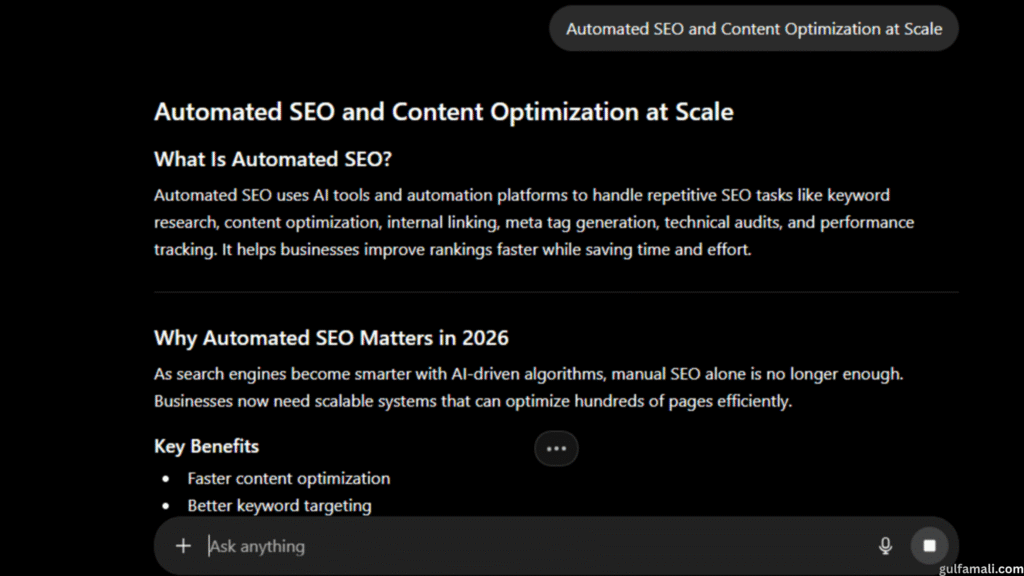
AI powered automation has made it possible for small teams to manage and optimize entire websites at a scale that was simply not achievable before. Automated SEO tools can crawl hundreds of pages, identify technical issues, generate metadata, and surface content optimization opportunities in a fraction of the time manual work would require. AI writing assistants help skilled human writers produce higher quality content faster by handling research, outlines, and first drafts. The key is using AI to amplify human expertise rather than replace it, because that combination is what Google’s AI systems consistently reward.
What Automation Has Made Possible
One of the most transformative capabilities that AI has brought to SEO is the ability to operate at scale in ways that were previously impossible for small teams. Content optimization, technical SEO audits, metadata generation, internal linking analysis, and performance monitoring can now be automated to a degree that changes what lean marketing teams can accomplish.
Automated SEO tools powered by AI can crawl entire websites, identify technical issues, prioritize fixes by estimated impact, and generate corrective recommendations. They can analyze content across hundreds of pages and identify optimization opportunities that manual review would never catch. They can monitor rankings, traffic patterns, and competitive movements in real time and surface actionable insights without requiring constant manual attention.
Practical Example: An online education platform with 600 course pages used an AI powered SEO tool to audit their entire site over a weekend. The tool identified that 220 pages had duplicate or near duplicate meta descriptions, 85 pages had internal linking gaps where highly relevant content was never linked to, and 40 pages had title tags that did not match the primary intent of the page’s content. Fixing these issues, which would have required weeks of manual work, took the team three days using AI generated recommendations. Organic impressions across the affected pages increased by 22 percent in the following 60 days.
AI Writing Tools: Power and Limitations
On the content side, AI writing assistants have dramatically changed what is possible for content teams. This does not mean that AI generated content automatically performs well in search. It does not. Google is sophisticated in identifying and downranking content that lacks genuine expertise, original insight, and real value for users.
However, AI tools used strategically as research assistants, outline generators, first draft accelerators, and optimization aids allow skilled human writers to produce higher quality content faster than ever before. The teams winning in this environment are those who have recognized that AI SEO is already happening at the production level and have redesigned their workflows accordingly.
Practical Example: A cybersecurity consulting firm had one expert writer producing two in depth articles per month. By integrating AI into their workflow, the writer used AI to handle initial research compilation, generate a detailed outline, and produce a first draft covering the structural elements. The writer then rewrote and enriched the draft with personal experience, client case studies, and expert opinions. Monthly output increased to seven articles without any reduction in depth or quality, and their average word count actually increased because the research phase no longer constrained their writing time.
The Right Way to Use AI in Your Content Workflow
The key distinction is between using AI to replace expertise and using AI to amplify expertise. The former produces content that ranks poorly and fails to convert. The latter produces content that ranks well and genuinely serves users. The most effective content teams today are those that have learned to integrate AI tools into a workflow that keeps human expertise, judgment, and creativity at the center while leveraging AI to handle repetitive, time consuming, and data intensive tasks.
When you operate this way, you are not just keeping up with the fact that AI SEO is already happening. You are actively leveraging it as a competitive weapon.
Practical Example: A medical information website tried two approaches to content production. Team A used AI to generate complete articles with minimal human editing, publishing 30 articles per month. Team B used AI only for research summaries and outlines, with a licensed physician reviewing and substantially rewriting every piece, publishing 12 articles per month. After six months, Team A’s content had been largely deindexed following a Google core update. Team B’s content had moved up in rankings, with three articles earning featured snippets. The difference was not the AI tool. It was how human expertise was embedded in the process.
Google AI Algorithm Updates and What They Mean for Your Strategy
Google releases hundreds of algorithm updates every year and the pace of AI driven changes has accelerated dramatically in recent years. The consistent direction of every major update has been toward rewarding genuine expertise, real helpfulness, and trustworthy content while penalizing anything created purely to game rankings. Google’s AI now reads your content the way an intelligent human reviewer would, looking for depth, accuracy, and real world value. Any SEO strategy that ignores this direction is built on borrowed time and will not survive the next major update.
The Pace of AI Driven Updates Has Accelerated
Google releases hundreds of algorithm updates every year, and the pace of AI related updates has accelerated dramatically. Understanding the direction of these updates is essential to building an SEO strategy that holds up over time rather than one that gets wiped out by the next major change.
The consistent direction of Google’s AI algorithm updates over the past several years has been toward rewarding genuine expertise and helpfulness while penalizing content that exists primarily to rank rather than to help users. The Helpful Content System, the various core updates of recent years, and the ongoing refinement of quality evaluator guidelines all point in the same direction.
What Google’s AI Is Actually Evaluating
Google’s AI systems are becoming increasingly effective at distinguishing between content written by people who genuinely know their subject and content written to game ranking algorithms. They are getting better at identifying whether a piece of content actually helps users accomplish their goals or just appears to address the right keywords.
This matters deeply for any brand or creator trying to understand how AI SEO is already happening within the algorithm itself. The evaluation is no longer surface level. Google’s AI reads your content the way an intelligent human reviewer would, looking for genuine knowledge, clear structure, trustworthy sourcing, and real world value.
Practical Example: A home improvement affiliate site published 400 articles in six months using AI generated content with minimal editing, all targeting high volume product keywords. Their rankings initially appeared strong. After Google’s September 2023 Helpful Content Update, the site lost 76 percent of its organic traffic in three weeks. A competing site with 90 articles written by tradespeople sharing first hand installation and repair experience maintained and improved its rankings through the same update. The difference was not domain age, backlink profile, or even topic overlap. It was genuine versus manufactured expertise.
Building a Strategy That Survives Algorithm Changes
The strategic implication is clear. Short term SEO tactics that focus on gaming signals without genuinely serving users are becoming less effective and riskier. The investment in building real expertise, real authority, and genuinely useful content is becoming more important, not less.
Any SEO strategy built without acknowledging that AI SEO is already happening inside Google’s ranking systems is a strategy built on borrowed time. The brands that are thriving through every algorithm update are the ones who aligned their content with user value long before the updates forced everyone else to.
Practical Example: An investment education platform committed three years ago to only publishing content reviewed by licensed financial advisors, to citing primary sources like SEC filings and Federal Reserve data, and to updating articles whenever underlying data changed. Through five major Google algorithm updates in that period, their traffic grew consistently while many competitors in their niche experienced dramatic volatility. Their strategy did not require reacting to updates because it was already aligned with where Google’s AI was heading.
The Future of SEO with AI: What to Expect Next
The future of SEO is being shaped by AI at every level and the changes coming are bigger than anything the industry has seen before. Voice and conversational search will continue to grow as AI assistants become more capable and deeply integrated into everyday life. Personalization will go deeper, multimodal search will expand beyond text into images and video, and SEO will no longer operate as a standalone discipline but as a fully integrated part of AI driven marketing systems. The marketers who build their strategies around these realities today will own their niches tomorrow.
Voice and Conversational Search Will Dominate
Looking at where AI SEO is heading helps you make strategic decisions today that will compound in value over time. Voice and conversational search will continue to grow as AI assistants become more capable and more integrated into everyday life. The queries people make will become more conversational and more complex. Optimizing content for natural language and question and answer formats will become increasingly important.
Practical Example: A restaurant chain added a dedicated FAQ page structured entirely around conversational queries their customers actually spoke aloud, such as “do you have gluten free options are you open on Christmas Day,” and “can I bring my dog to the patio.” Within 90 days, their Google Business Profile was surfacing answers to voice search queries in their local area at a rate three times higher than comparable restaurants that had not structured content for conversational intent.
Personalization Will Go Deeper Than Ever Before
AI systems are becoming better at tailoring search results to individual users based on their history, preferences, location, and context. This makes the user experience signal more important than ever, because content that genuinely resonates with specific users will be surfaced more often to users with similar profiles. AI SEO is already happening in the personalization layer of search, and marketers who build content around specific user segments will outperform those chasing generic traffic.
Practical Example: A fitness brand stopped writing general workout articles and instead created distinct content tracks for specific user segments, one for beginners over 40, one for postpartum women returning to exercise, and one for experienced lifters managing joint issues. Each track used language, examples, and pace appropriate to that audience. Engagement metrics for the segmented content were dramatically higher than generic counterparts, which led Google’s personalization layer to surface the segmented content more frequently to users matching those profiles, creating a compounding traffic advantage.
Multimodal and Visual Search Are Growing Fast
AI systems can now understand images, videos, and audio at a level that was not possible before. Optimizing for visual search, creating rich multimedia content, and ensuring that non text content is properly structured and described will become important dimensions of a comprehensive SEO strategy.
Practical Example: A furniture retailer added descriptive alt text, product schema, and structured image metadata to every product photo on their website. They also created short video tours of each product with spoken descriptions that AI systems could transcribe and index. Within four months, their products began appearing in Google Lens results and visual search queries, opening an entirely new traffic channel that drove 18 percent of their total organic sessions.
SEO Will Integrate Across the Entire Marketing Stack
The integration of AI across the entire marketing technology stack means that SEO will increasingly be managed not as a standalone discipline but as an integrated component of broader digital marketing systems that use AI to coordinate, measure, and optimize across channels simultaneously.
The future belongs to marketers who do not just accept that AI SEO is already happening but who build entire systems around that reality to stay permanently ahead of the curve.
What You Need to Do Right Now
The most important step you can take right now is to stop treating SEO as a keyword game and start building genuine topical authority in your niche. Optimize your content for entities and structured data, create material that AI systems can easily cite, and invest in real expertise signals that Google’s AI can recognize and reward. Monitor your traffic patterns closely because rankings alone no longer tell the full story in an AI Overview world. Every day you delay is a day your competitors who have already adapted are pulling further ahead of you.
Build Genuine Topical Authority
Understanding the AI SEO landscape is only valuable if it translates into action. The first priority is building genuine topical authority. Choose the subjects where you can demonstrate real expertise and commit to covering them comprehensively. Create interconnected content that addresses the full spectrum of user questions and needs within those subjects. Stop publishing isolated articles and start building genuine knowledge resources.
Every piece of content you publish should strengthen your claim to authority on a subject, because AI SEO is already happening in the topical evaluation layer of search and depth of coverage is now one of the most powerful ranking signals available to you.
Practical Example: A skincare brand reduced their publishing frequency from five posts per week on random beauty topics to two posts per week exclusively on the topic of skin barrier health. They mapped 60 subtopics within that single subject and began systematically publishing interconnected content with internal links connecting every piece. Six months in, they owned the top five positions across 34 related search queries and were receiving 3x the organic traffic they had generated from their previous scattered approach.
Optimize for Entities and Structured Data
Ensure that your content clearly establishes the entities you are associated with. Implement structured data markup that helps AI systems understand your content. Connect your content to the broader knowledge landscape through clear, accurate entity references. This is not optional infrastructure. It is the foundation that allows AI systems to trust, surface, and cite your content.
Practical Example: A chef and cookbook author had a popular food blog but was not appearing in Google’s Knowledge Panel for her own name or being cited as an authority in AI Overviews for recipe queries. She implemented person schema markup on her author page, added recipe schema to every recipe post, and connected her content explicitly to culinary entities like specific cooking techniques, ingredient categories, and cuisine types. Within two months, her Knowledge Panel appeared in search, and she began receiving citations in AI Overviews for queries in her specialty.
Create Content That AI Systems Can Cite
Structure your content so that specific, authoritative answers are easy to extract. Use clear headers, direct statements, factual accuracy, and comprehensive coverage of your subject. These are the characteristics that make content attractive to AI Overviews and AI assistants alike.
The marketers creating this kind of content have internalized that AI SEO is already happening at the citation level and they are positioning their content to be the answer, not just another result.
Practical Example: A software review publication restructured their review format after studying which content types appeared most in AI Overviews. They added a “bottom line” summary paragraph at the top of every review, created a standardized pros and cons section in consistent HTML structure, and added a direct answer to the single most common question users have about each product type. Their citation rate in AI Overviews for software category queries increased from near zero to appearing in 40 percent of relevant AI Overviews within four months.
Invest in Expertise and Experience Signals
Google’s AI systems are increasingly effective at evaluating whether content reflects genuine expertise. Invest in content that demonstrates real knowledge, includes original research or insight, and clearly reflects the voice and judgment of genuine subject matter experts. Author credentials, firsthand experience, and original perspective are not soft branding elements anymore. They are measurable ranking signals in an AI evaluated world.
Practical Example: A marketing agency added detailed author bios to every article, including credentials, years of experience, and links to their professional profiles and published work elsewhere on the web. They also added a “written from experience” note at the top of case study articles explicitly stating the author’s direct involvement with the campaign or client. Traffic to articles with enriched author information increased by 31 percent over three months compared to articles with generic author attribution, and those articles also showed higher AI Overview citation rates.
Monitor Your AI Driven Traffic Patterns
Track how your organic traffic is changing, not just your rankings. If you are maintaining rankings but losing clicks, you are experiencing the zero click effect of AI Overviews. Adjust your strategy accordingly, prioritizing queries where clicks are still converting rather than informational queries where AI Overviews are capturing the traffic.
Businesses that are monitoring their data with this lens have already accepted that AI SEO is already happening and they are adapting their metrics and KPIs to measure success in an AI first search environment.
Practical Example: A travel insurance company shifted their monthly reporting from ranking focused metrics to a new dashboard that tracked the ratio of impressions to clicks for each keyword group, specifically flagging any keyword where that ratio had declined by more than 20 percent quarter over quarter. This allowed them to quickly identify queries being consumed by AI Overviews and redirect content investment toward transactional and comparison queries where user intent still required clicking through to their website. Conversion efficiency from organic traffic improved by 28 percent after six months of this approach.
Stay Ahead of Google AI Algorithm Updates
Follow Google’s official communications, trusted SEO research sources, and algorithm tracking tools consistently. Build your strategy around the consistent direction of Google’s AI development rather than reacting to individual updates. The brands that thrive through every algorithm shift are the ones who understood early that AI SEO is already happening in a permanent and accelerating way, not as a temporary experiment.
Conclusion
AI SEO is already happening right now, whether your business is ready or not. Every search query processed today is being evaluated by artificial intelligence systems that reward genuine expertise and punish outdated tactics. The brands winning organic traffic in this environment are the ones who understood this shift early and built their content strategies around it.
The rules of search have changed permanently. Topical authority, entity optimization, and AI citable content structure are no longer advanced strategies reserved for enterprise teams. They are the new baseline for anyone serious about ranking.
The zero click revolution brought by AI Overviews and the rise of generative AI platforms like ChatGPT and Perplexity mean that your content must be structured to be cited, not just ranked. The window to position your brand as a trusted source inside these AI systems is open right now, but it will not stay open forever as competition for those citation spots intensifies every single month.
You do not need to master everything overnight. You need to start moving in the right direction today, because every day of delay is a day your competitors are pulling further ahead.
AI SEO is already happening. The only question that remains is whether it is happening with you or without you.