

This article explains what AI SEO is, how it works, and why it matters today.
It is written for beginners who want a clear, non-technical understanding of modern SEO and search engines.
You will learn how AI helps search engines understand content and intent, explained in simple language.
Quick Answer: What Is AI SEO?

AI SEO refers to how search engines use artificial intelligence to understand search intent, content meaning, and relevance. Instead of relying on exact keyword matching, modern search systems analyze context, language, and topic depth. This helps them show more accurate and useful results. Because of AI SEO, websites should focus on clear explanations, helpful structure, and full topic coverage rather than keyword repetition.
What Does AI SEO Mean? (Simple Explanation)
AI SEO means optimizing content for how search engines understand information today.
Search engines no longer look at keywords alone. They try to understand meaning.
In simple words, AI SEO is about helping search engines clearly understand what your content is about and who it is meant for.
How AI Changed Traditional SEO Thinking
Earlier SEO relied heavily on exact keywords and fixed rules.
If the keyword appeared often, the page could rank.
Today, AI systems focus on semantic meaning, context, and topical relevance. Ranking decisions are based on learning-based systems that improve as they process more data.
How AI SEO Works Behind the Scenes
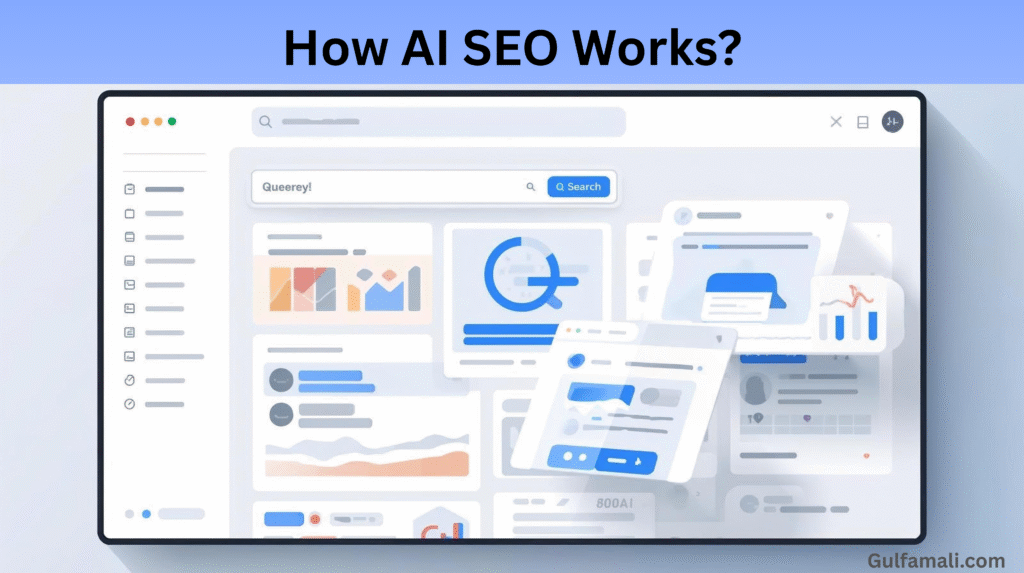
Modern search engines rely on AI-driven ranking systems to evaluate relevance at scale.
They analyze language patterns, topic relationships, and content quality across millions of pages.
Modern search engines rely on AI-driven systems to evaluate relevance and content quality at scale, as explained in Google’s documentation on how Google Search works.
This process happens automatically through data analysis and automated learning.
How Search Engines Understand Queries
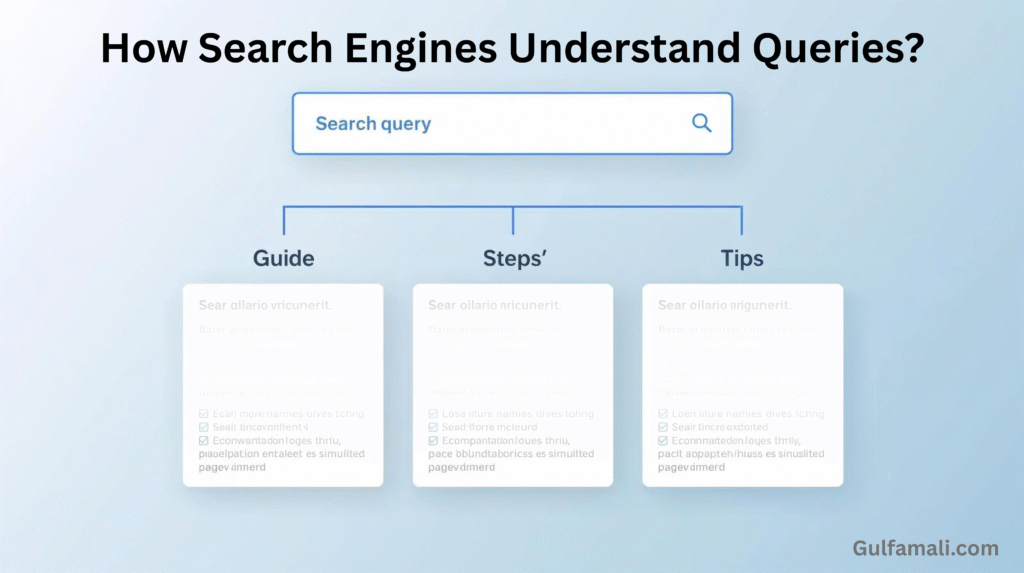
When a user searches, AI systems analyze search intent and user intent.
They try to understand what the user actually wants, not just the words typed.
For example, when someone searches for “how to write a blog post,” AI systems determine whether the user wants a beginner guide, step-by-step instructions, or writing tips. Pages that clearly match the intent tend to perform better than pages that simply repeat keywords.
How AI Understands Content
AI evaluates content through contextual understanding and semantic meaning.
It also uses entity-based search to connect related ideas within and across pages.
This allows search engines to understand topics as a whole, not as isolated words.
Role of Machine Learning and Language Processing in SEO
AI SEO depends on systems that learn from data and language patterns.
These systems improve relevance and result quality over time.
Machine Learning in SEO
Machine learning helps search engines recognize patterns and adjust relevance signals.
Through automated learning, ranking systems adapt based on real user interactions.
Natural Language Processing in SEO
Natural language processing enables deeper language understanding.
Content is interpreted based on meaning and context, not exact phrasing.
Search engines use natural language processing to interpret content based on meaning and context rather than exact word matching.
AI SEO vs Traditional SEO (Simple Comparison)
Both approaches aim to show relevant content.
The difference is how relevance is determined.
Traditional SEO Approach
Traditional SEO focused on keyword usage and rule-based optimization.
Most adjustments were manual and formula-driven.
AI-Driven SEO Approach
AI-driven SEO focuses on context, meaning, and content relevance.
Search engines rely on intelligent ranking systems to evaluate usefulness.
Traditional SEO still matters, but it works best when aligned with how AI systems interpret intent and meaning.
Why AI SEO Matters for Websites Today
AI SEO affects how content is discovered, evaluated, and ranked.
Search engines aim to improve the overall search experience.
Improving Search Results Quality
AI prioritizes helpful content and information accuracy.
This improves trust and result quality for users.
Supporting Modern SEO Goals
AI SEO supports topical relevance, topic clusters, and content depth.
It rewards websites that explain topics clearly and completely.
Practical AI SEO Basics for Beginners
You do not need advanced systems to apply AI SEO principles.
Focus on clarity and structure.
Step 1: Understand Search Intent
Identify what the user wants to learn or solve.
This is the foundation of AI-based search optimization.
Step 2: Create Clear, Helpful Content
Focus on content quality and logical structure.
Use clear headings and explain ideas step by step.
Step 3: Build Topical Coverage
Cover a topic fully instead of publishing isolated pages.
This improves topical relevance.
Step 4: Maintain Accuracy and Context
Ensure information accuracy and avoid thin content.
Context helps search engines trust your content.
Real-World Examples of AI SEO in Action
AI SEO is visible in how content is evaluated and connected.
Blog Content Example
AI evaluates whether content fully explains a topic and answers related questions.
Two articles may target the same topic. One is short and keyword-focused. The other explains the topic clearly, uses structured headings, and answers common questions. AI-driven systems tend to favor the second article due to better contextual understanding and content depth.
Website Optimization Example
Internal linking helps AI connect related topics across a website.
This strengthens topical relevance and content relationships.
Common AI SEO Mistakes Beginners Make
Many beginners misunderstand how AI SEO works.
- Treating AI SEO as a tool instead of a concept
- Keyword stuffing
- Ignoring search intent
- Writing shallow or incomplete content
- Copying competitors without understanding context
- Over-optimizing headings
- Chasing algorithm updates instead of clarity
Future of SEO with AI (Beginner Perspective)
AI will continue to influence how search engines work.
The change is gradual, not sudden.
What Is Likely to Change
Search systems will become smarter.
They will better understand content and intent.
What Will Not Change
Helpful content will always matter.
SEO fundamentals remain important.
Conclusion
AI SEO is about helping search engines understand meaning, intent, and relevance.
It shifts SEO away from keyword tricks toward clarity and usefulness.
For beginners, the best approach is learning SEO step by step and creating content that genuinely helps users.
About the Author
Gulfam Ali is an SEO specialist with over 7 years of experience in search engine optimization, with a strong focus on Technical SEO and organic growth. He has worked with businesses across multiple industries, managing SEO projects for clients in different countries and helping them improve Google rankings, increase organic traffic, and achieve sustainable growth.
His work includes contributions to international platforms, reflecting a strong understanding of high-quality content and SEO best practices. As the founder of GulfamAli.com, he helps businesses worldwide grow through structured SEO strategies, ethical practices, and performance-driven results.