

This guide explains how AI understands content in simple terms. You will learn how AI reads text, understands meaning, and interprets intent beyond keywords. This guide is for writers, SEOs, bloggers, and site owners who want their content to be clearly understood by modern search systems.
If you are looking for tools or software comparisons, this guide is not for that purpose.
Quick Answer: How AI Understands Content
AI understands content by analyzing meaning, context, and intent, not just individual words. It breaks text into smaller parts, studies patterns in language, and predicts meaning based on what it has learned from large amounts of data. AI does not think like humans. It recognizes patterns and probabilities to interpret written content.
AI understands content when it is clear, structured, and focused on meaning.
Context matters more than keywords.
Writing for humans first is the most reliable way to make content AI-friendly.
How AI Reads and Understands Text
When we say AI “reads” content, it does not read like a human.
It processes written text using structured analysis at scale.
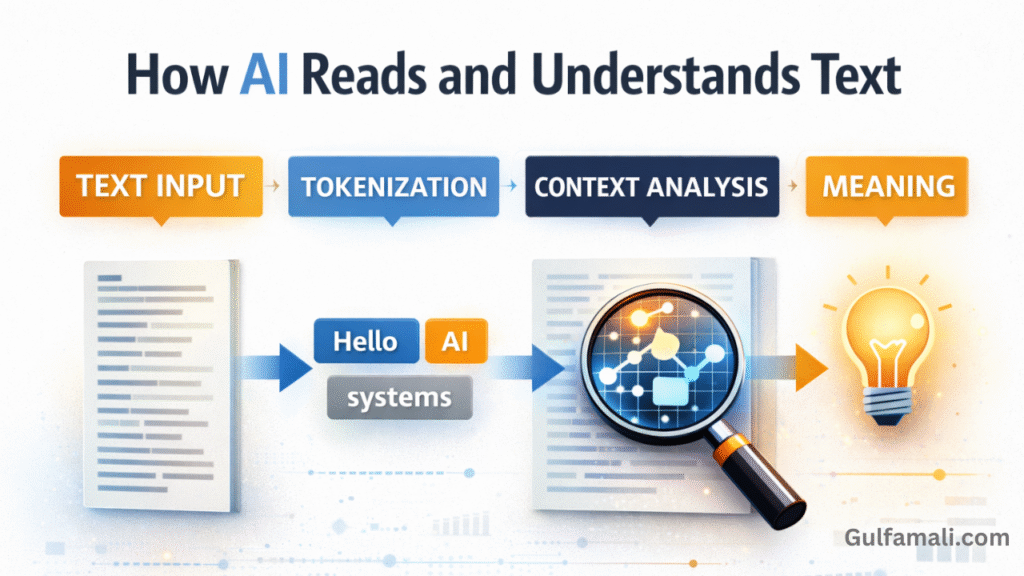
AI systems break text into tokens, which can be words or parts of words. From there, AI analyzes how these tokens relate across sentences and sections.
A simple flow diagram can help visualize this process from text input to meaning interpretation.
From Words to Meaning
AI does not treat words as isolated items.
It looks at sentence structure and relationships between words.
Meaning comes from how words work together, not from exact matches. This is why two different sentences can express the same idea and still be understood correctly.
Why Context Matters More Than Keywords
Context tells AI what a sentence is really about.
The same word can mean different things depending on surrounding text.
AI studies nearby sentences to understand intent. This helps it decide whether content is explanatory, instructional, or informational.
How AI Understands Human Language
AI understands human language through natural language processing.
This allows systems to analyze grammar, structure, and meaning together.
Language models are trained to understand how people actually write and communicate.
AI understands human language through natural language processing, which allows systems to analyze grammar, structure, and meaning together.
Learning From Large Amounts of Text
AI learns by studying very large collections of written content.
This training data helps AI learn how language is used in real situations.
By learning from examples, AI improves its understanding over time.
Recognizing Patterns in Language
AI identifies patterns in sentence structure and phrasing.
It learns which word combinations usually appear together.
This pattern recognition helps AI predict meaning more accurately.
How AI Analyzes Content Step by Step
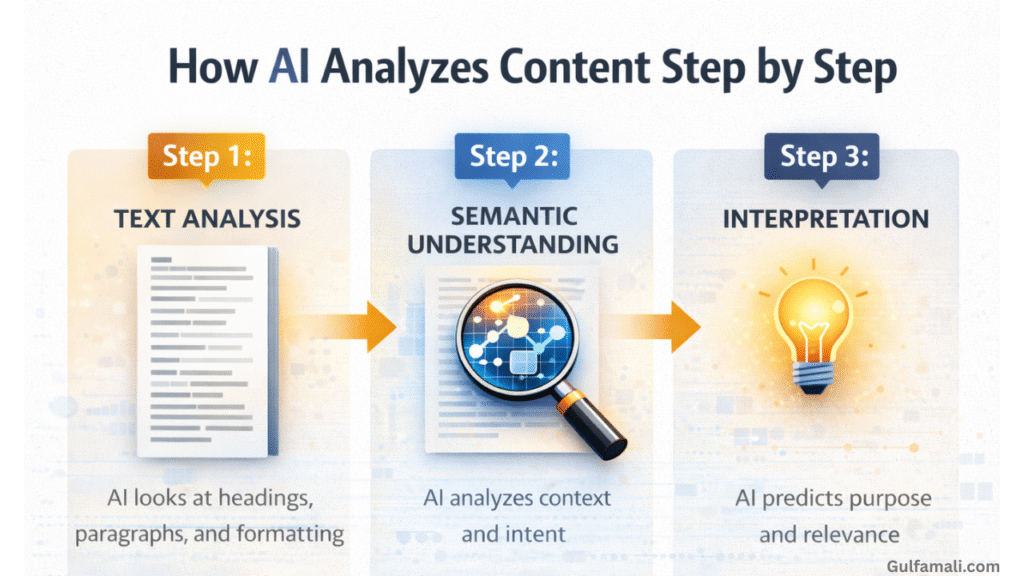
AI follows a consistent process to understand content.
This process can be explained clearly.
Step 1: Text Analysis
AI first breaks content into smaller parts.
It looks at headings, paragraphs, and formatting.
Clear structure makes it easier for AI to identify important information.
Step 2: Semantic Understanding
Next, AI focuses on meaning.
It analyzes context and intent rather than surface-level wording.
This step connects related ideas across sections.
Step 3: Prediction and Interpretation
Finally, AI predicts the most likely meaning.
It uses probability to interpret purpose and relevance.
This is how AI decides what the content is really about.
How AI Understands Blogs and Articles
Blogs and articles provide more context than short text.
This helps AI understand topics in depth.
Topic Understanding and Structure
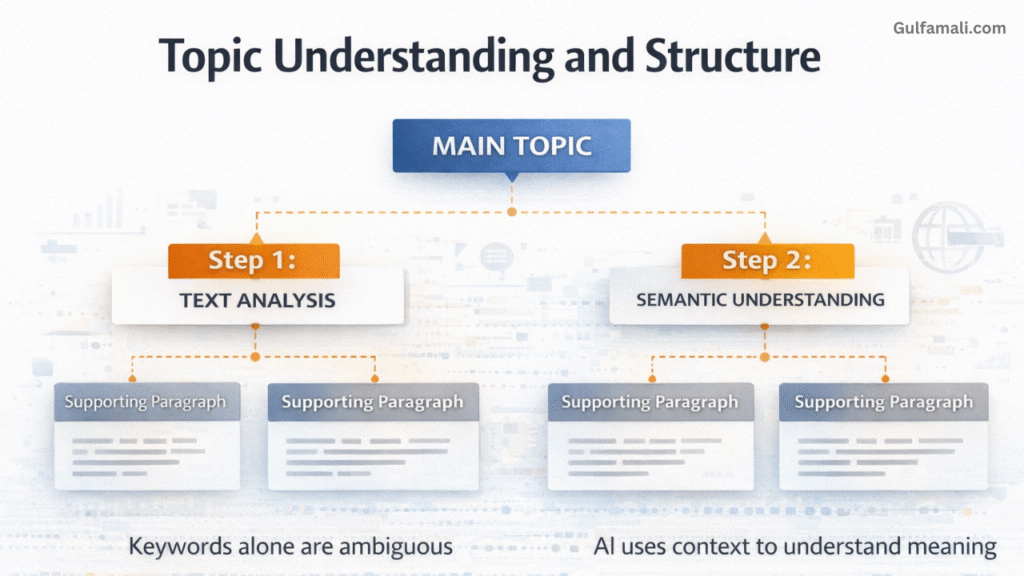
AI prefers one clear topic per section.
Logical headings guide AI through the article.
A simple structure diagram can visually show how sections support one main topic.
Entities and Relationships
AI identifies people, places, and concepts.
It then analyzes how these entities relate to each other.
Strong relationships between ideas improve clarity and interpretation.
Practical Framework: Writing Content AI Understands
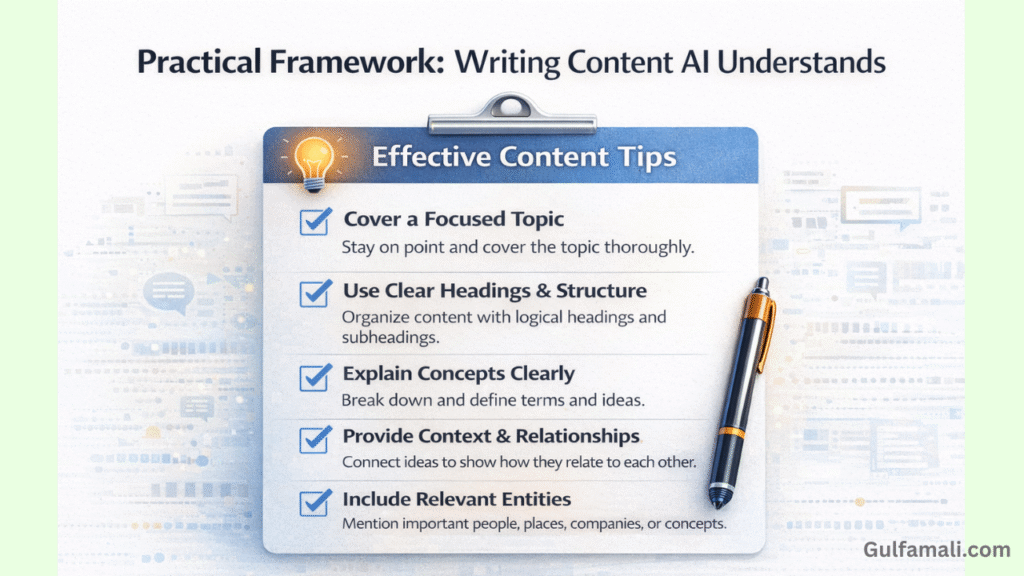
The best way to write for AI is to write clearly for humans.
Step-by-Step Framework
- Write for humans first
- Keep one clear idea per section
- Use simple language
- Structure content logically
- Explain ideas before expanding
Quick Checklist for AI-Friendly Content
- Clear topic focus
- Logical headings
- Simple sentences
- Context before details
- Helpful explanations
Real-World Examples of AI Content Understanding
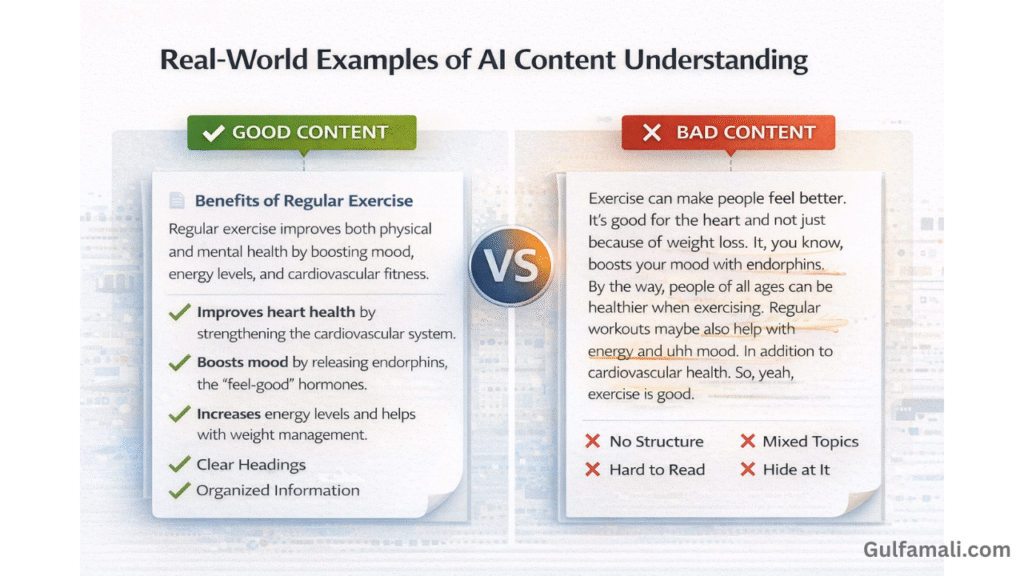
A clear paragraph explains one idea with enough context. AI understands it easily.
An unclear paragraph jumps between ideas. AI struggles to interpret intent.
A structured article uses headings and flow.
An unstructured article lacks signals and creates confusion.
Meaning-focused writing improves understanding.
Keyword-stuffed content creates mixed signals.
Common Mistakes That Confuse AI
Writing only for keywords removes meaning.
Mixing multiple topics weakens clarity.
Weak structure hides important ideas.
Overly complex language adds noise.
Repetition without purpose confuses interpretation.
Ignoring context limits understanding.
These issues help explain why some websites never appear in AI answers, even if they rank in traditional search results.
Where AI Can Misunderstand Content
AI struggles with vague or ambiguous writing.
Sarcasm and implied meaning are often misinterpreted.
Low-context or incomplete information creates gaps.
Conflicting signals reduce accuracy.
AI relies on probability, not human judgment.
How Search Engines and AI Models Understand Content Differently
Search engines and AI models use different approaches.
Search Engine Understanding
Search engines focus on indexing and ranking.
They evaluate relevance, structure, and usefulness.
Internal linking and clear topic signals support this process.
Search engines evaluate relevance, structure, and usefulness based on signals that help explain how Google understands content beyond keywords.
AI Model Understanding
AI models focus on generating responses.
They predict meaning based on learned language patterns.
Their goal is interpretation, not ranking. This also affects how AI systems choose sources when generating answers instead of just ranking pages.
AI Content Understanding vs Traditional Keyword Matching
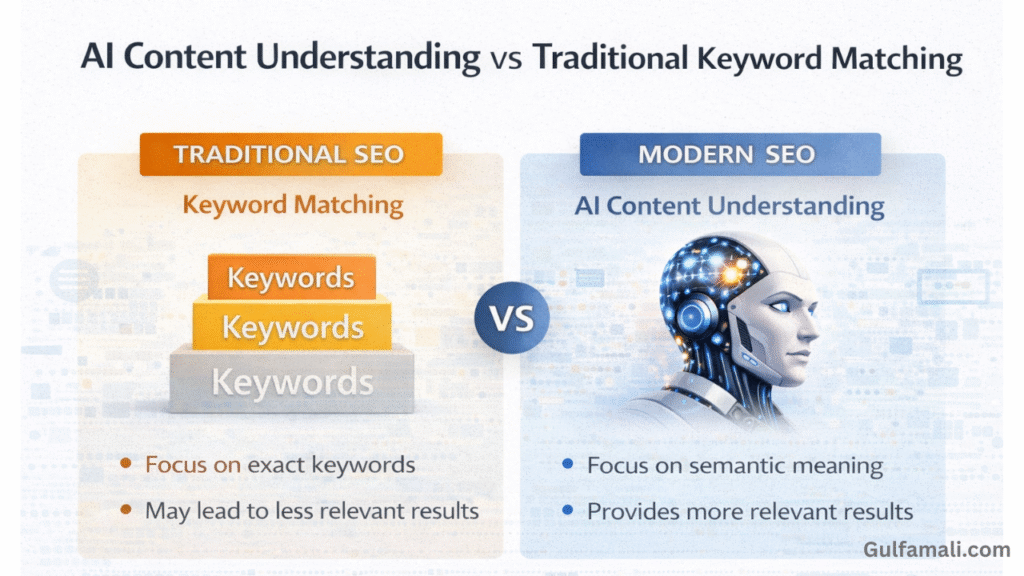
Content understanding has evolved beyond keywords. This shift clearly shows the difference between AI SEO vs traditional SEO, where meaning replaces simple keyword matching.
Traditional Keyword-Based Systems
Older systems relied on exact word matches.
Context played a limited role.
AI-Based Understanding
Modern systems focus on meaning and intent.
Language interpretation is deeper and more flexible.
Frequently Asked Questions
How does AI understand content in simple words?
AI looks for patterns in language to understand meaning and context.
Does AI understand meaning or just keywords?
AI focuses on meaning, not keywords alone.
How does AI read long articles?
It analyzes structure, sections, and relationships between ideas.
What helps AI understand written content better?
Clear structure, simple language, and strong context.
Can AI misunderstand content?
Yes, especially when writing is vague or unclear.
How can writers make content easier for AI to understand?
By writing clearly, staying focused, and explaining ideas simply.
Is writing for humans enough for AI?
Yes. Human-first writing is also AI-friendly.
Conclusion
AI understands content through meaning, context, and structure. Clear, human-focused writing works best for interpretation. When content is simple, organized, and helpful, both readers and AI understand it better.
About the Author
Gulfam Ali is an SEO and content writing expert with real-world experience optimizing content for search intent, topical authority, and AI-friendly structure. Founder of Gulfamali.com & Rankstraight.com.