
Two months ago a SaaS founder sent me an email with a question I hear more and more in 2026.
“Is AI SEO real? And if it is, why is my website not showing up anywhere in AI search when my competitors are?”
He was not panicking. He was genuinely confused. His business was solid. His product worked. He had been doing SEO for two years. Publishing content. Building backlinks. Optimizing meta titles. Everything the standard playbook told him to do.
But his customers were using ChatGPT and Google AI Overviews to find solutions. And every time they asked, AI recommended someone else.
I agreed to a 30 minute Zoom call. Before the call I spent time doing a full audit of his website. What I found was not surprising to me. But it would have shocked him if I had led with it.
His website had a trust problem. An expertise problem. An authority problem. And he had no idea any of those three things even existed as AI search signals.
The 30 minute call became one hour. By the end of it we had a complete strategy mapped out. Not a list of tactics. A structured system built around one goal: making his brand impossible for AI to ignore.
His content was optimized for Google’s old ranking system. Keywords in the right places. Meta descriptions written. Headers structured. But none of it was built for how AI actually evaluates a source before deciding to recommend it.
AI does not rank pages the way Google does. It selects sources. And the criteria for being selected are completely different from the criteria for ranking on page one.
He was not even ranking on Google’s first page for his main keywords. But that was almost secondary. The deeper problem was that AI systems had no clear understanding of what his brand was, what it was authoritative about, or whether it could be trusted to give accurate answers.
We rebuilt everything. Content structure. Schema validation. Page speed. Entity signals. New content written for AI extraction. Old content updated and restructured for GEO optimization.
Two months later his revenue increased by 31%, driven entirely by AI engines. Google AI Overviews. ChatGPT. Perplexity. All three started recommending his brand to people actively looking for his product.
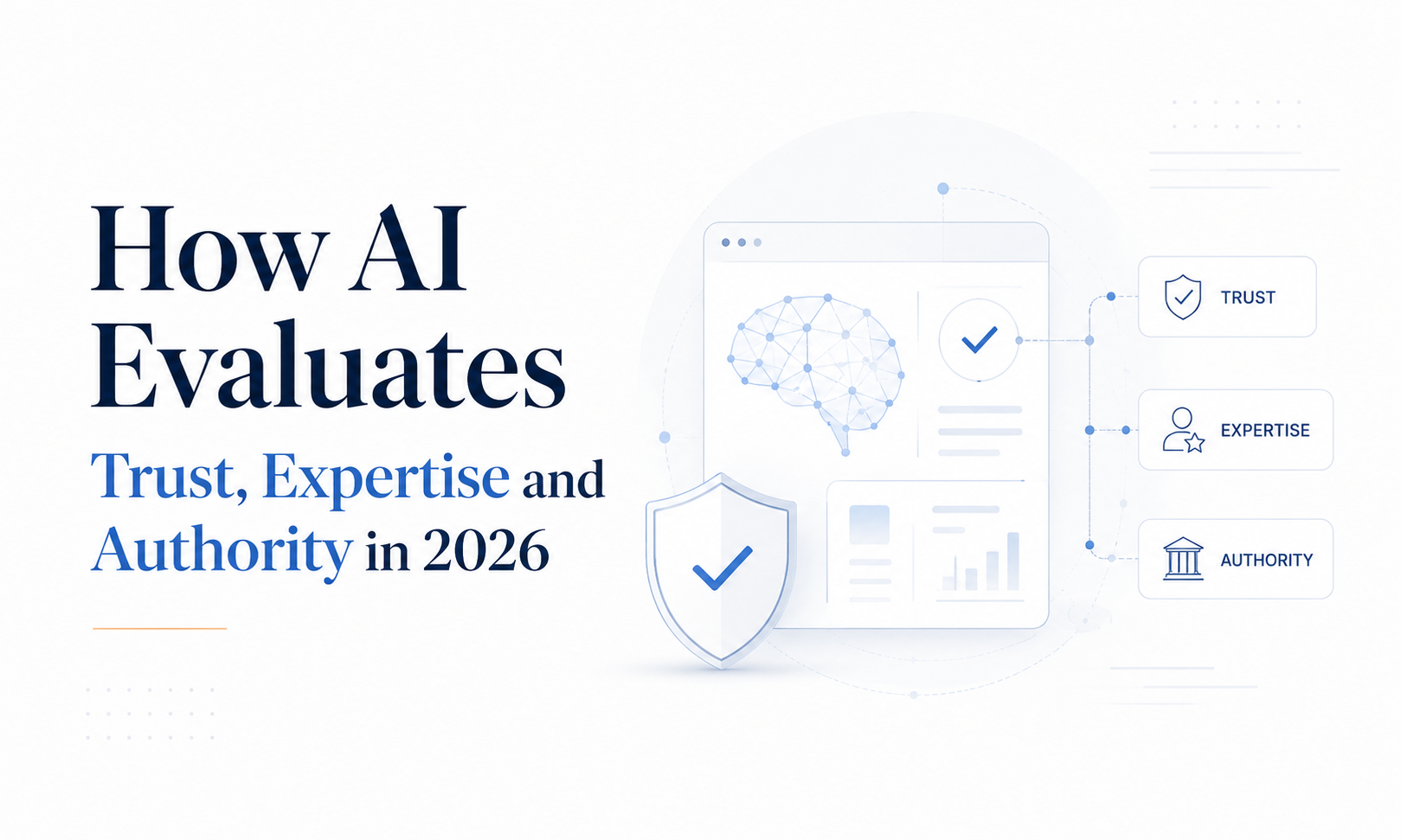
That result did not come from a single tactic. It came from understanding three things that AI search evaluates before it recommends anyone: trust, expertise, and authority.
This article explains exactly what those three things mean in 2026, how AI measures them, and what you need to do to make sure AI search is recommending you and not your competitor.
What Does AI Actually Look for Before Recommending a Business?
Most people think AI search works like Google. Find the right keywords, build enough backlinks, and you show up. That is not how it works.
When I audited that SaaS founder’s website before our Zoom call, I was not looking at his keyword density or his backlink profile. I was looking at three things that determine whether AI search recommends a business or ignores it completely.
Trust. Expertise. Authority.
These are not new concepts. Google introduced E-E-A-T, Experience, Expertise, Authoritativeness, and Trustworthiness, years ago. But in 2026, with AI systems like ChatGPT, Google AI Overviews, and Perplexity synthesizing answers rather than listing links, these three signals have become the most important factors in search visibility.
Here is the critical difference between old Google and AI search:
Google ranked pages. AI selects sources.
When someone asks ChatGPT “what is the best SaaS tool for X,” ChatGPT does not scroll through a list of ranked pages. It identifies which sources it trusts enough to extract an answer from and recommend to the user. AI models evaluate information sources based on multi-dimensional trust metrics rather than mere programmatic relevance.
That SaaS founder had decent Google rankings on secondary keywords. But AI had no reason to trust him, no evidence of his expertise, and no signals that his brand was authoritative on anything specific. So AI recommended his competitors every single time.
How Does AI Evaluate Trust in Your Content?
Trust is not a feeling. It is not a score. It is a set of specific, measurable signals that AI systems check before deciding whether your content is safe to recommend to a user.
When AI recommends a source it is putting its own credibility on the line. If ChatGPT recommends your brand and your information turns out to be wrong, misleading, or outdated, the user loses trust in ChatGPT. AI systems are designed to avoid that outcome. Which means they are extremely selective about what they trust.
Does AI Know Who You Are?
This is the first trust check and it is the one most businesses fail without knowing it.
AI systems use entity recognition to identify who is behind a website. Your brand name, your founder name, your business category, your location, your contact information, your social profiles, your structured data. All of these signals combine to create an entity profile that AI systems use to verify you are a real, identifiable source.
Entity identity establishes your organization as verifiable across platforms. Without clear entity signals AI systems cannot confirm who is responsible for the content they are being asked to trust.
The SaaS founder I worked with had scattered entity signals. His brand name appeared differently across his website, his Google Business Profile, and his social accounts. His author schema was missing. His about page gave no verifiable information about who ran the business or what their credentials were. To AI systems he was effectively anonymous. And anonymous sources do not get recommended.
The fix was systematic. We standardized his brand name and business information across every platform. Built a clear author entity with schema markup that linked his name to his expertise, his credentials, and his content history. Added a detailed about page with verifiable information. Connected his website entity to his LinkedIn profile, his Google Business Profile, and his industry mentions.
Within two weeks AI systems started recognizing him as a verifiable entity. That single fix changed how AI evaluated everything else on his site.
Is Your Information Accurate and Consistent?
The second trust check is factual alignment. AI systems are trained on vast amounts of verified information. When your content makes claims, AI cross-references those claims against what it knows to be accurate.
Content that contradicts established facts, makes unsupported claims, or contains outdated information scores poorly on trust evaluation. Content that aligns with verified data, references credible sources, and stays consistent over time scores strongly.
Consistency matters across two dimensions. First within a single page, your claims should not contradict each other. Second across your entire website, what you say on one page should align with what you say on every other page covering related topics.
The SaaS founder had inconsistency problems across both dimensions. Different pages made conflicting claims about the same topics. Older content contained outdated statistics that contradicted newer content. We conducted a full content audit, updated every outdated statistic with current verified data, and added source references to every significant claim.
Factual alignment is not just about being right. It is about being verifiably right. Every claim needs a source AI can cross-reference. Unsupported claims, however accurate, carry less trust weight than supported ones.
Does Your Site Signal Technical Trustworthiness?
The third trust check happens before AI even reads your content. Technical signals tell AI systems whether your site is maintained, secure, and professionally operated.
A slow website signals neglect. An insecure website signals risk. A site with broken links, missing pages, or poor mobile experience signals a brand that does not invest in its own digital presence. AI systems interpret these technical signals as indicators of overall reliability.
For the SaaS founder, page speed was one of the first things we fixed. Not because it was the most complex problem but because it was sending a negative trust signal on every single page before anyone read a word. Schema markup was also broken, validated schema tells AI systems exactly what each page is about, who created it, and how it relates to other content on the site. Missing or broken schema leaves AI to guess. And when AI has to guess, it defaults to caution.
Do Other Sources Trust You?
The fourth trust check is external validation. AI systems look beyond your own website to see whether other credible sources reference, cite, or mention your brand.
This is not just about backlinks. It is about the quality and context of external mentions. A mention in a respected industry publication carries significantly more trust weight than a mention in a low-quality directory.
For the SaaS founder we identified three industry publications relevant to his niche and created genuinely useful content that earned natural mentions. Not link building in the old sense. Content so specific and useful that other sources referenced it because it was the best available answer on that topic. That external validation completed the trust picture. AI systems could now verify his brand through multiple independent signals. That is when AI stopped hesitating and started recommending.
How Does AI Evaluate Expertise in Your Content?
Trust gets you in the door. Expertise determines whether you stay.
Once AI systems identify your brand as a verifiable, trustworthy entity they move to the second evaluation layer: do you actually know what you are talking about? This is where most businesses lose the competition for AI recommendations. Not because their content is wrong. But because their content is generic. And in 2026, generic content is invisible to AI search.
Does Your Content Reflect Real Experience or Just Research?
This is the most important expertise signal in 2026 and the hardest one to fake.
Experience-based content contains specific details that only come from real practice. Precise numbers from real situations. Observations about what actually happens versus what theory predicts. Nuanced caveats that only someone who has encountered edge cases would know to include.
Generic content describes processes in the abstract. It uses vague language like “it depends” without explaining what it depends on. It presents best practices without the context of when they apply and when they do not.
When I went through the SaaS founder’s content during the audit, the expertise problem was clear within the first three pages. Every article read like a summary of other articles. Accurate but containing nothing that could only come from someone who had actually worked in this space.
I asked him one question during our Zoom call: “What do your customers get wrong most often when they first start using your product?”
His answer was specific, detailed, and genuinely insightful. It reflected years of real customer interactions. None of that knowledge existed anywhere on his website. That is the expertise gap. The knowledge was there. The content did not reflect it.
We rebuilt his core content around his actual expertise. Real customer scenarios. Specific use cases from his own experience. The exact mistakes his customers made and why they made them. That content could not be replicated by a competitor. That uniqueness is exactly what makes AI systems cite it.
Is Your Content Deep Enough to Signal Real Knowledge?
Depth is the second expertise signal AI systems evaluate. Not word count. Depth.
There is a critical difference between a long article and a deep article. A long article covers a topic at surface level across many sections. A deep article covers the most important aspects of a topic with genuine detail, nuance, and completeness.
E-E-A-T functions as a quality evaluation lens not a publishing checklist. As AI output increases Google’s quality expectations have become stricter not looser. Content that is thin, misleading, or unhelpful is downgraded regardless of how it was created.
For the SaaS founder we identified the five most important questions his target audience was asking about his product category. Not the most searched questions. The most important ones. We wrote one comprehensive piece for each. Every relevant angle addressed. Every common misconception corrected. AI systems flagged those five pieces as high-expertise sources almost immediately. Within 30 days two of them were being cited in ChatGPT responses.
Is Your Content Structured for AI Extraction?
AI systems cannot cite expertise they cannot extract. And they cannot extract expertise that is buried in dense paragraphs without clear signposting. This is the structural framework that makes content extractable by AI:
• Question-based headings that match exactly how users phrase questions to AI systems. Not “content strategy” as a heading. “What is the most effective content strategy for AI search in 2026?” as a heading.
• Self-contained paragraphs that deliver one complete idea per paragraph. Each paragraph should stand alone as a citation without requiring surrounding context.
• Concise definitions followed by depth. Lead each section with a direct answer to the heading question. AI systems extract the lead answer. Human readers continue into the depth.
• Specific numbers and verifiable claims. “Many businesses see improved results” is uncitable. “Businesses that restructured content for GEO optimization saw an average 31% increase in AI-referred revenue within 60 days” is citable.
Does Your Author Entity Signal Expertise?
The fourth expertise signal sits outside your content entirely. It is your author entity, the verifiable connection between the content on your site and a real person with real credentials in the relevant field.
AI systems do not evaluate expertise in isolation. They evaluate expertise in context. Who wrote this? What is their background? What else have they written on this topic? Are they recognized as an expert by other credible sources in this space?
For the SaaS founder his author presence was almost nonexistent. No author schema. No author bio. AI systems saw expert content with no expert attached to it. We built his author entity from the ground up. Author schema on every page. A detailed bio reflecting his real experience and specific credentials. Within weeks AI systems began recognizing him as an authoritative voice in his niche.
| The Expertise Gap Most Businesses MissThe biggest expertise gap is not technical. It is not structural. It is not even about content depth. It is about the difference between what you know and what your content says you know. Most business owners have genuine expertise that never makes it onto their website. It stays in their head, in their client conversations, in their team meetings. AI systems cannot cite what is not on your website. The expertise that lives in your head is invisible to AI search. |
How Does AI Evaluate Authority in Your Content?
Trust makes AI look at you. Expertise makes AI consider you. Authority makes AI choose you over everyone else.
Authority is the final filter. It determines whether your brand becomes the source AI recommends consistently or the source AI occasionally mentions when nothing better is available. Consistent AI recommendations compound. Every citation builds recognition. Every recommendation drives traffic. Authority in AI search is not a one-time achievement. It is a compounding asset.
How Does Topical Authority Actually Work in AI Search?
Topical authority is the most misunderstood concept in AI search optimization. Most people think it means publishing a lot of content on one topic. It does not.
Topical authority means covering a topic so completely that AI systems cannot find a more comprehensive or reliable source on that subject. It means owning the topic, not just participating in it.
It starts with a pillar. One comprehensive piece of content that covers the core topic at the highest level. Around that pillar sits a cluster of supporting content. Each piece goes deep on one specific aspect of the core topic. The internal linking between pillar and cluster tells AI systems the coverage is intentional and systematic rather than accidental.
The SaaS founder’s biggest authority problem was scattered topical focus. His website covered ten different topics loosely connected to his product. None of them with enough depth to establish real authority. We identified three core topic territories his brand needed to own completely. Within six weeks AI systems began recognizing his brand as a specialist source. Optimizing for one AI search engine increasingly transfers to others because all platforms rely on overlapping trust indicators: domain reputation, structured data, and topical depth.
Does Your Brand Get Cited by Other Authoritative Sources?
Internal topical authority gets AI to recognize you as a specialist. External citation signals get AI to rank you as the leading specialist.
External citations in AI search work differently from backlinks in traditional SEO. A backlink passes domain authority through a hyperlink. An AI citation signal comes from being referenced, mentioned, or quoted by other sources that AI systems already recognize as authoritative.
Content that provides original research, named authors, and transparent methodology receives priority. Direct citations and structured attribution patterns are particularly effective for earning citations from AI systems.
For the SaaS founder we created two pieces of original research based on his actual customer data. Information that existed nowhere else because it came from his own business. Those pieces earned natural external citations from industry sources within the first month because they contained genuinely unique data.
Does Your Content Maintain Authority Over Time?
Authority is not static. It degrades if you stop maintaining it. And it compounds if you keep building it.
AI systems recognize when content has not been updated and factor that into authority evaluation. A piece of content regularly maintained, updated with current data, and expanded with new insights signals an active, committed source. A piece left untouched for a year signals a source that may no longer be reliable.
We built a simple content maintenance framework for the SaaS founder. Every core piece of content scheduled for a quarterly review. Key statistics updated when new data became available. This maintenance framework keeps the content accurate for readers and sends a continuous signal to AI systems that this brand is actively maintaining its knowledge base.
The Authority Signal Most Businesses Overlook Completely
There is one authority signal that almost every business ignores and almost every AI authority article fails to mention.
Sentiment.
AI systems do not just evaluate whether your content is accurate and well-structured. They evaluate what the broader digital ecosystem says about your brand. Reviews on third-party platforms. Mentions in industry discussions. The tone and context of how other sources reference you.
A brand with strong content signals but negative sentiment in external mentions sends a conflicted authority signal to AI systems. For the SaaS founder we identified three platforms where his target audience left reviews and built a simple process for encouraging satisfied customers to share their experience. Within two months the sentiment signal around his brand shifted measurably. Combined with the content authority, the topical depth, and the external citations, AI systems had a complete and consistent picture of a trustworthy, expert, authoritative source worth recommending.
Why Trust, Expertise and Authority Must Work Together in AI Search
Here is something most SEO articles get wrong about trust, expertise and authority.
They treat them as three separate checklists. Fix your schema for trust. Write deeper content for expertise. Build more backlinks for authority. Check three boxes. Done.
That is not how AI search works.
Trust, expertise and authority are not independent signals that AI evaluates separately and adds together. They are interconnected. Each one amplifies the others. And the absence of any one of them undermines the other two regardless of how strong they are individually.
When trust signals are broken, expertise and authority cannot be recognized. AI systems find the content, note the signals, and hesitate. That hesitation is fatal. AI systems do not recommend sources they are uncertain about. They default to the competitor with cleaner overall signals even if that competitor knows less and publishes shallower content.
When expertise is missing, trust and authority become a shell. Large established domains with decades of content and strong authority signals are losing AI citations to smaller specialist sources in 2026. Generic content that could have been written by anyone loses to genuinely expert content that could only have been written by someone with real experience in the field. High domain authority alone does not guarantee AI citations.
When authority is underdeveloped, trust and expertise produce only occasional citations rather than consistent recommendations. The content is good. AI recognizes it. But without the topical depth and external validation that builds authority, citations appear sporadically rather than compounding over time.
The Compounding Effect When All Three Align
This is what nobody tells you about trust, expertise and authority working together.
When all three signals are strong and consistent the effect is not additive. It is multiplicative.
Trust alone gets AI to look at you. Expertise alone gets AI to consider you. Authority alone gets AI to occasionally mention you. But trust plus expertise plus authority together gets AI to consistently recommend you as the primary source on your topic.
That consistency is where the compounding begins. Every consistent recommendation drives traffic. That traffic signals to AI systems that users find your content valuable. User value signals strengthen authority. Stronger authority leads to more consistent recommendations. More recommendations drive more traffic. The cycle reinforces itself.
The only strategy that produces compounding AI search results is the one that builds all three signals simultaneously with equal intention.
How to Know Which Signal Is Your Weakest
Here is the diagnostic I use with every client before building a strategy.
Trust gap indicators:
• Your brand information is inconsistent across platforms
• Your schema markup is missing or invalid
• Your page speed score is below 70 on mobile
• Your content makes claims without citing sources
• You have no clear author entity connected to your content
Expertise gap indicators:
• Your content covers topics at the same depth as your competitors
• Nothing on your site could only have been written by someone with your specific experience
• Your articles describe processes without showing the nuance of real-world application
• You have no original data, original research, or proprietary frameworks on your site
Authority gap indicators:
• Your content is scattered across many loosely related topics without a clear topical focus
• You have no pillar and cluster content structure
• External sources rarely reference or cite your brand
• Your content has not been updated or maintained consistently
• AI systems cite your competitors more often than you on your core topics
Most businesses have weaknesses across all three. But one is almost always the primary bottleneck. Fix the primary bottleneck first. Then build all three simultaneously.
How to Build Trust, Expertise and Authority for AI Search: The Practical Framework
Understanding trust, expertise and authority is one thing. Building them systematically is another. This framework is what I used with the SaaS founder. Not a theoretical checklist. A sequenced, practical system built around the reality that most businesses cannot fix everything simultaneously and need to know what to do first, what to do second, and what to measure along the way.
Phase 1: Fix the Foundation, Trust Signals (Weeks 1 to 2)
Trust is the prerequisite. Nothing else you build will be recognized by AI systems until your trust signals are clean.
Step 1: Audit and fix your entity signals
Search your brand name across Google, ChatGPT, and Perplexity. What comes up? Is it consistent? Then check every platform where your brand appears. Your website, Google Business Profile, LinkedIn, social accounts, industry directories. Your brand name, description, location, and contact information should be identical across all of them. Any inconsistency is a trust signal problem.
Step 2: Validate and rebuild your schema markup
Use Google’s Rich Results Test and Schema Markup Validator to check every core page on your site. Fix every error. Add missing schema types for your organization, your author, your articles, and your FAQ sections. Every piece of content on your site should have a named author connected to a schema profile that describes their credentials and content history. Anonymous content is low-trust content in AI search.
Step 3: Fix technical trust signals
Run your site through Google PageSpeed Insights. Target a score above 80 on mobile. Check your Core Web Vitals in Google Search Console. LCP under 2.5 seconds. FID under 100 milliseconds. CLS under 0.1. Check for broken links, missing pages, and crawl errors. A site with technical problems signals neglect.
Step 4: Add source references to every significant claim
Every statistic, every process claim, every statement that could be questioned needs a reference point AI can cross-check. This single step improves trust signals faster than almost any other action because it directly addresses the factual alignment check AI systems run on your content.
Phase 2: Rebuild for Expertise, Content Restructure (Weeks 3 to 6)
With trust signals clean, you are now visible to AI systems. The expertise phase determines whether AI considers your content worth extracting and citing.
Step 1: Extract your real expertise
Sit down and answer these questions honestly: What do your customers get wrong most often? What does everyone in your industry say that you know from real experience to be oversimplified or wrong? What have you learned from your specific work that you cannot find written accurately anywhere else? What frameworks or processes have you developed that are genuinely yours? The answers are your expertise assets. They do not exist on your website yet. They need to.
Step 2: Identify your five most important questions
Not your five most searched keywords. Your five most important questions, the ones your ideal customer needs the most complete, most accurate, most expert answer to before they can make a good decision. One comprehensive, genuinely deep piece for each question. Written with your real expertise. Structured for AI extraction. Referenced with verifiable sources.
Step 3: Restructure existing content for AI extraction
Convert topic-based headings to question-based headings. Restructure paragraphs so each one delivers one complete, self-contained idea. Add a direct answer at the top of every section. AI systems look for the clearest, most direct answer to the question the heading poses. Give it to them in the first two sentences. Then go deep.
Step 4: Add original data and proprietary insight
Create at least one piece of content built around original data. A study, a report, an analysis, a benchmark. Something that contains information AI systems cannot find anywhere else because it comes from your specific experience and your specific data. This single piece will earn more citations than ten generic pieces of content.
Phase 3: Build Authority, Topical Domination (Weeks 6 to 10)
With trust signals clean and expertise content live, the authority phase consolidates everything into a compounding system.
Step 1: Define your three core topic territories
Not ten topics. Not five. Three. Everything you publish from this point forward connects to one of these three territories. Depth on three topics produces more citations than breadth across ten topics because AI systems recognize specialist sources and reward topical depth over topical width.
Step 2: Build your pillar and cluster structure
For each of your three topic territories build one pillar piece, the most comprehensive resource available on that topic. Around each pillar build a cluster of five to eight supporting pieces. Each one links back to the pillar and to related cluster pieces. This structure tells AI systems your brand has thought about this topic from every angle and is committed to it rather than casually participating.
Step 3: Build external citations and manage sentiment
Identify five authoritative sources in your industry that AI systems already cite regularly. Create genuinely useful content specifically designed to earn mentions from these sources. Original research earns the most natural citations. Simultaneously, identify the platforms where your audience leaves reviews. Make it easy for satisfied customers to share their experience. Monitor your brand mentions using tools like Otterly or Profound and address negative signals directly.
What Are the Most Common Mistakes That Destroy Trust, Expertise and Authority in AI Search?
Most businesses do not lose AI search visibility because they do something dramatically wrong. They lose it because they do several small things consistently wrong over a long period of time. By the time they notice the problem the mistakes have been compounding for months.
Mistake 1: Optimizing for Google Rankings While Ignoring AI Search Visibility
This was the SaaS founder’s core mistake. A site optimized exclusively for traditional Google rankings will rank for keywords but remain largely invisible to AI systems. Google ranks pages based on relevance and authority signals measured primarily through links and on-page optimization. AI systems select sources based on trust, expertise, and authority signals measured through entity clarity, content depth, and citation potential. A business can rank on page one of Google for a keyword and still be completely absent from AI-generated answers on that same topic.
Mistake 2: Publishing Volume Without Depth
Publishing ten shallow articles produces less AI citation potential than publishing one genuinely deep article. The businesses struggling most with AI search visibility in 2026 invested heavily in content volume over the past two years. They have hundreds of articles. None of them are deep enough to be cited. All of them are diluting their topical authority by spreading it too thin. Twenty deep expert pieces will outperform two hundred shallow pieces in AI search every single time.
Mistake 3: Ignoring Entity Signals
This is the invisible mistake. Businesses never see it happening because there is no ranking drop, no traffic cliff, no obvious signal that something is wrong. AI systems simply pass them over silently. Brand name inconsistency across platforms is the most common problem, the website says one thing, the Google Business Profile says something slightly different, the LinkedIn page says something else. To AI systems these look like three different entities. Missing author schema and a thin about page compound the problem further.
Mistake 4: Writing for Search Engines Instead of AI Extraction
Content written for keyword placement is almost never structured for AI extraction. AI systems extract answers at the paragraph level. They look for direct, self-contained responses to specific questions. Content written to satisfy keywords buries the direct answer inside long paragraphs of context and preamble. When AI has to work to find the answer, it moves on to a source where the answer is immediately clear.
Mistake 5: Waiting Until the Problem is Obvious
AI search visibility does not disappear suddenly. It erodes gradually. Fewer citations this month than last month. Slightly less AI-referred traffic each quarter. By the time the revenue impact is obvious the erosion has usually been happening for six to twelve months. Rebuilding eroded authority takes longer than building it correctly in the first place. The SaaS founder came to me when he first noticed something was wrong. Not when his business was in crisis. That timing meant we could rebuild quickly and see results within two months. Start now. Not when it hurts.
Frequently Asked Questions About How AI Evaluates Trust, Expertise and Authority
How does AI evaluate trust in a website?
AI evaluates trust through four interconnected signals. Entity clarity, whether your brand is clearly identifiable and consistent across platforms. Factual alignment, whether your content claims are accurate and verifiable against known reliable sources. Technical signals, whether your site is fast, secure, well-structured, and professionally maintained. External validation, whether credible third-party sources reference or cite your brand. All four signals work together. Strong performance on three with a significant weakness on the fourth creates enough uncertainty that AI systems default to a competitor with cleaner overall trust signals.
What is the difference between expertise and authority in AI search?
Expertise is about the quality and depth of your content. Authority is about how consistently AI systems recognize your brand as the go-to source on a specific topic. You can have genuine expertise without authority if your content is deep and accurate but not systematically organized around a clear topic territory. You can have surface-level authority without expertise if your brand is widely recognized but your content is generic and shallow. Expertise and authority together produce consistent citations across a defined topic territory, which is what drives compounding AI search revenue.
How long does it take to build trust signals for AI search?
Trust signals can show meaningful improvement within two to four weeks when the right fixes are applied in the right sequence. Entity signal fixes, standardizing brand information across platforms, building author schema, creating a detailed about page, produce the fastest results. Technical trust signals, page speed, Core Web Vitals, schema validation, produce results within weeks of implementation. External validation signals take longer because they depend on third-party sources citing or referencing your brand. Building original research content that earns natural citations is the fastest legitimate path to external validation.
Can a small website compete with large domains for AI citations?
Yes. And this is one of the most important opportunities in AI search in 2026. High domain authority alone does not guarantee AI citations. Structure and credibility signals determine actual citation. Well-structured transparent content from a smaller specialist source is regularly cited over higher domain authority content that is poorly formatted or generic. The SaaS founder I worked with competed successfully against large established domains in his niche within two months, not because he had more backlinks but because he had cleaner trust signals, deeper expertise content, and more focused topical authority on the specific questions his audience was asking AI systems.
What type of content gets cited most by AI systems?
Four content types earn disproportionately high AI citation rates in 2026. Original research and data that cannot be found elsewhere, AI systems prioritize sources that provide information they cannot synthesize from generic content. Direct answer content structured around specific questions. Expert frameworks and proprietary processes, a named, original framework signals genuine expertise that AI systems recognize as citation-worthy. Case studies with specific results, real outcomes from real situations with real numbers are verifiable, attributable, and more useful to users than general claims.
What is the fastest way to start getting cited by AI systems?
The fastest legitimate path follows three steps in sequence. First, fix your entity signals, standardize your brand information across all platforms, build author schema on every page, create a detailed verifiable about page. This takes one to two weeks and produces faster results than any content change. Second, restructure your most important existing content for AI extraction, convert topic headings to question headings, open every section with a direct answer, make every paragraph self-contained. Third, create one piece of original research built around data only you have. One piece of genuinely original content with unique data earns more citations faster than ten restructured generic pieces.
How do I know if AI search is sending traffic to my competitors instead of me?
Search your core keywords and product category questions directly in ChatGPT, Google AI Overviews, and Perplexity. Note which brands appear in the answers. If your competitors appear consistently and you do not, you have a GEO visibility gap. Use tools like Otterly or Profound to track your brand’s citation frequency across AI platforms. Check your Google Search Console for declining click-through rates on informational queries. Ask your customers directly how they found you, an increasing proportion saying they found a competitor first through AI search is one of the clearest signals your AI search visibility needs attention.
The Bottom Line
Let me bring this back to where we started.
A SaaS founder sent me an email two months ago. Confused. Doing everything right by the old playbook. Publishing content. Building backlinks. Optimizing for Google. But watching his leads dry up month after month while his competitors were being recommended by ChatGPT and Google AI Overviews every single day.
The problem was not his product. It was not his team. It was not even his SEO. The problem was that AI search had changed the rules and nobody had told him.
Two months of focused execution. Trust fixed in the first two weeks. Expertise content live within six weeks. Authority building from week six onward. 31% revenue increase driven entirely by AI engines.
That result is not exceptional. It is what happens when trust, expertise and authority align correctly for a business that was already doing good work but sending the wrong signals to AI systems.
Most of your competitors are still optimizing for a search engine their customers are quietly moving away from. The businesses that understand this shift right now and build these three signals intentionally are building a compounding advantage that will be extremely difficult for late movers to close.
AI search is not coming. It is here. And every month you wait is another month your competitors are being recommended instead of you.
About the Author
I am Gulfam Ali, Technical SEO and GEO Specialist, and founder of GulfamAli.com.
For over 10 years I have worked with SaaS companies, AI businesses, e-commerce brands, and content-driven websites across the United States, United Kingdom, and international markets. My work sits at the intersection of Technical SEO, topical authority architecture, and GEO optimization, the three things that determine whether your brand shows up in Google, Google AI Overviews, ChatGPT, and Perplexity when your customers are searching for answers.
I do not do SEO for vanity metrics. I build structured search systems that make businesses impossible for both Google and AI to ignore and I measure success in traffic, visibility, and revenue, not rankings alone.
A few results from that work:
• US-based AI website: 591K to 4.3M organic clicks in 5 months
• US-based SaaS tool: 18% to 63% GEO visibility in 68 days
• AI SaaS platform: Zero to 3.9K organic clicks in 90 days
These are highlights. The full body of work spans over a decade, multiple industries, and businesses at every stage of growth.
If you are ready to move beyond basic SEO and build search dominance that compounds in both traditional and AI search, let us talk.