From 18% to 63% GEO Visibility in 68 Days | GEO Case Study
This is a GEO Visibility Case study.
GEO CASE STUDY
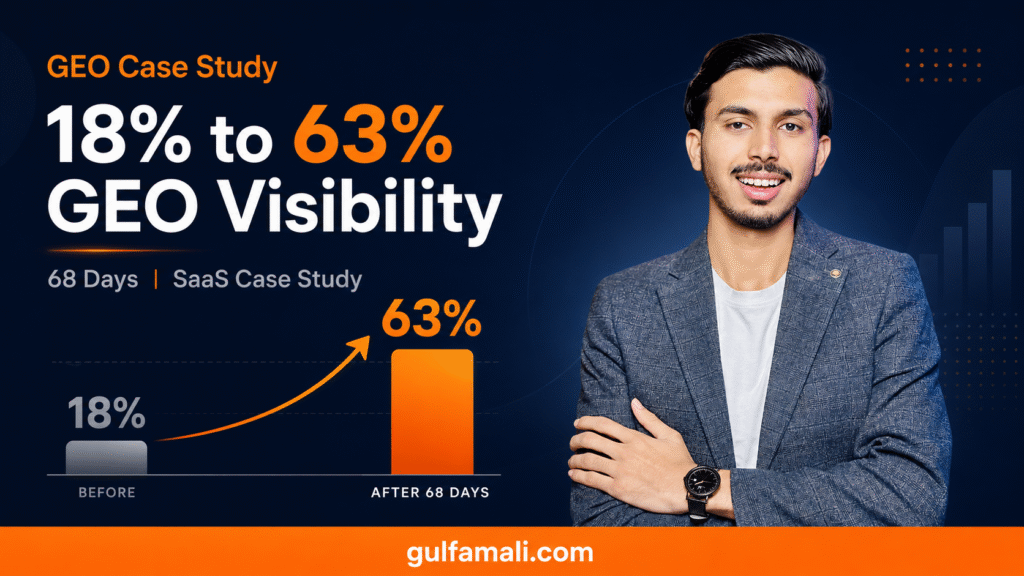
From 18% to 63% GEO Visibility in 68 Days
How a US-Based SaaS Tool Went from Invisible to AI-Recommended
Industry: SaaS (Software as a Service) Market: United States Timeline: 68 Days Strategy: 100% Organic GEO
TL;DR
| GEO Visibility: 18% to 63% — 3.5x increase in 68 days |
| Organic Traffic: 30,000 to 90,000 — 3x increase |
| Revenue: 2.1x increase |
| AI Platforms: Google AI Overviews + ChatGPT |
| Root Problem: Weak entity signals, AI could not identify the brand |
| Core Fix: GEO-optimized content restructure + citation-worthy original research |
Results at a Glance

| 3.5xGEO Visibility | 3xOrganic Traffic | 2.1xRevenue Growth | 68Days |
The Real Story
This client was not failing because they had a bad product. Their SaaS tool was solid. Their team was working hard. They were publishing content, doing keyword research, building backlinks the way every SEO guide tells you to.
But their leads were drying up. Month after month, less inbound. Less visibility. Less revenue. They could not figure out why.
When they reached out to me, the first thing I told them was this: the game has changed. And your content does not know that yet.
That is where the audit began.
The Starting Point: What the Audit Revealed
I spent 6 days on a full content and entity audit before touching a single page. What I found was not surprising to me. But it was eye-opening for them.
1. AI Could Not Identify What This Brand Was About
Their entity signals were scattered. Google and ChatGPT had no clear understanding of what this SaaS tool actually did, who it served, or why it was authoritative. When AI cannot clearly identify your brand, it does not recommend you. Simple as that.
According to BrightEdge’s AI Catalyst research, 89% of AI citations come from outside the top 10 organic results, proof that ranking position alone does not determine whether AI systems trust a source. This site had no topical authority or entity clarity to earn that trust either way.
2. Content Was Built for Old Google, Not AI Search
Every page was keyword-stuffed in the old way. Long paragraphs. No question-based structure. No self-contained answers that AI could extract and cite. The content was written for a crawler, not for an AI system trying to find the best answer to a user question.
Google AI Overviews and ChatGPT do not rank pages. They extract answers. If your content is not structured to be extracted, you simply do not exist in AI search.
3. Zero Citation-Worthy Content
Nothing on the site gave AI a reason to cite them. No original data. No unique research. No statistics that could not be found elsewhere. AI systems cite sources that provide information they cannot synthesize from generic content. This site gave them nothing to work with.
4. They Were Optimizing for a Search Engine That Was Shrinking
Here is the hard truth I shared with them during the audit: Gartner predicts traditional search engine volume will drop 25% by 2026 as users shift to generative AI assistants. Their entire strategy was built on a foundation that was actively losing market share.
They were not doing SEO wrong. They were doing the wrong SEO.
What Was the Goal?
The goal was not just more traffic. Traffic without AI visibility in 2026 is a short-term win with a long-term ceiling.
The goal was to make this SaaS brand impossible for AI to ignore. Specifically across two platforms that their target audience used daily: Google AI Overviews and ChatGPT.
That meant three things:
• AI systems could clearly identify what this brand does and who it serves
• Content was structured so AI could extract and cite specific answers
• The brand became the most authoritative source on its core topics
What We Did: The 62-Day Execution
After 6 days of audit, we had 62 days to execute. No wasted moves. Every action mapped to a specific GEO outcome.
1. Entity Clarity First
Before restructuring a single piece of content, we fixed the entity problem. We built a clear, consistent entity framework across the site: what the brand is, what it does, who it serves, and what it is authoritative about. This included structured data, consistent NAP signals, and author entity markup.
This alone started moving the needle within the first two weeks. When AI systems can clearly identify your brand, they begin considering you as a citation source.
2. Content Restructured for AI Extraction
We went through every core page and restructured it from the ground up. Question-based H2s that matched exactly how users ask questions to AI. Self-contained paragraphs that could stand alone as an answer. Concise definitions followed by deeper context.
This is not just good content structure. This is how you get extracted by Google AI Overviews. The AI needs a clean, direct answer it can pull and present. We gave it exactly that on every page.
3. Original Research and Data AI Cannot Find Elsewhere
This was the biggest lever. We created content that contained original data, proprietary insights, and researched statistics that no other source had. When AI systems are synthesizing answers, they prioritize sources that contain information they cannot get anywhere else.
We produced three in-depth research pieces in 62 days. Each one built around a core question their target audience was asking AI systems. Each one contained data and insights unique to this brand.
Within 30 days, two of those pieces were being cited in ChatGPT responses.
4. Citation-Worthy Statistics and Proof Points
Every article we produced included verified statistics, referenced studies, and original proof points formatted specifically for AI citation. Short, attributable, specific. AI systems love citing a crisp statistic. We made sure every piece had several.
5. Topical Authority Consolidation
Rather than spreading content across every possible topic, we consolidated authority around the three core themes that mattered most to their audience. Depth over breadth. This is how AI systems recognize expertise. Not by seeing you publish on everything, but by seeing you own specific territory completely.
The Results After 68 Days
| 3.5xGEO Visibility | 3xOrganic Traffic | 2.1xRevenue Growth | 68Days |
GEO Visibility: 18% to 63%
This is the number that matters most. GEO visibility measures how often your brand appears in AI-generated answers across platforms. Starting at 18%, the brand was occasionally mentioned but never as a primary recommendation. At 63%, it became a go-to citation source in both Google AI Overviews and ChatGPT responses for its core topics.
Organic Traffic: 30,000 to 90,000
A 3x traffic increase in 68 days without a single paid ad. Without a single backlink outreach campaign. Just clean content architecture and GEO optimization. This is what happens when AI starts recommending you. The traffic compounds because the citation creates trust, which creates more citations.
Revenue: 2.1x Increase
Traffic without revenue is noise. This client saw revenue more than double in the same period. Why? Because the traffic coming from AI recommendations is pre-qualified. When ChatGPT recommends your SaaS tool as the answer to someone’s specific problem, that person arrives already convinced. The conversion rate from AI-referred traffic is significantly higher than cold organic search traffic.
Why This Worked
There was no secret tactic here. No hack. No exploit.
What worked was understanding something most businesses and most SEO agencies still have not accepted: AI search does not work like Google search. It does not rank pages. It selects sources. And the criteria for being selected are completely different from the criteria for ranking on page one.
This client was invisible to AI not because their content was bad, but because their content was not built for how AI works. Once we rebuilt it with that understanding, the results followed.
Frequently Asked Questions
How is GEO visibility measured?
GEO (Generative Engine Optimization) visibility measures how frequently a brand or domain is cited or referenced in AI-generated answers across platforms like Google AI Overviews, ChatGPT, and Perplexity. Tools like Otterly.ai and Profound track this. In this case study, visibility was tracked across Google AI Overviews and ChatGPT specifically.
Can any SaaS business achieve these results?
The results depend on three things: the current state of your content, the competitiveness of your niche, and the quality of GEO execution. A business with weak entity signals and unstructured content has significant upside because the baseline is low. That was the case here. Businesses already partially optimized for AI search will see different starting points but the same directional gains.
Why did revenue increase alongside traffic?
AI-referred traffic converts at a higher rate than cold organic traffic. When an AI system recommends your product as the answer to a specific user question, that user arrives with high intent and pre-built trust. They were not browsing. They were looking for a solution and AI pointed them to you.
How long does GEO optimization take to show results?
In this case, meaningful movement began within 2 to 3 weeks of execution. The first ChatGPT citations appeared within 30 days. Full results compounded over 62 days of execution. GEO moves faster than traditional SEO because AI systems update their knowledge and citations more dynamically than Google’s crawl cycle.
What makes content citation-worthy for AI systems?
Three things make content citation-worthy: original data or research that cannot be found elsewhere, clear and extractable answer structures, and strong entity signals that establish topical authority. Generic content that rephrases what already exists online has almost zero citation potential. Original, structured, authoritative content gets cited.
My Takeaway
This project reinforced something I tell every client now: the question is no longer “where do I rank on Google?” The question is “does AI know who I am and does it trust me enough to recommend me?”
For this SaaS client, the answer went from “barely” to “consistently” in 68 days.
If your business is still optimizing exclusively for traditional Google rankings while your audience is asking ChatGPT and Google AI Overviews for recommendations, you are not standing still. You are falling behind.
AI SEO is not the future. It is what is happening right now.
Want the same results for your business?
I work with SaaS, AI, and content-driven businesses that are ready to move beyond basic SEO and build long-term search dominance in both traditional and AI search.
Reach out to discuss your project: gulfam@gulfamali.com
Explore More Case Studies
Real results. Real clients. Real strategies that work in 2026.


About the Author
I am Gulfam Ali, a Technical SEO & GEO Specialist and founder of GulfamAli.com, a results-driven SEO & GEO agency focused on scaling organic traffic for AI, SaaS, and content-driven websites.
With over 8 years of experience, I have helped businesses grow from stagnant traffic to millions of organic clicks by building structured SEO systems, implementing topical authority frameworks, and executing GEO strategies that make brands impossible for AI to ignore.