
The way people search has fundamentally changed. In 2026, AI powered search engines like Google’s Search Generative Experience (SGE), Bing Copilot, and Perplexity AI are now responsible for delivering answers not just links. If your website is not optimized for these AI systems, you are invisible to a rapidly growing segment of searchers.
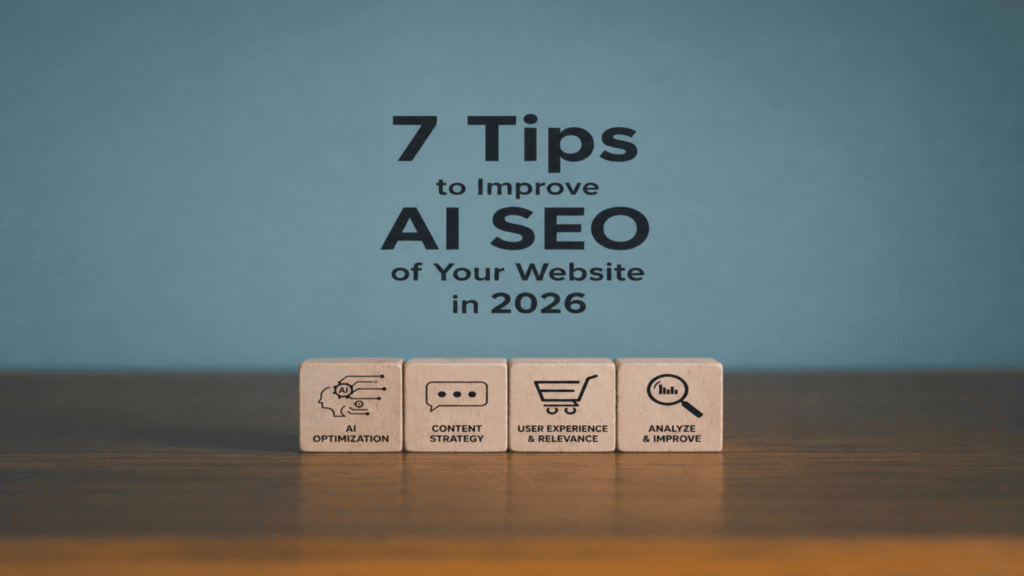
This comprehensive guide covers the 7 most powerful tips to improve AI SEO of your website right now, backed by the latest search science and practical implementation strategies. Whether you run a blog, an eCommerce store, or a business website, these tips to improve AI SEO will help you stay visible, competitive, and authoritative in the AI search era. Every website owner asking how to grow organic traffic needs to understand that tips to improve AI SEO are no longer optional they are the new standard for digital success in 2026.
Tip 1: Optimize for Semantic & Entity Based Search
The first and most foundational of all tips to improve AI SEO is to shift your thinking from keywords to entities. Traditional search engines matched exact phrases. Modern AI search engines understand meaning, context, and the relationships between concepts a discipline known as semantic search.
An entity is any clearly defined concept: a person, place, brand, product, or idea. Google’s Knowledge Graph, which now powers its AI search systems, contains billions of entities and the relationships between them. When your content clearly defines and connects entities, AI systems can accurately understand what your page is about and when to surface it.
What Entity Based Optimization Looks Like in Practice
If your page is about “AI SEO strategies,” the related entities you should naturally mention include large language models (LLMs), Search Generative Experience (SGE), Knowledge Graph, semantic indexing, structured data, crawl budget, topical authority, and E E A T. These entities signal to AI systems that your content belongs in the authoritative cluster around this topic.
You should also use co occurrence patterns placing related terms in close proximity in your text because AI systems evaluate semantic proximity, not just keyword presence. A page that mentions “voice search” within two sentences of “conversational queries” signals a stronger semantic relationship than one that mentions them in isolated paragraphs
How to Audit Your Content for Entity Gaps
Search your focus topic in Google and open the top 10 results. Identify which entities appear repeatedly across those pages these are the entities your content must also address. Use Google’s “People Also Ask” and “Related Searches” sections to find satellite entities. Add a dedicated definitions subsection that clearly names and explains your key entities. This directly feeds into AI systems’ understanding of your expertise.
Action step: Pick your three most important pages. For each one, list 15 related entities that should appear on the page. Audit which ones are missing and naturally add them to your existing content. Applying this step alone is one of the most effective tips to improve AI SEO that any website owner can act on this week.
Tip 2: Write Content That AI Systems Can Easily Extract & Cite
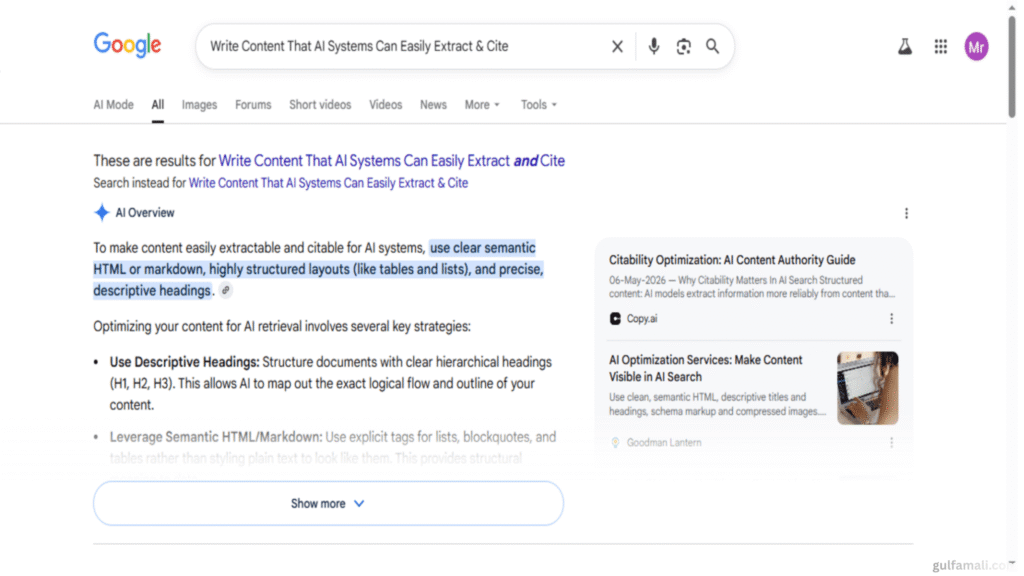
One of the most powerful tips to improve AI SEO is to engineer your content specifically for machine extraction. AI search engines scan your page, extract the most relevant passages, and use them to compose answers. Pages that structure their content to be citation ready win significantly more AI Overview placements, featured snippets, and voice search appearances.
Think of your content as a series of answer units each heading introduces a question, and the first two sentences below it directly answer that question in a complete, self contained statement. This is what AI models look for when deciding which passage to pull into a generated answer.
The Answer First Writing Framework
Every section of your article should follow this four part structure for maximum AI extractability:
- Lead with the direct answer state the answer to the section’s implied question in the very first sentence, in 25 40 words.
- Expand with context provide the supporting reasoning, data, and nuance in the following 2 3 paragraphs.
- Use structured formatting numbered lists, bullet points, and comparison tables make it dramatically easier for AI systems to parse relationships and sequences.
- Close with a takeaway a one sentence summary reinforces the answer and helps AI systems verify they captured the right information.
Content Formatting Rules for AI Era SEO
Use descriptive H2 and H3 headings that read as questions or clear topic statements. Keep paragraphs to 3 4 sentences maximum long, dense paragraphs are difficult for AI models to segment into discrete facts. Include a clear definition of your focus topic within the first 100 words of the article. Use tables to compare options, as AI systems extract tabular data efficiently and often present it verbatim in generated answers. Content formatting is one of the most underrated tips to improve AI SEO that immediately lifts your extraction rate.
Action step: Take your highest traffic article and rewrite the opening paragraph of every H2 section. Make each one a direct, standalone answer that would make sense if pulled out of context
Tip 3: Strengthen Every E E A T Signal on Your Website
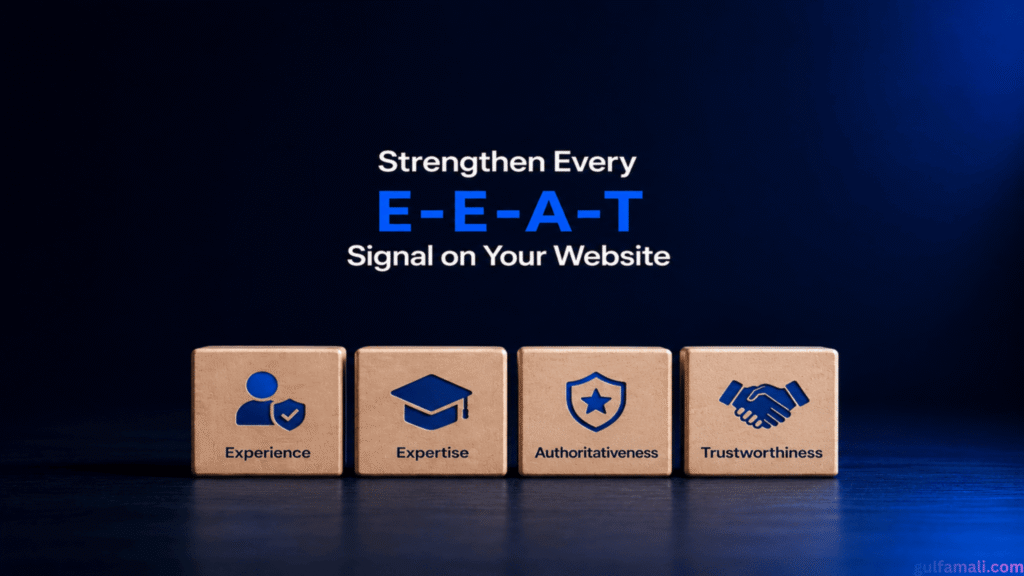
Among all the tips to improve AI SEO available in 2026, strengthening your E E A T signals delivers some of the most durable and long lasting results. Experience, Expertise, Authoritativeness, and Trustworthiness are the primary trust filters that Google’s AI ranking systems use to evaluate whether a website deserves to be cited as an authoritative source.
AI systems are trained to recognize signals of genuine expertise. They analyze not just your on page content but your entire digital footprint: your author profiles, external mentions, citation patterns, and the trustworthiness of the websites that link to you.
The Four Pillars of E E A T
Experience means demonstrating that you have personally encountered the topic not just researched it. Add first person case studies, real examples from your own work, original research data, screenshots of actual results, and client testimonials. AI systems weigh original experience signals heavily, especially in YMYL (Your Money, Your Life) topics.
Expertise is signaled through depth of knowledge and credential verification. Every key article should have an author bio with verifiable credentials, professional experience, and links to the author’s external profiles such as LinkedIn, industry publications, or academic institutions.
Authoritativeness is built through backlinks from recognized publications, citations in industry research, and being mentioned by other authoritative voices in your niche. Guest posting, press coverage, and earning links from .edu and .gov domains all strengthen this signal.
Trustworthiness requires transparent site infrastructure: a clearly accessible privacy policy, terms of service, contact information, SSL certificate, fast page speed, and a clear disclosure of who owns and operates the site.
Action step: Audit your top 10 pages for E E A T gaps. Add a verified author bio to any page that lacks one. Link every author bio to a detailed, credential verified author profile page. Add Person and Organization schema via JSON LD. This is one of the most trust building tips to improve AI SEO you can implement this month
Tip 4: Target Conversational Queries & Voice Search Patterns

One of the most overlooked tips to improve AI SEO is optimizing for how people actually speak, rather than how they type. With AI assistants like Siri, Google Assistant, Amazon Alexa, and Microsoft Copilot handling hundreds of millions of searches per day through voice, query patterns have become dramatically more conversational and question based.
Voice searches are typically 4 6 words longer than typed searches and almost always formed as complete questions. Your content must match this linguistic pattern to appear in voice search results and AI generated answers.
How to Identify and Target Conversational Queries
Use the “People Also Ask” box in Google search results every question listed is a high value conversational query target. Use AnswerThePublic or AlsoAsked.com to generate a complete map of question based queries around your topic. Check Reddit, Quora, and industry forums for the exact language real people use. Review your Google Search Console Queries report and filter for queries that begin with who, what, when, where, why, and how.
Writing for Voice Search
The ideal voice search answer is 29 43 words roughly one paragraph. Structure your content so that every FAQ question has a direct answer within this 30 40 word window, followed by 2 3 supporting paragraphs for users who want to read more. This two layer structure serves both voice search and in depth reading simultaneously. Understanding voice search behavior is one of the most relevant tips to improve AI SEO for websites targeting mobile and smart device users.
Action step: Add a dedicated FAQ section to every major article on your site. Write each question as a real conversational query and each answer in exactly 30 40 words. Test your page by asking the same question to Google Assistant or Siri and see whether your content is selected.
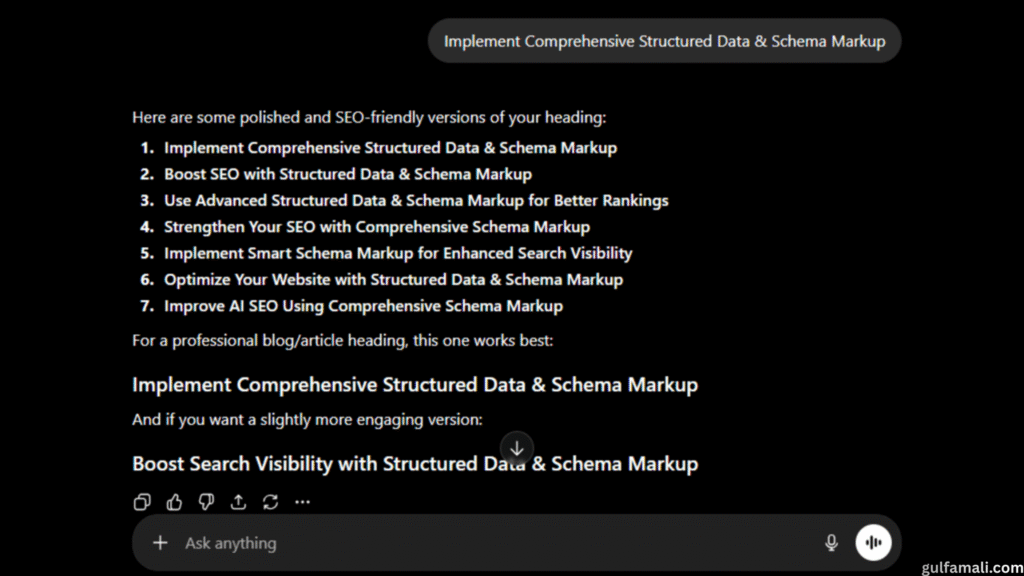
Tip 5: Implement Comprehensive Structured Data & Schema Markup
When discussing technical tips to improve AI SEO structured data and schema markup stand out as the single most impactful technical investment you can make in 2026. Structured data is the technical language that tells AI search engines exactly what your content represents, and implementing comprehensive JSON LD schema markup dramatically increases the chances of your content appearing in rich results, AI Overviews, featured snippets, knowledge panels, and voice search responses.
Schema markup does not directly change your rankings, but it provides AI systems with a precise map of your content making it far easier to extract, understand, and cite your pages accurately.
Essential Schema Types for AI SEO in 2026
- Article schema required for all blog posts and editorial content. Include headline, author, datePublished, dateModified, and image properties.
- FAQPage schema mark up every FAQ section on your site. This is one of the most frequently cited schema types in AI generated answers.
- HowTo schema use this for any step by step instructional content.
- BreadcrumbList schema helps AI systems understand your site’s information hierarchy.
- Person schema on every author profile page, establishes author credibility as a verifiable entity.
- Organization schema on your about page, establishes your brand in the Knowledge Graph.
- AggregateRating schema for products and services, surfaces trust signals in AI generated answers.
Always validate your schema using Google’s Rich Results Test before deploying. Monitor performance in Google Search Console’s Enhancements section to catch and fix errors as they appear.
Action step: Audit your top 20 pages in Google Search Console for schema errors. Add FAQPage schema to every page with a FAQ section and Article schema with all required properties to every blog post. Schema implementation is one of the fastest technical tips to improve AI SEO with measurable results.
Tip 6: Optimize Specifically for AI Overviews & Featured Snippets
Among all the tips to improve AI SEO in this guide, optimizing for AI Overviews and featured snippets delivers some of the highest visibility gains in the shortest time. Google’s AI Overviews the AI generated answer summaries that appear above organic results have become one of the most consequential positions in all of search marketing. Pages cited within AI Overviews receive dramatically higher brand visibility even when the user does not click through.
AI Overviews pull content from multiple sources and synthesize them into a single coherent answer. To be selected as one of those sources, your content must be accurate, authoritative, clearly structured, and written at the right level of depth for the query complexity.
The AI Overview Optimization Formula
Pages most frequently cited in AI Overviews share a consistent set of characteristics:
- A clear, concise definition or answer in the first 100 words of the page
- Content length of 1,500 3,000 words for informational queries
- Three or more credible external citations embedded within the content
- A published or updated date within the past 12 months
- Mobile optimized pages with Core Web Vitals scores in the “Good” range
- High engagement signals: low bounce rate, long session duration, and return visitors
Zero Click Search Strategy
A zero click search is one where the user gets their answer directly in the search results without visiting any website. While this sounds like a loss, appearing in AI Overviews and featured snippets builds significant brand authority and recall users see your brand name as the source of the answer, which drives direct searches and conversion ready traffic in later sessions. Mastering the zero click environment is one of the most forward hinking tips to improve AI SEO for brand building in 2026.
Action step: In Google Search Console, filter your impressions report for queries where you rank between positions 4 and 10. Rewrite their opening paragraphs as direct answers and add structured lists to improve extraction probability.
Tip 7: Build Unbeatable Topical Authority with Content Clusters
The final and most strategically powerful of all tips to improve AI SEO is to build genuine topical authority. AI search systems in 2026 do not just evaluate individual pages they evaluate entire websites for the depth and breadth of their coverage of a subject. A website that comprehensively covers a topic from every angle is consistently elevated across all related queries.
The content cluster model one comprehensive pillar page at the center, surrounded by a network of in depth subtopic articles is the most effective architecture for building topical authority in the AI search era.
How to Build a Content Cluster That Dominates AI Search
Step 1: Define your core topic. Your pillar page should target a broad, high volume keyword and be your single most comprehensive resource on that topic typically 4,000 6,000 words covering all major subtopics.
Step 2: Map your cluster topics. Identify 10 20 specific subtopics within your core subject. Each becomes a dedicated article of 1,500 3,000 words. For an “AI SEO” cluster, subtopics might include schema markup for AI search, voice search SEO strategies, E E A T explained, and semantic SEO techniques.
Step 3: Build dense internal linking. Every cluster article must link back to the pillar page and to at least 3 other cluster articles. The pillar page must link to every cluster article. This internal link graph helps AI systems map relationships between your content and verify topical authority. Dense internal linking is one of the most underused tips to improve AI SEO that costs nothing to implement and pays dividends for years.
Step 4: Maintain content freshness. Update your pillar page and at least 20% of your cluster articles every 6 months. Freshness is a significant ranking signal for AI systems covering rapidly evolving topics.
Action step: Choose your single most important topic. Map 12 subtopic articles. Publish or optimize 2 cluster articles per week for 6 weeks. Build all internal links as you go. By the end of this sprint, you will have a complete content cluster that dominates AI search for your subject.
Frequently Asked Questions
What is AI SEO and how is it different from traditional SEO?
AI SEO refers to optimizing website content to rank well within AI powered search systems such as Google’s SGE, Bing Copilot, and Perplexity AI. Unlike traditional SEO, which focused on keyword density and backlink quantity, AI SEO emphasizes semantic content structure, entity clarity, E E A T signals, conversational query matching, and structured data. The tips to improve AI SEO in this guide cover every one of these dimensions in practical, actionable detail.
How long does it take to see results from AI SEO strategies?
Most websites see measurable improvements within 6 to 12 weeks of implementing the tips to improve AI SEO covered in this guide, including structural content improvements, schema markup, and topical cluster strategies. Sites with existing domain authority often see results within 3 4 weeks of making targeted content changes.
What are the most important tips to improve AI SEO in 2026?
The most impactful tips to improve AI SEO are optimizing for semantic and entity based search, writing AI extractable answer first content, strengthening E E A T signals, targeting conversational and voice search queries, implementing schema markup, optimizing for AI Overviews and featured snippets, and building topical authority through content clusters.
Does keyword research still matter for AI SEO?
Yes, keyword research remains foundational but its application has evolved. Among the most practical tips to improve AI SEO is to conduct keyword research that focuses on identifying semantic clusters of related terms and entities, not just high volume head terms. You should also target conversational, long tail question phrases that match how people speak to AI assistants.
How do I get my website cited in Google’s AI Overviews?
To get cited in Google’s AI Overviews one of the most sought after outcomes of applying tips to improve AI SEO your content should include a clear, direct answer within the first 100 words, use structured formatting, demonstrate strong E E A T signals through verified authorship, implement Article and FAQPage schema markup, and maintain content freshness with regular updates.
Is technical SEO still important in the age of AI search?
Technical SEO is more important than ever, and it sits at the heart of many tips to improve AI SEO. AI crawlers need to efficiently access, parse, and index your content. Critical requirements include fast page loading speeds, mobile optimization, correct structured data implementation, a clean internal link architecture, and an accurate XML sitemap.
What is topical authority and why does it matter for AI SEO?
Topical authority is one of the most powerful outcomes of consistently applying tips to improve AI SEO It means your website comprehensively covers a subject from multiple angles, making it the go to reference that AI systems trust and consistently surface. It is built through content clusters, strong internal linking, consistent publishing, and earning backlinks from relevant, authoritative sources in your niche.
Conclusion
AI search has permanently changed how websites get discovered, ranked, and trusted online. The seven tips to improve AI SEO in this guide give you a complete roadmap from semantic content structure and E E A T signals to schema markup and topical authority clusters. You do not need to implement everything at once; start with the two tips that address your biggest current gap and build from there. Every improvement you make compounds over time, strengthening your entire site’s visibility across AI powered search. The websites that invest in AI SEO today are building an advantage that will grow stronger with every passing month.