
AI-generated answers are changing how people discover information online. Many websites, even well-optimized ones, never appear in these answers. This happens because AI understanding and AI citation are not the same thing. This article explains why websites not appearing in AI answers is becoming common, what limits AI visibility, and how AI systems decide which sources to show.
Quick Answer: Why websites are not appearing in AI answers
Most websites do not appear in AI answers because AI systems prioritize clarity, topical authority, and trust over keywords or rankings. AI may understand your content but still avoid citing it if explanations are weak, structure is unclear, or confidence signals are missing. AI-generated answers aim to deliver one clear, reliable explanation, not to credit every source.
How AI-generated answers choose which websites to cite
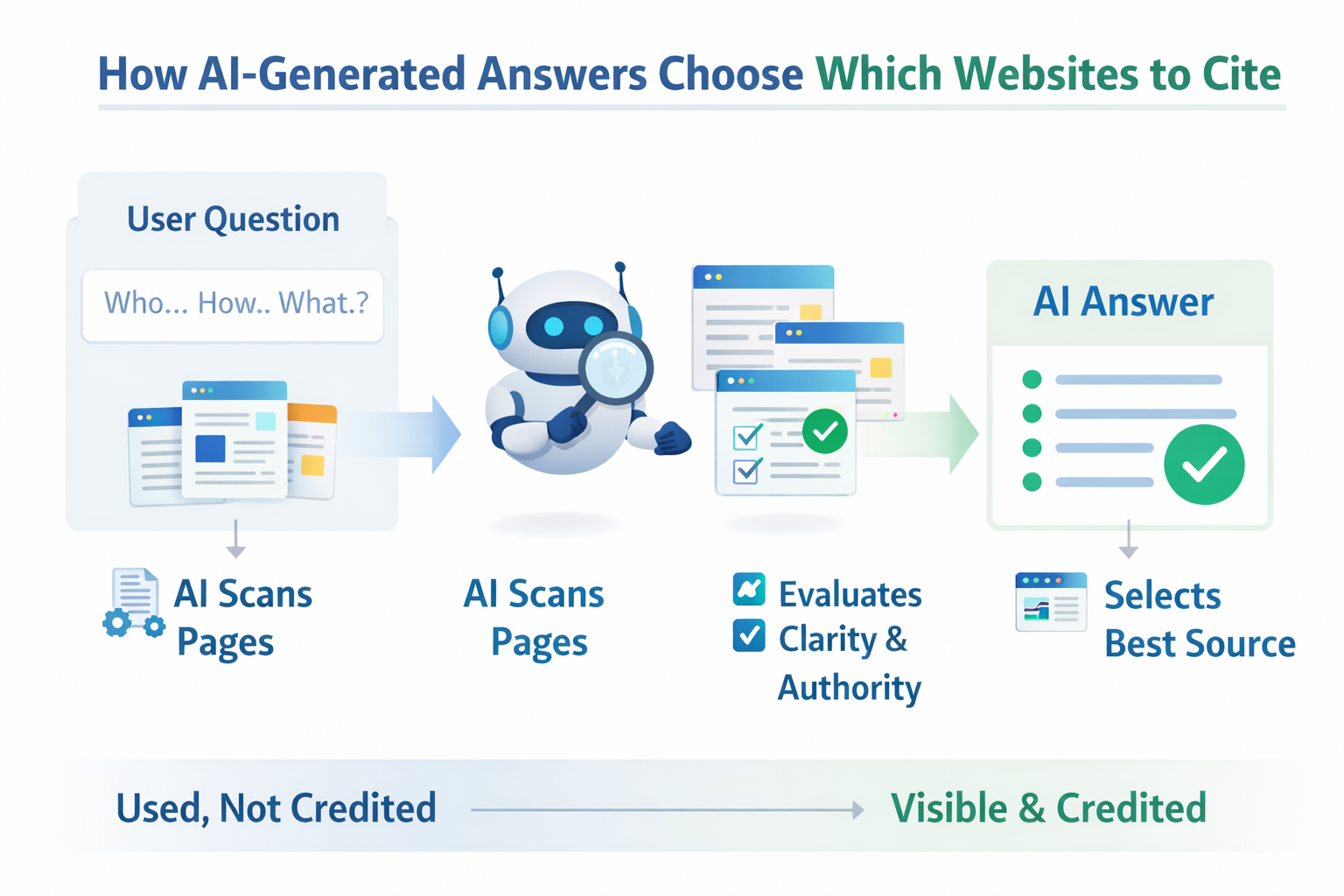
AI-powered search results are designed to reduce confusion for users. To do that, AI must limit sources and select only the clearest explanations.
Google AI Overviews summarize answers directly in search results.
How AI search engines understand content
AI search engines rely on natural language queries and semantic context. They evaluate how clearly a topic is explained and how ideas connect. Entity relationships help AI recognize whether a page actually understands a subject or is only repeating surface-level information.
Content that lacks clear explanations is harder for AI to trust.
Content Authority VS Keyword Relevance
Keywords help discovery, but authority decides selection. AI content evaluation favors topical authority in SEO over isolated keyword usage. A page that explains a topic fully often wins over multiple pages that briefly mention it.
This is how content relevance scoring works in practice.
Trust and source credibility signals
AI looks for website trust signals such as stable authorship, consistent explanations, and clear intent. E-E-A-T signals and source credibility are built when content stays accurate, focused, and aligned across the site.
Contradictions or vague claims weaken AI confidence.
Understanding VS Citing: Why AI Reads Content But Doesn’t Include Your Website
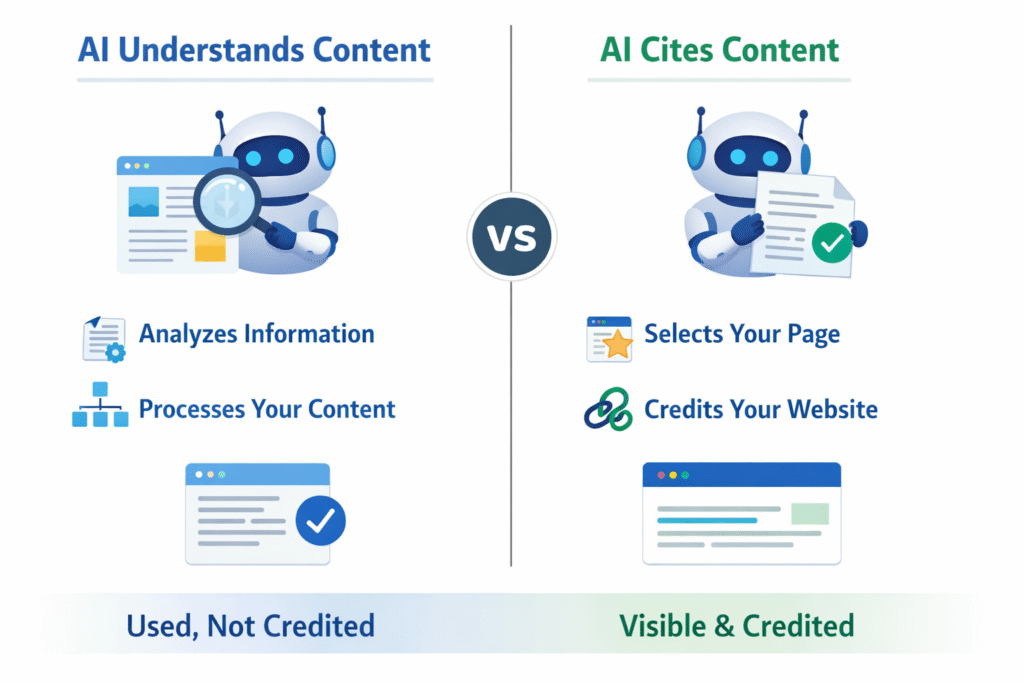
Many site owners ask why AI answers not citing my website even when rankings exist. The reason lies in summarization.
AI summarization vs attribution
Generative AI answers combine information from many sources into one response. The goal is a confident summary, not attribution. AI usually selects one strong source instead of listing several similar ones.
This is why citation is limited.
Lack of clear evidence and confidence signals
AI avoids uncertain explanations.
For example, saying “this improves SEO” is weaker than explaining why it works and how it helps. Missing definitions, unclear reasoning, or unsupported claims reduce confidence.
AI prefers explanations over opinions.
Redundant content across multiple websites
When many websites publish the same explanation, AI selects one. Others become redundant. This is a common reason for websites missing from AI results despite good quality.
Why Some Websites Never Appear In AI Answers
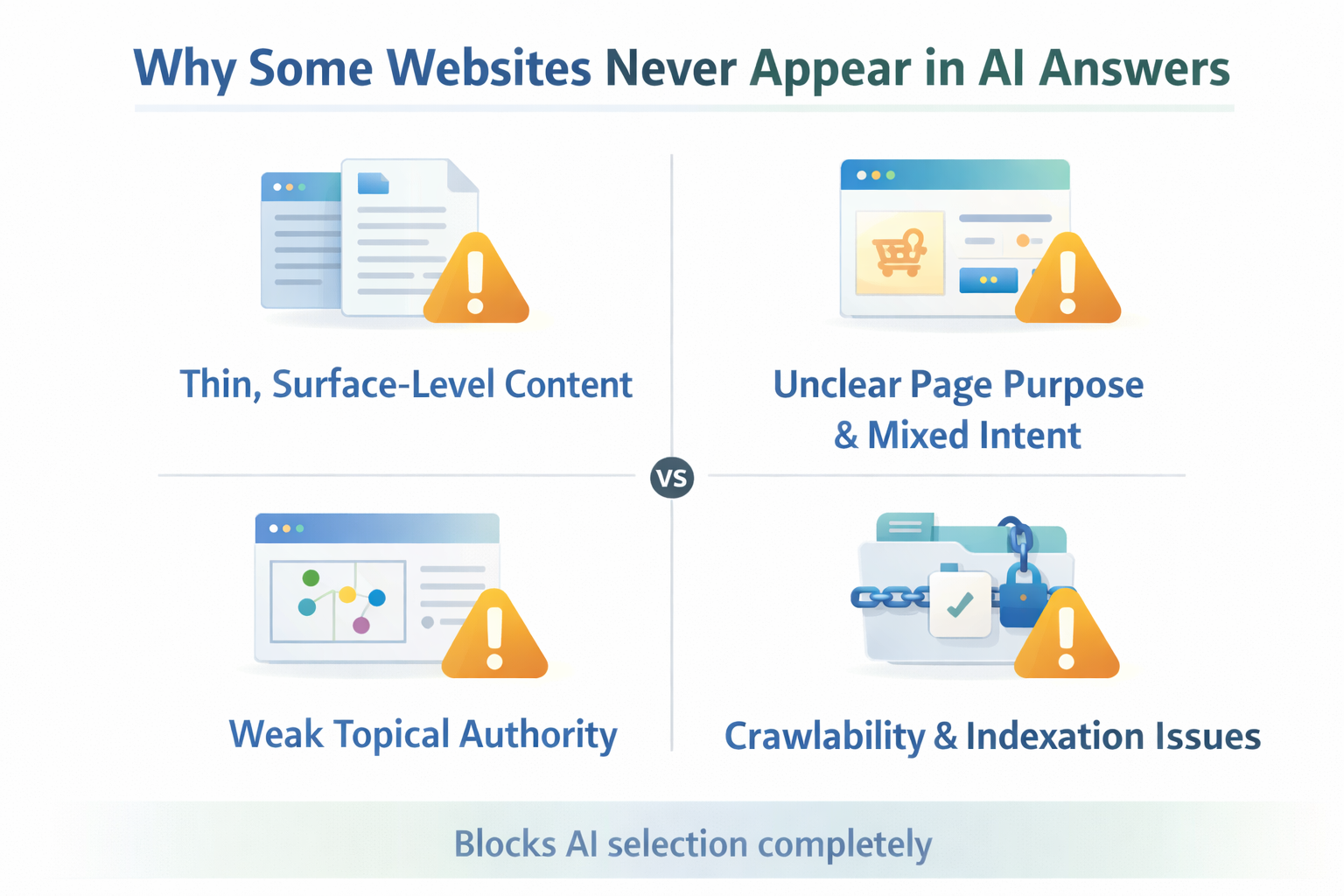
Some issues block AI inclusion entirely.
Thin, surface-level content
Thin content repeats known ideas without depth. AI search engines detect this and avoid using it in AI-generated answers.
Unclear page purpose and mixed intent
Pages that mix informational search intent with sales messaging confuse AI. If the page goal is unclear, AI avoids it.
Weak topical authority across the site
Publishing unrelated topics weakens topical authority. AI prefers sites that consistently explain one subject well.
Crawlability and indexation issues
Crawlability issues and indexation problems prevent AI systems from fully accessing content. If AI cannot reliably read a page, it cannot include it.
AI Search Visibility Issues Most Site Owners Overlook
Some problems reduce AI visibility quietly.
Poor content structure and formatting
Long paragraphs and missing logical sections make content harder to process. Structured content helps both humans and AI understand information faster.
Lack of structured content signals
Schema markup and clear formatting guide AI toward important information. Without these signals, AI must guess.
Content freshness and relevance decay
Content freshness matters. Outdated explanations reduce trust, especially in fast-changing topics.
How AI Selects Sources For Answers (Step-by-Step)
Here’s how AI selects sources for answers:
- Interpret the user’s informational search intent
- Scan multiple pages for relevance and clarity
- Evaluate topical authority at the site level
- Assess trust and consistency signals
- Compare redundancy across sources
- Select the clearest and most confident explanation
- Generate a summarized AI answer
This explains why content not picked by AI is often still “good,” just not the best match.
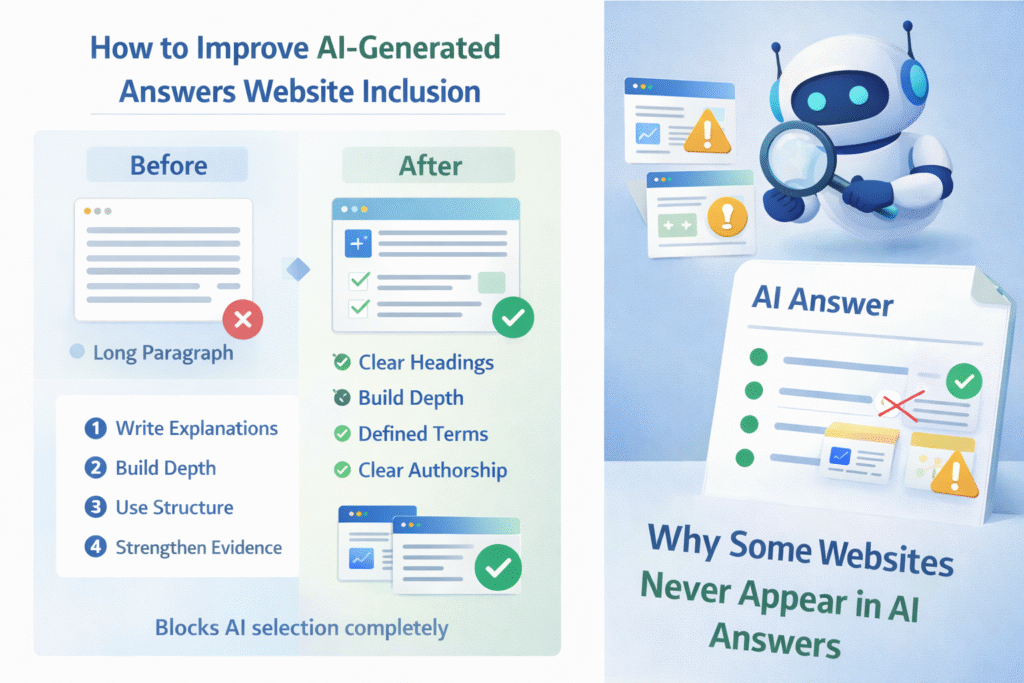
How to Improve AI-generated Answers Website Inclusion
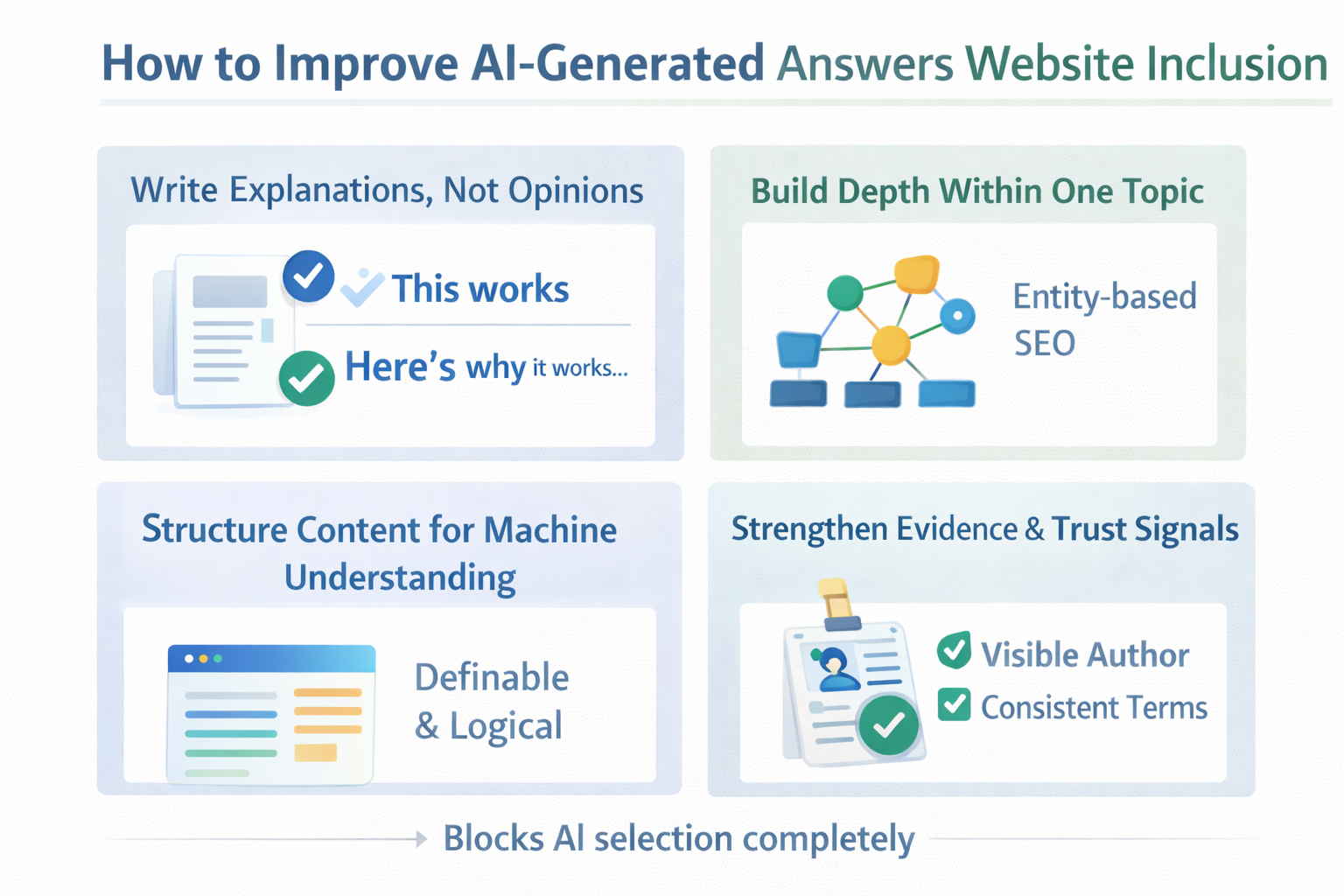
Improvement comes from clarity, not shortcuts.
Write explanations, not opinions
Define concepts before concluding.
Explaining why something works is stronger than stating that it works.
Build depth within one topic
Entity-based SEO works better than scattered posts. Cover one topic fully instead of many topics lightly.
Structure content for machine understanding
Use clear headings, short paragraphs, and logical flow. This supports semantic search optimization and improves AI comprehension.
Strengthen evidence and trust signals
Show clear authorship. Use consistent terminology. Avoid vague claims. These steps improve AI trust signals for websites.
When AI Answers Are Unlikely to Include Your Website
Some pages are rarely selected.
Purely transactional or sales-focused pages
AI avoids pages that exist only to sell.
Thin affiliate or comparison pages
Pages with little original explanation struggle with AI evaluation.
Generic content with no unique value
If the content adds nothing new, AI chooses another source.
Real Examples of Websites Missing From AI Results
Ranking blog posts not cited by AI
Some pages rank well but lack clarity. AI understands them but finds better explanations elsewhere.
High-traffic niche sites with low AI visibility
Traffic does not equal topical authority. Without depth, AI ignores them.
Business websites ignored by AI answers
Promotional content without education limits AI inclusion.
Common mistakes that cause AI to ignore websites
- Writing for keywords instead of meaning
- Publishing shallow content
- Mixing multiple intents on one page
- Ignoring structure and formatting
- No clear topical focus
- Outdated content
- Assuming rankings guarantee AI inclusion
AI Answers VS Traditional Search Results
Zero-click AI answers vs blue links
Zero-click search results aim to answer questions instantly. Visibility matters more than clicks.
Why ranking does not guarantee citation
Ranking measures relevance. AI citation requires clarity and confidence.
Frequently Asked Questions: Websites Not Appearing In AI Answers
Why is my website not showing in AI answers?
Because AI prioritizes clarity, authority, and trust over rankings.
Does ranking on Google guarantee AI visibility?
No. AI uses different evaluation signals.
How does ChatGPT choose which websites to cite?
It selects the clearest and most reliable explanation.
Why does AI read my content but not credit it?
AI summarizes information and usually credits only one source.
Can new websites appear in AI-generated answers?
Yes, if they explain topics clearly and build trust signals.
What type of content is most likely to be selected by AI?
Clear, structured, in-depth informational content.
Do AI answers replace traditional SEO?
No. SEO still matters, but clarity matters more.
How long does it take to improve AI search visibility?
It depends on content quality, structure, and consistency.
Conclusion
AI answers reward clarity, evidence, and topical authority. Many websites fail because of weak structure, mixed intent, or shallow explanations. In AI search, being clear is more important than being everywhere. Understanding how AI evaluates content is essential for long-term visibility.
About the Author
Gulfam Ali is an SEO specialist with over 7 years of experience in search engine optimization, with a strong focus on Technical SEO and organic growth. He has worked with businesses across multiple industries, managing SEO projects for clients in different countries and helping them improve Google rankings, increase organic traffic, and achieve sustainable growth.
His work includes contributions to international platforms, reflecting a strong understanding of high-quality content and SEO best practices. As the founder of GulfamAli.com, he helps businesses worldwide grow through structured SEO strategies, ethical practices, and performance-driven results.