

Google search has changed. AI Overviews now summarize answers directly on the results page.
This article explains Google AI Overviews source selection, focusing on how Google evaluates, filters, and chooses sources. It explains the process, not how to game the system.
Quick Answer: How Google AI Overviews Choose Sources
Google AI Overviews generate summaries using trusted and relevant information from across the web. Google evaluates sources based on credibility, relevance, and factual accuracy. The process is fully algorithmic, not manual. Content with clear structure, strong intent alignment, and reliable information is more likely to be selected as a source in AI Overviews.
What Are Google AI Overviews and Why Sources Matter
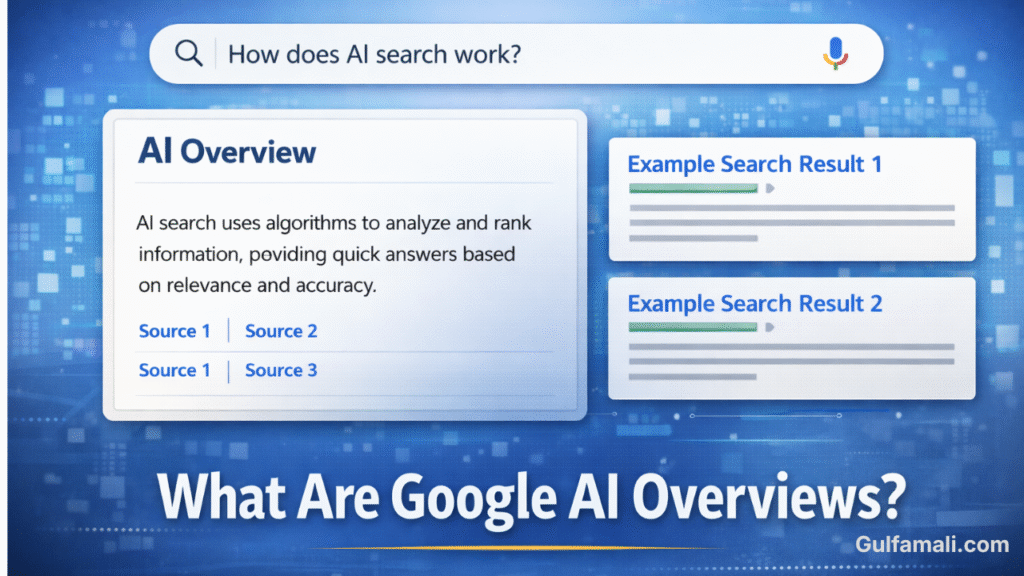
Google AI Overviews are AI-generated summaries shown at the top of some search results. Their purpose is to help users understand a topic quickly without opening multiple pages. This shift is closely connected to how modern search works, which is explained in detail in our guide on what AI SEO is and why it matters.
Because these summaries shape user understanding, source quality directly affects visibility and trust. Weak or unclear sources reduce confidence in the answer.
AI summaries differ from standard results because they focus on explanation, not exposure. This makes source evaluation a critical part of modern search.
How AI Overviews Differ From Traditional Search Results
Traditional search ranks pages and shows links. AI Overviews generate direct answers.
Instead of asking which page ranks highest, AI systems focus on which content explains the answer best. Understanding matters more than ranking position.
How Google AI Overviews Choose Sources
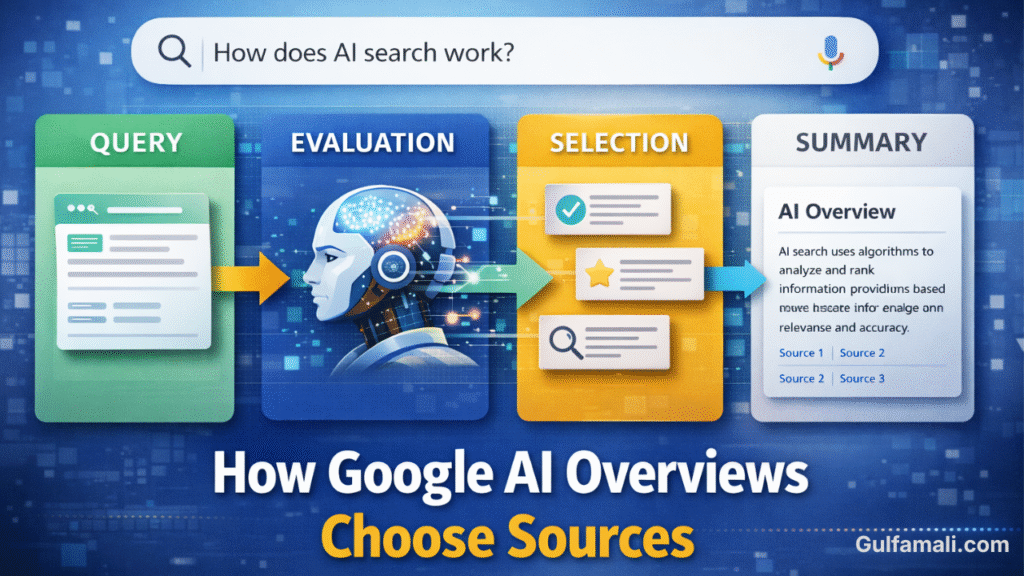
Google AI Overviews choose sources through evaluation, not manual review. The system analyzes content signals to decide which information best fits a specific query.
For a deeper understanding of how AI systems evaluate and interpret content, see this detailed breakdown of how AI SEO works in modern search.
The focus is on meaning, accuracy, and usefulness rather than SEO tactics alone.
Understanding Search Intent
AI systems analyze the intent behind a query. They determine what the user is actually trying to learn or solve.
Content that answers the question directly and clearly aligns better with this intent.
Evaluating Source Credibility
Google evaluates whether a source can be trusted. This includes expertise, consistency, and factual accuracy over time.
Sources that publish misleading or unsupported information are filtered out during Google AI content evaluation.
Content Relevance and Topical Coverage
AI favors content that covers a topic fully. Shallow explanations rarely perform well.
Consistent coverage across related subjects helps establish topical authority in AI search systems.
Key Signals Google AI Uses to Select Sources
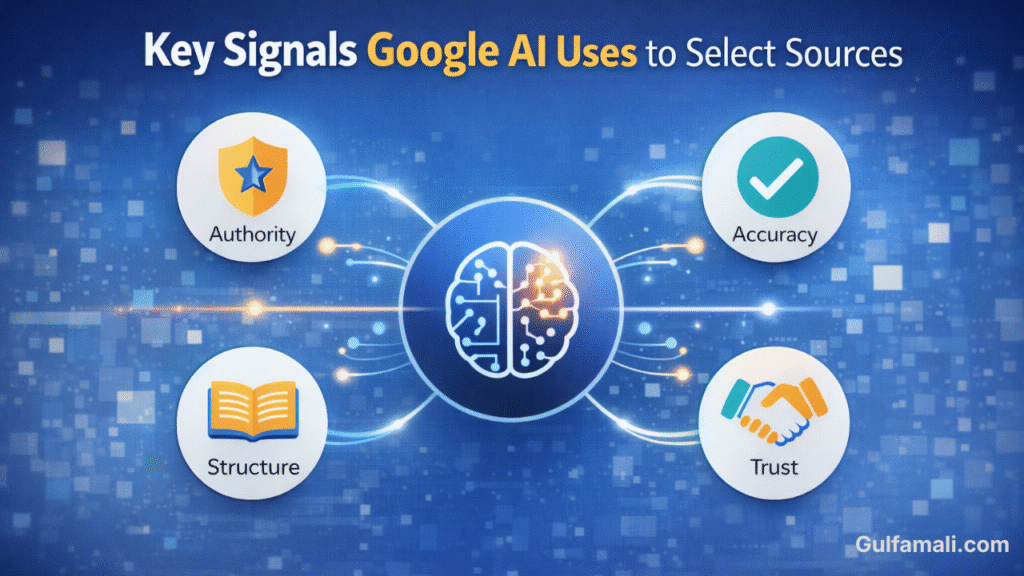
Google does not rely on a single signal when selecting sources for AI Overviews. Multiple signals work together to evaluate content quality.
These signals help determine whether information is reliable, understandable, and suitable for summarization.
Content Authority and Expertise
AI looks for clear signs of expertise. This includes who created the content and how consistently the site covers the topic.
Strong content authority signals increase the likelihood of being treated as a reliable information source.
Factual Accuracy and Clarity
Information must be correct and verifiable. AI systems reduce reliance on opinion-heavy or vague explanations.
Clear, neutral explanations perform better than dramatic or exaggerated language.
Structured and Readable Content
Well-structured content helps AI understand context. Headings, definitions, and logical flow support the Google AI summarization process.
Good structure benefits both human readers and AI-driven content selection.
How Google AI Handles Citations in AI Overviews
Not every source used by AI is shown as a citation. Citations appear when linking improves clarity or transparency.
Being used as a source and being cited publicly are two different outcomes.
Google has stated that showing sources is part of helping users verify information, a principle also reflected in documentation shared by Google Search Central.
Why Some Sources Are Linked and Others Are Not
Google applies trust thresholds when showing links. Sources that add clear value to user understanding are more likely to appear.
AI search result citations support credibility rather than reward rankings.
Practical Framework to Improve Your Chances of Being Selected
Step 1: Answer one clear question per page
Focus each page on a single problem or query.
Step 2: Demonstrate real expertise and experience
Explain concepts clearly instead of making claims.
Step 3: Ensure factual accuracy and freshness
Update content and verify information regularly.
Step 4: Use clean structure with clear headings
Make content easy to scan and summarize.
Step 5: Build topical depth across related content
Cover connected subtopics to strengthen authority.
Real-World Examples of AI Overview Source Selection
A step-by-step explainer answering one specific question is often selected over a thin or generic article.
Authority blogs usually outperform keyword-stuffed pages because they focus on understanding, not manipulation.
Well-structured educational content often performs better than list-style pages that lack explanation.
Common Mistakes That Prevent Content From Appearing in AI Overviews
- Writing vague or generic explanations reduces clarity.
- Over-optimizing for keywords weakens trust signals.
- Mixing multiple intents on one page confuses AI systems.
- Weak or missing expertise signals lower credibility.
- Poor structure limits summarization.
- Outdated or unverified information reduces reliability.
Google AI Overviews vs Traditional Search Results
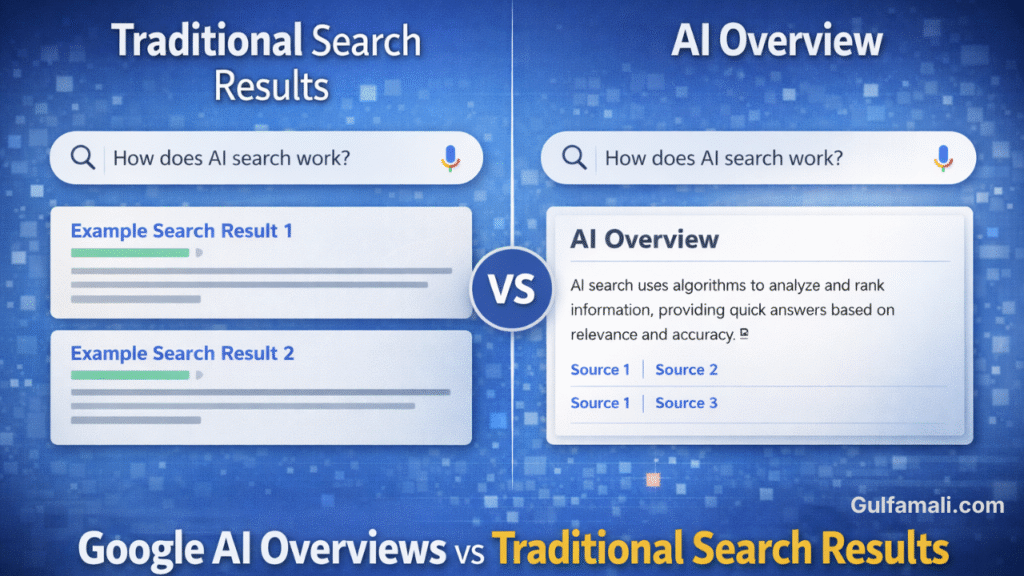
AI Overviews provide summarized answers. Traditional search displays ranked links.
AI selection focuses on understanding and explanation. Traditional ranking focuses more on relevance and authority signals.
Both systems coexist and serve different user needs.
Frequently Asked Questions
How does Google AI decide which sources to trust?
Google evaluates credibility, accuracy, and usefulness across multiple signals rather than relying on one factor.
Why doesn’t my website appear in Google AI Overviews?
The content may lack clarity, depth, or strong expertise signals, even if it ranks in traditional search.
Can small websites be selected as sources?
Yes. Smaller sites can appear if their content is accurate, focused, and clearly explained.
Does backlink strength affect AI Overviews?
Backlinks help authority, but they are not the only factor in AI Overviews content ranking.
Are AI Overview citations permanent?
No. Citations can change as content and signals are re-evaluated.
How often does Google update AI Overview sources?
Sources are updated continuously as Google processes new and updated content.
Does structured content help AI selection?
Yes. Clear structure improves understanding and summarization.
Can AI-written content appear as a source?
It can, but only if it meets standards for accuracy, clarity, and reliability.
Conclusion
Google AI Overviews prioritize trust, relevance, and clarity. Source selection is based on understanding, not shortcuts or tricks. Content written for real users aligns best with AI systems. Knowing the process helps future-proof SEO strategy.
This approach explains why Google AI Overviews source selection is driven by trust, relevance, and clarity rather than shortcuts or manipulation.
About the Author
Gulfam Ali is an SEO specialist with over 7 years of experience in search engine optimization, with a strong focus on Technical SEO and organic growth. He has worked with businesses across multiple industries, managing SEO projects for clients in different countries and helping them improve Google rankings, increase organic traffic, and achieve sustainable growth.
His work includes contributions to international platforms, reflecting a strong understanding of high-quality content and SEO best practices. As the founder of GulfamAli.com, he helps businesses worldwide grow through structured SEO strategies, ethical practices, and performance-driven results.