
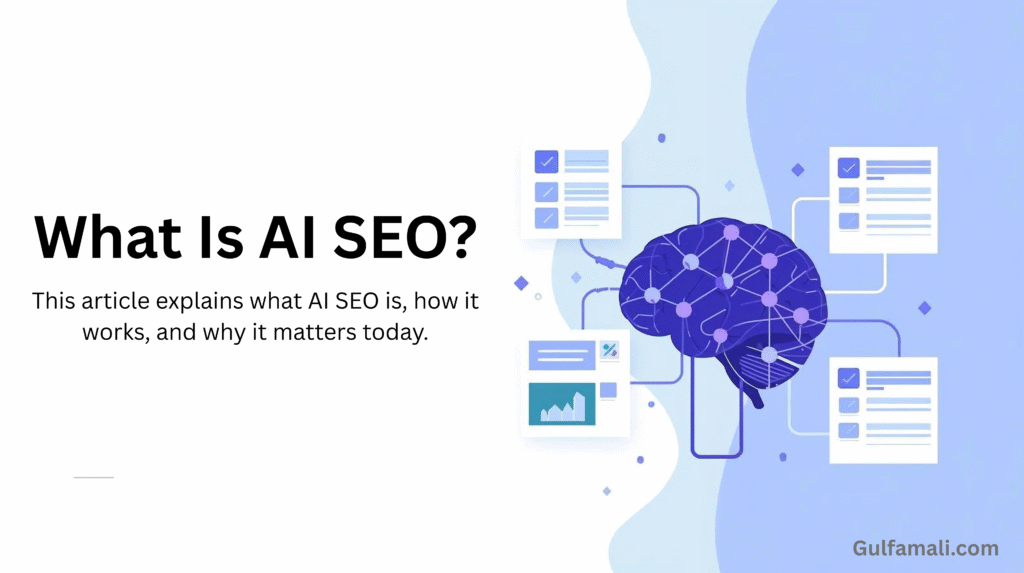
AI SEO is the practice of making your website easy for AI-powered search systems to find, understand, trust, and cite. That includes Google’s ranking systems and AI Overviews, plus answer engines like ChatGPT and Perplexity. It is still SEO. The difference is that you are optimizing to be chosen as the answer, not just to rank as a link.
I have been doing SEO since 2017. For most of that time, the game was simple: rank on page one, get the click. That game is ending.
In the first four months of 2026, 68% of Google searches in the US ended without a single click to any website, up from about 60% in 2024 (SparkToro and Similarweb data, via Search Engine Land). Google says AI Overviews alone now reach more than 2.5 billion people every month (announced at Google I/O 2026). The answer is increasingly delivered before anyone reaches your site.
This guide explains what AI SEO actually is, how it works, who it matters for, and the exact steps I use to make websites visible in AI search. No jargon, no hype.
What Does AI SEO Mean?
People use “AI SEO” to mean two different things, and mixing them up causes most of the confusion.
- Optimizing for AI-powered search. Making your content understandable and citable for systems like Google AI Overviews, ChatGPT search, and Perplexity. This is what this guide is about, and it is where the real opportunity is.
- Using AI tools to do SEO. Using ChatGPT, Claude, or tools like Semrush and Surfer to speed up research, audits, and drafts. Useful, but it is a workflow choice, not a strategy.
You will also hear GEO (Generative Engine Optimization) and AEO (Answer Engine Optimization). In practice, they describe the same goal: getting your brand inside AI-generated answers. I break down the differences in my guide on why GEO optimization matters for AI citations.
How AI Search Actually Works
Search engines have used machine learning for years. Google introduced RankBrain in 2015 and BERT in 2019 to understand the meaning of queries instead of just matching words. What changed recently is the output.
Traditional search ranks a list of pages and lets the user pick. AI search does something different. It reads many sources, writes one answer, and selects a handful of sources to back it up. That selection usually works in four stages:
- Access. The AI system’s crawler has to be able to reach your page. If your firewall, CDN, or robots.txt blocks it, you do not exist for that platform.
- Retrieval. The system pulls candidate pages from an index. Google uses its own index. ChatGPT search draws on third-party search providers, including Bing, so Bing indexing matters more than most people think.
- Understanding. The system works out what each page is about, who wrote it, and which parts directly answer the question. I explain this in detail in how AI understands content.
- Selection. It picks the sources it trusts enough to cite. This is where clear structure, consistent entity signals, and outside validation decide who wins.
Most websites fail at stage 1 or stage 3 without knowing it.
AI SEO vs Traditional SEO
AI SEO does not replace traditional SEO. It builds on top of it. Crawlability, site speed, and good content still matter for both. The difference is what you are optimizing for.
| Traditional SEO | AI SEO | |
|---|---|---|
| Goal | Rank a page in a list of results | Get cited inside the answer itself |
| Unit of competition | The whole page | A single passage or sentence |
| Main signals | Keywords, backlinks, relevance | Entity clarity, extractable answers, outside validation |
| Platforms | Google, Bing | Google AI Overviews, ChatGPT, Perplexity, Gemini, Claude |
| Success metric | Rankings and clicks | Citations, brand mentions, and qualified leads |
A page can rank number one on Google and still never appear in ChatGPT’s answer for the same question. I cover this gap in depth in AI SEO vs traditional SEO.
Why AI SEO Matters for Your Business
The cost of ignoring AI search does not show up as a sudden drop. It shows up as flat or slowly falling leads while your rankings look fine. The traffic you are losing never gets counted as lost, because the person got their answer without reaching you.
Here is what that means in practice:
- Your competitors get recommended in your place. When someone asks ChatGPT for a solution in your category, an answer gets generated either way. If your site is not citable, a competitor’s is.
- Citations compound. AI systems favor sources that are already referenced across the web. The brands building this now are making it harder for late movers to catch up.
- The leads are better. Someone who clicks through from an AI answer has already been told you are a good fit. They arrive further along in their decision.
Is AI SEO important for every business?
Honest answer: it matters most if your customers research before they buy. That covers SaaS, B2B services, agencies, e-commerce, and any business where people ask “what is the best…” or “how do I…” questions.
It matters less if you are a purely walk-in local business, like a corner shop, where Google Maps and your Business Profile do most of the work. Even then, AI assistants increasingly answer “best [service] near me” questions, so the basics still apply.
Is AI SEO worth it for small businesses?
Yes, and it may be the best opportunity small businesses have had in years. AI systems do not simply favor the biggest brand. They favor the clearest, most specific, most trustworthy answer. A small specialist with focused content and clean entity signals can be cited ahead of a large competitor with generic content.
Most of what follows costs time, not money.
The 5 Signals AI Search Looks For
After working on AI visibility for SaaS, AI, and content-driven websites, these are the five signals I check first on every project.
1. Crawler access
AI platforms use their own crawlers: GPTBot and OAI-SearchBot for OpenAI, ClaudeBot for Anthropic, PerplexityBot for Perplexity. Many sites block them by accident through Cloudflare’s AI bot settings, a security plugin, or a hosting firewall. Checking takes five minutes. On my own site, my host’s AI audit showed 259 AI crawler requests in 24 hours and zero blocked, so I knew access was not the problem and could focus on the next signals.
2. Entity clarity
Before an AI system cites you, it needs to know exactly who you are. That means the same business name, description, founder, and contact details across your website, LinkedIn, Google Business Profile, and directories, plus Organization and Person schema linking them together. Inconsistent details make you look like several different entities, and AI systems avoid sources they cannot identify with confidence.
3. Extractable answers
AI systems lift passages, not pages. Use headings that match how people actually ask questions, then answer directly in the first one or two sentences under each heading. Each answer should make sense on its own, without the paragraphs around it. I walk through the full method in how to write AI-friendly content.
4. Topical depth
AI systems trust specialists. A site that covers a few topics completely beats a site with shallow posts on dozens of topics. Fewer, deeper pages win. Overlapping posts on the same subject work against you, because neither one looks like the definitive source.
5. Outside validation
What other sites say about you matters more than what you say about yourself. Reviews on third-party platforms, mentions in industry articles, directory listings, and links from relevant publications all tell AI systems that your claims are verified, not just self-published.
How to Start With AI SEO: A 7-Step Plan
This is the order I use on client sites. Each step builds on the one before it.
- Check AI crawler access. Review robots.txt, your CDN settings (Cloudflare has a “Block AI bots” option), and any security plugin. Make sure GPTBot, OAI-SearchBot, ClaudeBot, and PerplexityBot are allowed.
- Verify your site in Bing Webmaster Tools and submit your sitemap. This is the fastest win for ChatGPT visibility, and most sites skip it.
- Make your entity consistent. Same name, description, and details everywhere. Add an About page, author bios, and Organization and Person schema.
- Consolidate overlapping content. If you have several posts on the same topic, merge them into one strong page and redirect the rest.
- Restructure your key pages. Question-based headings, direct answers first, short self-contained paragraphs, and tables for comparisons.
- Add proof only you have. Original data, real client results, screenshots, and specific numbers with sources. Generic content gets summarized without credit. Specific content gets cited.
- Track your AI visibility. Ask ChatGPT, Perplexity, and Google your customers’ real questions every month and note who gets cited. Dedicated tools can automate this once you are ready.
For a real example of this process, see how I took a US SaaS brand from 18% to 63% AI visibility in 68 days. For more on the citation side specifically, read how to appear in AI answers.
Common AI SEO Mistakes
- Blocking AI crawlers without realizing it. One setting in Cloudflare or a security plugin can make you invisible to ChatGPT and Perplexity.
- Publishing many thin posts on the same topic. Volume does not build authority. It dilutes it.
- Publishing unedited AI-written content. AI drafts are fine as a starting point. Without real expertise added, they are interchangeable with every other page and give AI systems no reason to cite you.
- Using statistics without sources. AI systems cross-check claims. Unsourced numbers reduce trust instead of building it.
- Inconsistent business details. Different names, descriptions, or experience claims across platforms make your brand harder to identify.
- Treating AI SEO as separate from SEO. Technical health, indexing, and good content are still the foundation. AI SEO is what you build on top.
Frequently Asked Questions
What is AI SEO in simple terms?
AI SEO means making your website easy for AI-powered search to understand, trust, and cite. Instead of only trying to rank as a link, you structure your content and brand signals so systems like Google AI Overviews and ChatGPT choose you as part of their answer.
Is AI SEO different from GEO?
The terms overlap heavily. GEO (Generative Engine Optimization) usually refers specifically to getting cited in generative AI answers, while AI SEO is often used more broadly. The practical work is nearly identical: entity clarity, extractable structure, and content worth citing.
Does AI SEO replace traditional SEO?
No. Traditional SEO builds the foundation AI SEO depends on: crawlability, indexing, site speed, and relevance. AI SEO adds the signals that decide whether AI systems select your content once they can see it. You need both.
Is AI-generated content bad for SEO?
Not by default. Google’s guidance focuses on whether content is helpful, not how it was produced. The problem is unedited, generic AI content that adds nothing new. Use AI for drafts and research, then add real experience, data, and examples.
How long does AI SEO take to show results?
Technical fixes like unblocking crawlers and Bing verification can help within weeks. Content and entity improvements usually show movement in one to three months. Outside validation, like reviews and mentions, builds over longer periods and compounds over time.
Can a small website compete in AI search?
Yes. AI systems favor clear, specific, trustworthy answers, not just big brands. A focused specialist site with clean entity signals and original insight can be cited ahead of much larger competitors with generic content.
How do I know if my website appears in AI answers?
Ask ChatGPT, Perplexity, and Google the questions your customers actually ask, and check whether your brand is mentioned or linked. Repeat monthly and track changes. Paid AI visibility tools can automate this across hundreds of prompts.
The Bottom Line
AI SEO is not a new trick. It is SEO adapted to a world where the answer arrives before the click. The businesses winning right now are not publishing more content. They are making sure AI systems can reach them, identify them, extract clear answers from them, and verify them through other sources.
If you want to know where your site stands, get a free consultation and I will show you what is holding your site back in Google and AI search.
About the Author
I am Gulfam Ali, a Technical SEO and GEO Specialist and founder of GulfamAli.com, a results-driven SEO and GEO agency focused on scaling organic traffic for AI, SaaS, and content-driven websites.
Since 2017, I have worked with SaaS companies, AI businesses, e-commerce brands, and content-driven websites across the United States, United Kingdom, and international markets. My work sits at the intersection of Technical SEO, topical authority architecture, and GEO optimization, the three things that determine whether a brand shows up in Google, Google AI Overviews, ChatGPT, and Perplexity.
You can see the results of this work in my SEO and GEO case studies.