

If you publish anything online, ignoring AI is like choosing a cycle when a fast, reliable car is parked right in front of you.
You can still reach your destination, but you’ll waste time, energy and opportunities. So the question of how to use AI for writing is not optional anymore.
Smart writers use modern tools to write better, work faster and stay ahead of the competition.
When I first started integrating AI into my writing workflow, the difference was immediate. I’ve written thousands of articles and trained writers from different countries, and the moment I combined my experience with AI, everything became more efficient.
Understand How to Use AI For Writing
Before you fully explore how to use AI for writing exceptional content, you need a clear understanding of what AI can do and what can’t do. This is the foundation every professional writer should master.
AI is at his best in ideas generation, outlining and research. It will provide you fresh angles, structured outlines or a breakdown of what top-ranking pages are covering in just a few seconds.
But AI can’t replace your lived experience, your emotional nuance or your professional judgment. It does not understand real audience behavior. And it certainly can’t replicate the human insight that comes from years of writing, editing and working with clients worldwide.
I call this Human Insight Gap, the space where your personal expertise, examples, storytelling and decision-making turn an AI draft into exceptional content.
Google supports this balance too. Google has already confirmed that AI-generated content is allowed as long as it’s helpful, original and reviewed by humans.
So, understanding how to use AI for writing is necessary for every writer in 2026.
#1: Use AI for Research, Not Full Articles
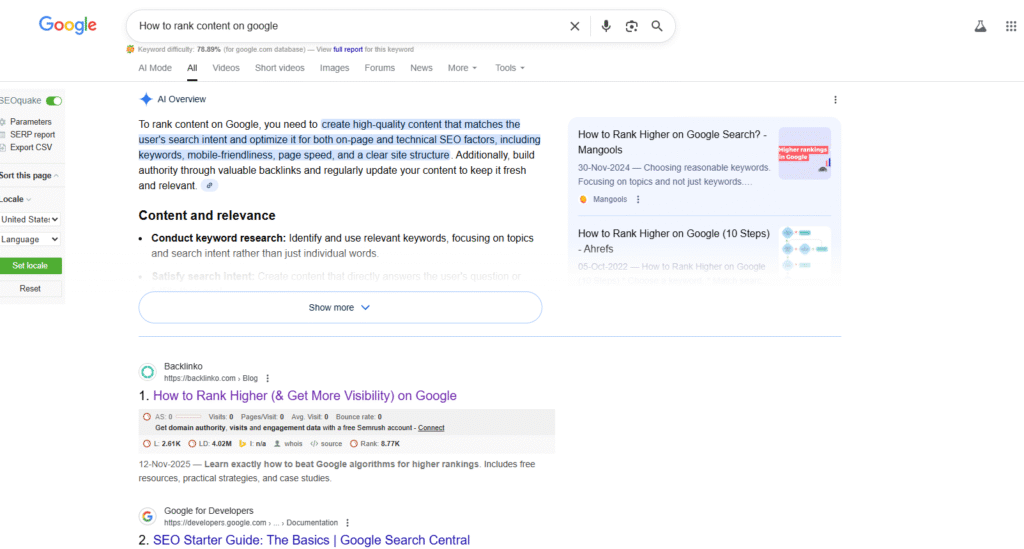
Use AI for research not for writing an entire article.Instead of asking AI to “write an article,” use it to build the structure. Ask for outlines, bullet points, missing angles, audience pain points or questions people frequently search for. This is where AI becomes a true research assistant, not a replacement for your expertise.
Here’s a prompt I personally use often:
Act as a senior SEO strategist. Analyze the top 20 ranking pages for the keyword ‘email marketing strategy’ in the USA and UK markets. Now create a list of 15 advanced subtopics that go beyond the standard basics. Prioritize unique angles, data-backed insights, overlooked pain points, and topics that experienced marketers would find valuable. Exclude beginner-level tips. Make sure each subtopic supports long-form, high-authority content and reflects current trends, user intent, and real competitive gaps.
It takes seconds for AI to do what might normally take 30-40 minutes of manual research.
#2: Master Advanced Prompting (The Skill Most Writers Lack)
The biggest difference between average AI users and expert AI-assisted writers is the depth of the prompt. AI is only as good as the prompt you give it.
Most writers still rely on short, vague prompts—and then wonder why the output feels generic or flat. Short prompts give weak output because the model has no direction.
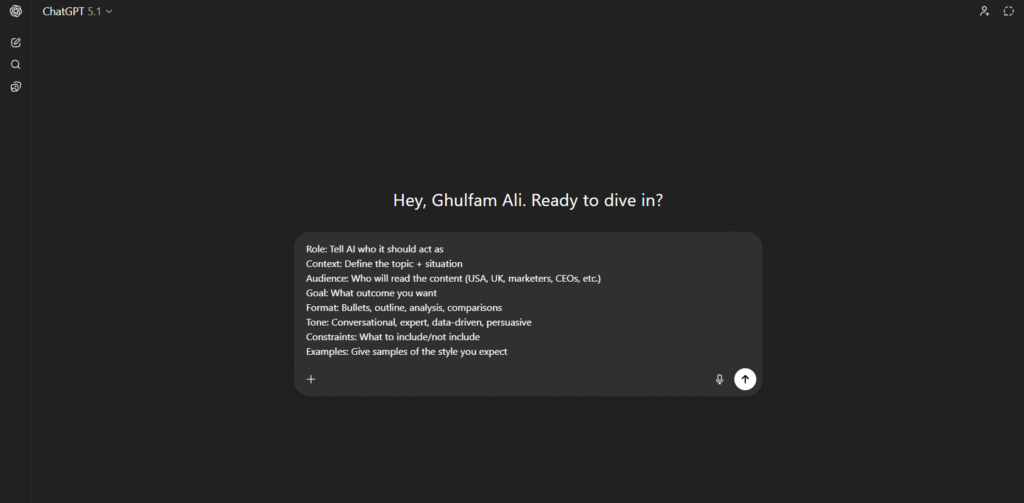
Over the last few years, after writing thousands of articles and experimenting with hundreds of prompt styles, I developed a personal framework that consistently delivers high-level, professional results. I call it the Ghulfam Ali Prompt Formula, and it works beautifully for research, outlines, rewrites and advanced content development.
The Ghulfam Ali Prompt Formula
Role + Context + Audience + Goal + Format + Tone + Constraints + Examples
Here’s how each part works:
Role: Tell AI who it should act as
Context: Define the topic + situation
Audience: Who will read the content (USA, UK, marketers, CEOs, etc.)
Goal: What outcome you want
Format: Bullets, outline, analysis, comparisons
Tone: Conversational, expert, data-driven, persuasive
Constraints: What to include/not include
Examples: Give samples of the style you expect
3: Use AI to Improve Structure, Flow, and Readability
If you combine all these elements, the output becomes sharper, deeper and far more aligned with your goals. You’re not just “telling AI to write”—you’re guiding it with the same clarity you’d give a high-level human assistant.
#3: Use AI to Improve Structure, Flow, and Readability
I use this approach regularly. Whenever a paragraph feels heavy, repetitive or unclear, I let AI rework it while keeping my original meaning intact. It’s also helpful when you need to expand a short section or shorten a long one based on search intent or content structure. For example:
“Rewrite this paragraph to sound more conversational, global-friendly and easier to read, but do not change any facts.”
This type of prompt instantly elevates the section while keeping your voice, experience and insights in place.
SEO Angle
Improving structure and readability directly boosts your ranking signals. When your content flows smoothly and delivers value without friction, readers spend more time on the page, scroll deeper and stay engaged longer.
#4: Add Your Experience + Insights
Your real experience is the goldmine that makes people trust you and makes Google reward your content. This is the strongest ranking signal today, and it fits directly into E-E-A-T: Experience, Expertise, Authoritativeness, and Trustworthiness.
No matter how advanced a model becomes, it still cannot replicate stories from your real projects, your client experiences or the challenges you’ve personally solved.
#5: Fact-Check and Verify Everything AI Generates
Add practical examples from your own workflow. Share what worked for you, what failed, what you learned from ranking articles in tough niches, and how you’ve trained writers from different countries to improve their results.
As a professional writer, accuracy is non-negotiable. You should always double-check stats, quotes, tool descriptions, prices, timelines and even basic definitions AI provides. A small error can instantly damage trust and hurt your credibility.
Use reliable sources for verification:
• Google Scholar
• Statista
• Ahrefs
• Semrush
• Government websites (.gov)
• Industry reports and trusted publications
For example, AI might confidently tell you that “CAN-SPAM was updated in 2021” but that never happened. That’s why you cannot publish anything without verifying the information through credible sources.
SEO Angle
Accurate content keeps users engaged longer and reduces bounce rates. When readers trust your information, they stay on the page, share your content and are more likely to return. Strong accuracy signals help improve your overall E-E-A-T, which directly strengthens your chances of ranking in highly competitive niches.
#6: Combine AI With SEO Tools for High-Ranking Content

AI alone can’t give you real search volumes, keyword difficulty or competitor gaps. But when you pull insights from SEO tools and feed that data into your prompts,
Use AI to generate topic clusters, refine headings, and map out internal links. And use SEO tools to confirm search intent, keyword value and ranking opportunities.
For example, instead of asking AI for generic keyword ideas, give it something data-driven:
“Act as an advanced SEO strategist. Using the keyword list I’ll provide from Ahrefs as the primary dataset, generate 30 highly targeted keyword variations with strong commercial intent for the USA market specifically within the ‘email software’ niche.
Before generating keywords, analyze the base list for:
• search intent patterns
• commercial vs transactional opportunities
• gaps competitors are not covering
• related sub-niches and feature-driven angles
Now produce the new keyword list with:
• exact match and phrase match variations
• feature-specific variations (automation, templates, deliverability, AI tools, etc.)
• long-tail keywords that show purchase intent
• keyword modifiers used by USA buyers (best, top, pricing, alternatives, reviews, comparison)
Finally, categorize all keywords into intent groups:
Commercial, Transactional, Navigational and Bottom-of-Funnel. Present the output in a clean table.”
This combination of SEO data and advanced prompts can build true topical authority.
#7: Build a Human-First Editing Process

My workflow always follows a simple rule: AI creates speed, but the human touch creates quality. When I edit content for international clients, the transformation from a basic AI draft to a polished, high-authority article happens during the editing phase, not the generation phase.
Here’s the process I use:
- Remove repetitive wording
AI often repeats ideas or phrases—cleaning this up instantly improves clarity. - Add your own examples
This is where you inject experience, case studies and personal insights, which AI cannot generate. - Improve storytelling
Add context, hooks and flow to make the content engaging, not robotic. - Add screenshots or visuals
This boosts user trust and makes complex points easier to understand. - Add unique insights
Your real-world knowledge sets your content apart from thousands of AI-generated articles online. - Add clarity and a stronger hook
Make sure every section starts with purpose and ends with value. - Use Grammarly or Quillbot lightly
These tools help polish grammar and readability without altering your natural tone.
#8: Maintain Originality and Avoid AI Detection Issues
One of the biggest concerns writers still have is whether AI-generated content is safe. The truth is simple: Google does not penalize AI content, Google penalizes low-quality content.
Rewrite lines that feel too stiff, add emotnal flow where needed, and integrate personal context from your professional work. This simple approach instantly elevates authenticity.
I also run a quick plagiarism check before publishing anything. A quick scan gives peace of mind and adds an extra layer of quality control.
SEO Angle
Maintaining originality and a strong human voice keeps your content fresh, unique and far more trustworthy. Google’s systems are designed to reward helpful, experience-driven writing.
So, mastering how to use AI for writing is not about hiding AI. It’s about using it smartly while keeping your authenticity and originality intact.
How I Use AI to Create Exceptional Content? Step by Step Workflow
Over the years, I’ve refined a practical workflow that blends AI’s speed with human expertise.
Step 1: Topic Research
I always start by researching the topic manually. I look at competitors, SERP patterns, trending questions and content gaps. Then, I feed this information into AI to speed up the discovery process.
Step 2: Search Intent Check
Before writing anything, I check the search intent. Is the reader looking for a guide, a comparison, a definition, or a solution? Once I’m clear on this, I ask AI to analyze the intent with me.
Step 3: Outline Creation
This is where AI becomes incredibly helpful. I give AI a detailed prompt (using my prompt formula), and it generates a structured outline. I then refine it manually adding sections from my experience, rearranging flow, and removing anything that feels unnecessary.
This gives me a clean blueprint before writing a single line.
Step 4: AI-Assisted Draft
Now I let AI produce the first rough draft. Not the final version just a starting point. AI helps me save time on basic explanations, transitions and initial paragraph structure.
Step 5: Human Expansion
This is where the real writing begins. I go through the AI draft and add my experience, personal examples, case studies, failures, insights, and real observations. I rewrite weak areas, strengthen arguments, and add depth that AI simply cannot create. This step gives the article its uniqueness and E-E-A-T value.
Step 6: SEO Optimization
Once the draft feels strong, I use SEO tools to refine it. I check keyword coverage, search intent, internal link opportunities, and topical gaps.
Step 7: Final Editing + Proof
The last step is polishing everything. I read the entire article out loud, fix tone inconsistencies, strengthen hooks, and clean up confusing sentences. I use Grammarly or Quillbot lightly only as assistants, not substitutes. By the end, the article feels smooth, clear and ready to rank.
Frequently Asked Questions: How to Use AI For Writing?
1. Is it safe to use AI for writing content?
Yes. Google has clearly stated that AI content is allowed as long as it’s helpful, accurate and original. AI becomes unsafe only when writers publish low-quality, unedited drafts. If you combine AI with your own insights, it’s completely safe.
2. Does Google penalize AI-generated content?
No. Google does not penalize AI content. It penalizes low-quality, unhelpful, or spammy content—no matter who wrote it. When you use AI responsibly and add your experience, your content can rank normally.
3. How do I make AI content sound more human?
Add personal examples, real experiences, industry observations, case studies and data points. Rewrite stiff sentences, improve flow and refine tone. AI gives you the base structure—you add the human voice.
4. What is the best way to use AI for writing?
Use AI for research, outlines, idea generation, structure improvement and clarity. Do not rely on it for full articles. The best results come when you use AI for speed and your expertise for depth.
5. How can AI help me write faster?
AI can generate outlines, expand ideas, rewrite drafts, suggest better phrasing, and summarize research. This removes repetitive tasks and allows you to focus on the core message, saving hours per article.
6. Can AI replace human writers in the future?
AI can support writers, but it cannot replace lived experience, personal insights, emotional nuance or real-world judgment. Human writers who learn how to use AI effectively will always stay ahead.
About the Author
Gulfam Ali is an SEO specialist with over 7 years of experience in search engine optimization, with a strong focus on Technical SEO and organic growth. He has worked with businesses across multiple industries, managing SEO projects for clients in different countries and helping them improve Google rankings, increase organic traffic, and achieve sustainable growth.
His work includes contributions to international platforms, reflecting a strong understanding of high-quality content and SEO best practices. As the founder of GulfamAli.com, he helps businesses worldwide grow through structured SEO strategies, ethical practices, and performance-driven results.